
How to Start Running From Scratch
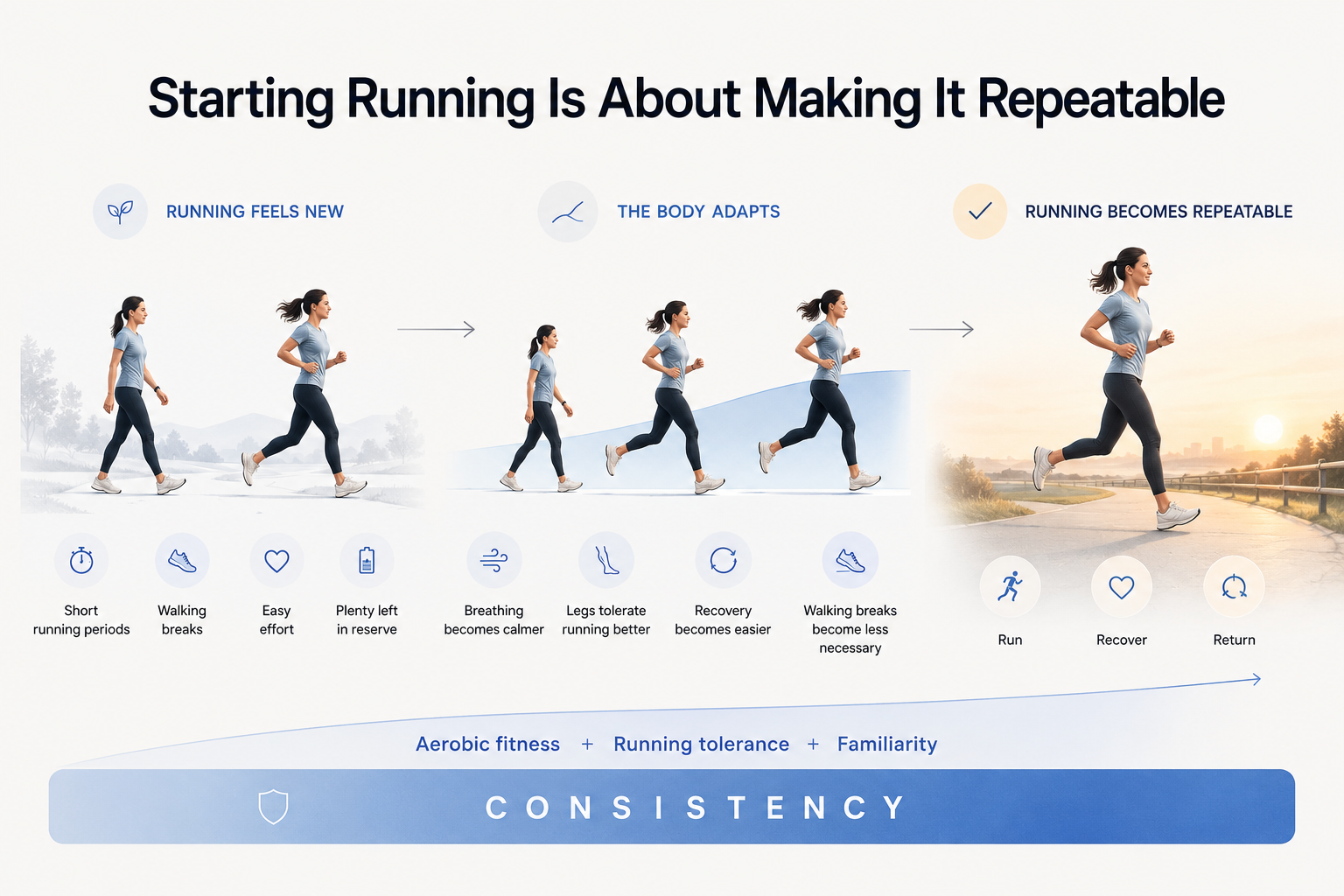
The first goal of running is not to go farther or faster. It is to find an amount of running your body is ready to repeat.
There is an awkward thing about starting running: almost everyone already knows how to run.
You do not need to learn a completely new movement. You put on a pair of shoes, step outside and start moving faster than a walk. For the first minute or two, it can feel surprisingly straightforward.
Then your breathing changes. Your legs begin to feel heavier than expected. The relaxed jog you imagined starts becoming an effort, and suddenly you are wondering how other people seem to keep doing this for thirty minutes without stopping.
That first experience can give running a misleading introduction.
It is easy to assume that you are simply not fit enough yet, or that the solution is to keep pushing until you can run continuously for longer. But when you are starting from scratch, the ability to tolerate running is often developing alongside your aerobic fitness. Your heart and lungs are learning, but so are your muscles, tendons and joints.
Trying to prove too much on the first few runs does not make those adaptations happen faster. It mostly makes the next run harder to repeat. I think the first useful milestone in running is therefore much smaller than completing a particular distance. It is reaching the point where you can finish a session, recover from it normally and come back a few days later without the previous run still dominating how your body feels.
That may initially mean running very slowly. It may mean alternating running with walking. It may mean finishing after twenty minutes even though part of you thinks a proper workout should last longer.
None of those things make the session less real. When you are beginning from zero, you are not trying to demonstrate the runner you will eventually become. You are giving your body the first small doses of running that allow that runner to develop.
Start With Less Running Than You Think You Need
The first few runs have an unusual problem: your motivation can improve much faster than your body can adapt.
You may finish one session feeling encouraged and immediately want to do more next time. Perhaps you ran for two minutes before walking, so three minutes seems like the obvious progression. Perhaps twenty minutes felt manageable, so thirty feels like the next proper target.
But early running does not need to progress every time you go outside. Repeating the same manageable session is already training.
If you can alternate short periods of running and walking for twenty or thirty minutes, finish feeling reasonably comfortable and do something similar again a few days later, your body is already receiving a new stimulus. Muscles are learning to tolerate repeated loading. Tendons are being exposed to forces they may not have experienced regularly for years. The cardiovascular system is beginning to adapt to sustained movement.
There is no additional prize for making every session harder than the previous one. This is one reason I would not worry too much about continuous running at the beginning. Walking for a minute does not reset the training effect. It simply lowers the immediate demand enough to let you continue accumulating useful movement.
Over time, the balance can shift naturally. Two minutes of running and one minute of walking may become four minutes and one minute. Eventually you may notice that you no longer feel much need for the walking break at all.
That progression does not have to follow a perfect schedule. What matters more is that the amount of running remains something your body can absorb. The same principle becomes increasingly important as weekly volume grows, which is why How To Increase Weekly Running Volume Safely is useful well beyond the beginner stage.
For now, though, the simplest rule is enough: Finish your first runs with the feeling that you probably could have done a little more. That small amount left unused is not wasted training. It is often what makes the next run possible.
Walking Is Part of Starting to Run
Walking can feel strangely disappointing when the goal is to become a runner. You start running, breathing becomes uncomfortable, and eventually you slow to a walk. It is easy to interpret that moment as the point where the workout stopped going well.
For a new runner, I would interpret it almost the opposite way. Walking gives you control over the dose. A short walking break lowers the cardiovascular demand, gives the running muscles a brief change in load and allows you to begin another running segment without turning the entire session into a struggle. Instead of spending ten difficult minutes trying to preserve continuous running, you may be able to spend thirty minutes moving comfortably while accumulating several manageable periods of actual running.
That can be much more useful. The important part is not to turn every running segment into a test. If you run hard until you are forced to walk, recover, and then run hard again, you have effectively created an interval workout before you have built the basic running tolerance to need one.
Run-walk works better when the running itself remains controlled. You should be able to finish a running segment because you planned to walk, not because another ten seconds of running feels impossible.
This is also where many beginners discover that their idea of slow running is still surprisingly fast. There is nothing wrong with a pace that feels almost awkwardly gentle at first. How to Run Slower explores this in more detail, but the basic idea is simple: slowing down is a skill, and learning it can completely change how manageable early running feels.
As the weeks pass, the walking portions usually become less necessary without much drama. Your breathing settles more easily, the legs stop reacting to every run as a major event, and the running segments begin to join together.
You do not need to rush that transition. Walking is not the opposite of running when you are starting from scratch. It can be one of the tools that helps you accumulate enough comfortable running to eventually stop needing it.
How Often Should You Run When You Are Starting?
Once the first few sessions begin to feel manageable, another temptation appears: running more often. If running twice in a week feels good, three times sounds better. If three runs are going well, perhaps running every day will build fitness even faster.
The problem is that early fitness can improve before the body has fully adapted to the repeated mechanical load of running. Your breathing may already feel noticeably easier after a few weeks. You may be able to run farther without stopping and recover your breath much faster after a hill. Those improvements are encouraging, but they do not necessarily mean every part of the body is ready for the same rate of progression.
Muscles, tendons and other tissues have their own timeline. This is why I like leaving genuine space between runs when someone is starting from scratch. Two or three running days per week can already provide plenty of opportunity to learn the movement and build fitness while giving the body time to absorb something that is still relatively new.
The days between do not have to become completely inactive. Walking, ordinary daily movement and other comfortable activity can remain part of the week. The important distinction is that you are not adding another running stimulus simply because yesterday’s run felt good.
There is no perfect weekly number that everyone needs to reach. How Many Times a Week Should You Run? becomes more useful once you start thinking about how running frequency fits into a sustainable training week, but at the beginning I would pay more attention to what happens between sessions.
Do the legs return to normal? Does ordinary walking feel comfortable? When the next running day arrives, do you feel ready to run rather than still recovering from the previous attempt? If the answer is consistently yes, the structure is probably giving you enough space.
And this is where the first real habit begins to form. Not running every day. Running often enough that going for another run starts to feel normal.
Do Not Let Pace Decide Whether a Run Was Good
Once you can run for longer stretches, pace tends to appear surprisingly quickly. Perhaps you use a running watch. Perhaps an app tells you how fast each kilometre was. Or perhaps you simply notice that another runner passes you while looking far more comfortable.
Suddenly, a session that felt perfectly good can start looking slow. For a new runner, that comparison is rarely useful. Your early pace is being influenced by almost everything that is still developing: aerobic fitness, running economy, muscular endurance, coordination and simply how relaxed you are while running. Even small hills, wind or a poor night’s sleep can change the number considerably.
Trying to force that number downward can turn an otherwise appropriate run into something much harder. I would rather see the opposite happen. You finish a run and realize that your breathing remained under control. You did not spend the final ten minutes waiting desperately for the session to end. Perhaps you could speak in short sentences. Most importantly, when you stop, you feel as though you have trained rather than tested yourself.
That is useful information.
The Run Effort Check Calculator can help put that feeling into context if you are unsure whether a session that looked slow on paper was actually appropriately controlled.
Pace will become more meaningful later because you will have something to compare it with. The same comfortable effort may gradually carry you farther. A route that once required walking breaks may become continuously runnable. Eventually you may notice that you are moving faster without deliberately trying to run faster.
That is a much better relationship with pace. At the beginning, the number does not need to tell you how good a runner you are. It can simply record what happened while you were learning to run comfortably.
The First Goal Is to Make Running Repeatable
At some point, something subtle begins to change. You no longer spend the morning after a run wondering why your legs feel so different. The first few minutes stop feeling quite as unfamiliar. A walking break that once seemed essential becomes optional, and the route you used to think of as a workout starts to feel like somewhere you simply go for a run.
None of these changes are dramatic enough to feel like a breakthrough. But together they tell you something important: your body is beginning to recognize running as normal activity.
This is a much more useful early milestone than reaching a particular pace or distance.
A five-kilometre run can be completed by pushing through an effort you are not ready to repeat. Thirty continuous minutes can become a test of determination. Neither necessarily tells you that the training underneath them is sustainable.
Repeatability does. If you can run, recover normally and return for another session without needing to negotiate with tired legs every time, you have already built the foundation that allows almost everything else to develop.
From there, the questions gradually change. You may begin wondering whether to run a little longer, add another day or simply keep repeating what is already working. That is where How to Build an Aerobic Base becomes a more useful next step than trying to accelerate immediately toward harder training.
There will be plenty of time for longer runs, faster running and more structured workouts. The first job is simpler. Make running something your body is ready to do again.
Conclusion
Starting running from scratch can feel as though you are beginning with a fitness problem. Usually, you are beginning with an adaptation problem.
Your cardiovascular system has to become more comfortable with sustained effort, but the rest of the body is learning too. Muscles have to tolerate repeated work. Tendons and joints have to become accustomed to running load. The movement itself has to become familiar enough that every step stops demanding quite so much attention and energy.
That is why the beginning does not need to be ambitious. Running slowly is enough. Walking is allowed. Two or three runs can make a perfectly useful week. Pace can remain something you record rather than something you chase.
What matters is what those sessions gradually allow you to do next.
If twenty minutes of run-walk leaves you ready to do it again a few days later, you have started well. When those twenty minutes become easier, you do not need to celebrate by immediately making the next session difficult. You can let the body become good at what it has just learned. Eventually, running begins to ask for less negotiation.
You put your shoes on without wondering whether your legs will cooperate. The first kilometre no longer feels like an event. Distances that initially looked significant become ordinary parts of the week. Fitness is growing underneath all of this, but I think the more important change is familiarity.
You are no longer repeatedly proving that you can run. You have built something you can return to.
And from that point, running becomes much easier to develop because the question is no longer how to survive the next session. It becomes what you would like to build with the running you can now repeat.
You do not need much equipment to begin running, but shoes are one place where comfort matters. There is no need to buy the fastest or most technical model available; a comfortable daily trainer is usually the more sensible starting point. If you are choosing your first pair, our guide to the Best Running Shoes for Daily Training 2026 explains what to look for without turning the decision into something more complicated than it needs to be.
Frequently Asked Questions
How should a complete beginner start running?
Start with short, controlled periods of easy running and use walking breaks whenever they help keep the session comfortable. The first goal is not continuous running or a particular distance. It is finding an amount of running you can recover from normally and repeat several days later.
How long should my first run be?
There is no minimum duration that makes a first run worthwhile. Around twenty to thirty minutes of total movement can be plenty, particularly if some of that time is walking. Finishing comfortably is more useful than extending the session until you are exhausted.
Is it okay to walk during a run?
Yes. Walking can be deliberately built into beginner running rather than treated as something that happens when the run fails. Controlled run-walk periods allow you to accumulate more manageable movement while your aerobic fitness and running tolerance develop.
How many times a week should a beginner run?
For someone genuinely starting from scratch, two or three runs per week can provide a useful starting point. The appropriate frequency depends on how well you recover between sessions, so there is no need to add another running day simply because one session went particularly well.
How slow should a beginner run?
Slow enough that the effort remains controlled. That may initially feel much slower than you expected running to feel. Breathing and perceived effort are usually more useful guides than trying to achieve a particular pace.
When should I start running without walking?
There is no deadline. As your running segments become easier, you can gradually extend them and shorten the walking portions. Continuous running often emerges naturally once the current run-walk structure no longer feels necessary.
When should a beginner start running faster?
Not immediately. Early improvement can come simply from repeating comfortable running consistently. Once running itself feels familiar and your body is recovering reliably between sessions, faster training can eventually become another tool rather than something required to prove progress.