
How to Start Running When You Can’t Run for Five Minutes
You do not need to be able to run for five minutes before you start running. Building the ability to run for five minutes is part of learning to run.
Five minutes does not sound like very long until you try to run for five minutes.
For someone who already runs regularly, it can disappear inside the warm-up. For someone starting from almost no running background, those same five minutes can feel remarkably long.
The first minute may be manageable. Then breathing starts to change. The legs become heavier. You slow down, but the effort keeps rising anyway. Eventually you stop and walk, look at the time and discover that you ran for two minutes and forty seconds.
That can be discouraging. It is also where many people make an unnecessary judgement about themselves. If I cannot even run for five minutes, perhaps I am too unfit to start running.
But there is something backwards about that logic. You would not expect to perform any other unfamiliar physical activity continuously before you had spent time learning and adapting to it. Yet running is so familiar as a movement that we often assume the ability to sustain it should already be there.
It may not be. Running continuously requires more than being generally active. Your cardiovascular system has to support the effort, your legs have to tolerate repeated running steps and you have to find a pace that does not push the effort upward faster than you can sustain it.
When all of those things are new, five continuous minutes can be a substantial amount of running. So I would remove five minutes as the first test entirely.
If you can run comfortably for ninety seconds and then need to walk, ninety seconds is not a failed five-minute run. It is your current starting point. Walk until the effort settles.
Run again.
Then repeat the process for an amount of time that leaves you feeling as though you could have done a little more. The first useful question is not whether you can run for five minutes without stopping. It is whether you can create a small amount of running that your body is ready to experience again.
Walking Is Not What Happens When the Run Fails
Once you stop treating five continuous minutes as the entry requirement, walking starts to look different too. Instead of being the moment when running ends, it becomes part of how you accumulate running in the first place.
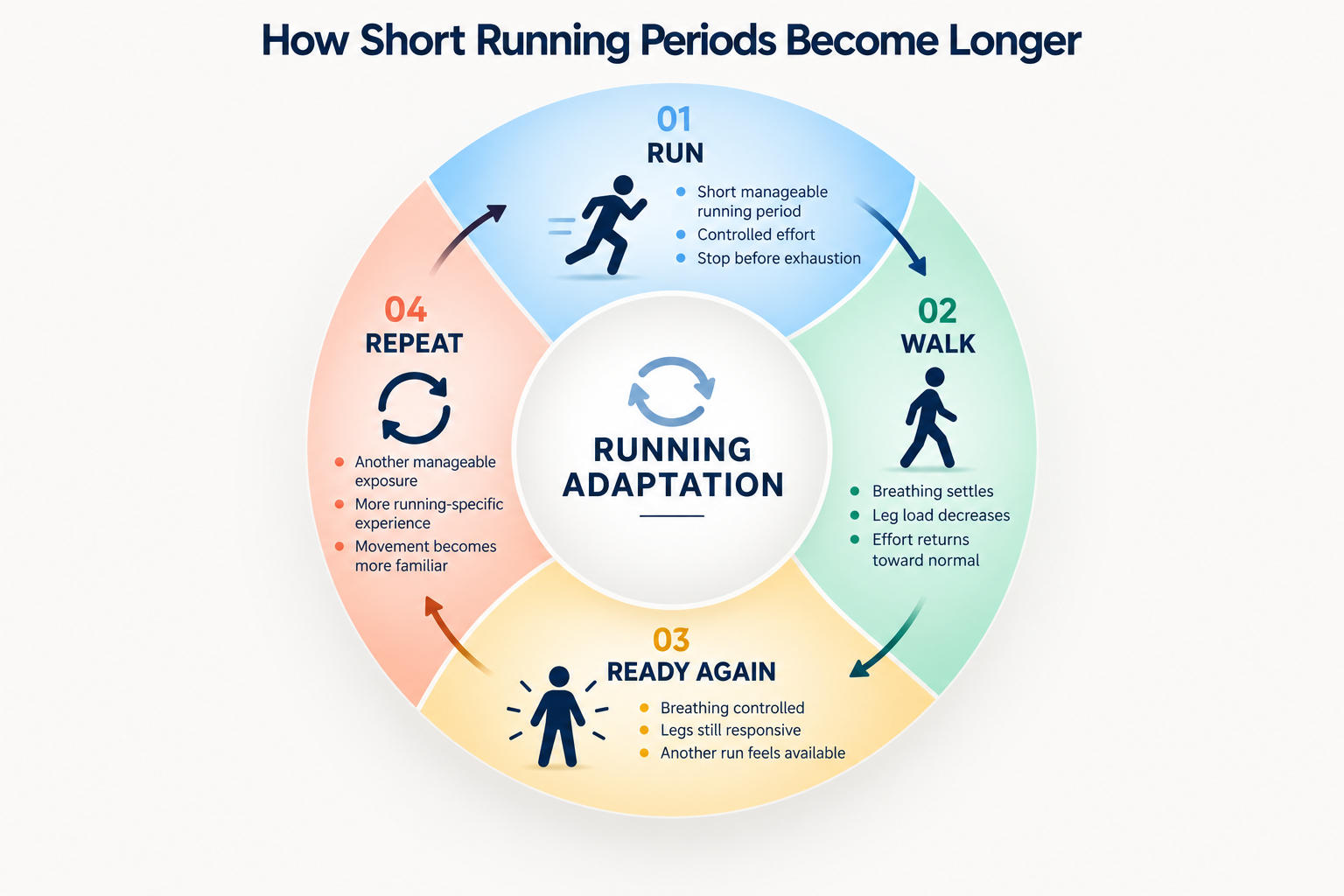
You might run for a minute, walk for two, then run again. Perhaps the second running period feels similar to the first. Perhaps it is slightly shorter. The exact pattern matters less than what the walking period allows to happen.
Breathing settles. The legs get a brief reduction in load. Most importantly, the next running period begins before the entire session has turned into a struggle.
That creates a very different experience from trying to run continuously for as long as possible.
If you repeatedly run until you are forced to stop, every running period teaches you roughly the same lesson: running begins comfortably and ends when you can no longer sustain it.
I would rather have a beginner stop running while the effort is still under control. Walk before you desperately need to walk. Then start running again when you genuinely feel ready.
This is one of the central ideas behind How to Start Running From Scratch. Run-walk is not a watered-down version of running that you have to escape as quickly as possible. It is a practical way of controlling the dose while your ability to sustain running is still developing.
And the total amount of running can become surprisingly meaningful. Six separate ninety-second running periods already give you nine minutes of running, even though you never ran continuously for more than a minute and a half.
Your body still experienced those running steps. Your cardiovascular system still had to respond to them. Your muscles and tendons still received the running-specific stimulus. You still practised finding a comfortable rhythm.
The walking simply prevented all of that useful exposure from being compressed into one increasingly difficult effort. Over time, you may notice that you no longer need quite as much of it. Not because walking has finally stopped being allowed. Because running has started becoming easier to sustain.
Do Not Make Every Running Period a Test
Once run-walk starts feeling more manageable, another temptation appears.
You begin testing yourself. Yesterday you managed two minutes, so today you try for three. The first three-minute interval works, so perhaps the next one can be four. Soon the session becomes a sequence of small challenges designed to discover how long you can keep running before you have to stop.
That can feel like progression. But it changes the purpose of the session. Instead of accumulating manageable running, you are repeatedly approaching your current limit. Breathing rises higher, walking breaks need to become longer and each running period becomes harder to reproduce.
This is particularly easy to do when continuous running is still difficult because almost any running interval can become a performance test. I think a better sign of progress is much quieter.
The same ninety seconds stops feeling important. You finish it without waiting for the countdown. Breathing settles quickly during the walk. The next running period no longer feels like something you have to prepare yourself for.
That is when extending the interval begins to make sense. Perhaps ninety seconds becomes two minutes. Later, two minutes becomes three. There is no need for every running period to become longer at once, and there is certainly no reason to increase it simply because you successfully survived the previous one.
This is where Why Running Feels So Hard at the Beginning provides useful context. Early running feels disproportionately difficult because several systems are adapting at the same time. Repeatedly pushing those systems toward their limit does not necessarily make that adaptation happen faster.
Give the current dose time to become ordinary. Then change it. Eventually, five minutes may arrive almost accidentally. And by then, it will matter much less than it did when five minutes still felt like the test you had to pass.
Slow Down Before You Assume You Need More Walking
There is another reason someone may struggle to run for five minutes that has very little to do with how long they are capable of running. They are simply running too fast. This can be surprisingly difficult to recognize when you are new to running.
A pace that looks slow from the outside may still be demanding for you. And because very slow jogging can initially feel awkward, there is a natural tendency to speed up until the movement feels more like running.
For the first minute or two, that can feel better. Then the cost appears. Breathing rises quickly, the legs begin to tighten and suddenly it seems as though continuous running itself is the problem.
Walking is still a perfectly good response. But before concluding that you can only run for two minutes at a time, it is worth experimenting with what happens when those two minutes become considerably slower.
Not slightly slower. Sometimes almost comically slower. You may discover that the boundary between walking and running is much closer than you imagined. That is fine. There is no pace requirement attached to learning how to run.
This is also why I would avoid using pace as the main measure of whether these early sessions are going well. The useful question is whether you can keep the effort sufficiently controlled that another running period still feels available afterwards.
If you are not yet sure what controlled effort should feel like, the Run Effort Check Calculator can help you interpret the session from breathing, muscular effort and overall control rather than from pace alone.
Eventually, you begin to recognize that effort while you are moving. You notice the moment when breathing starts climbing unnecessarily and ease back before the run becomes difficult. Hills make you slow down rather than fight to maintain speed. You find a jogging rhythm that may look very modest but feels sustainable from the inside.
And that skill changes the five-minute problem considerably. Sometimes the first breakthrough is not being able to run longer. It is finally learning how little effort running can require.
Let the Running Periods Grow Because They Feel Easier
At some point, the structure begins to change. You may still start with the same short running period you have used for several sessions. But when it ends, you notice that you were not really waiting for it to end.
Breathing is controlled. The legs still feel normal. You could comfortably continue. That is a much more useful reason to extend a running period than simply deciding that another week has passed.
Add a little. A ninety-second run might become two minutes. A two-minute period might occasionally become three. The walking breaks can remain exactly where they are while you discover what the slightly longer running feels like.
There is no need to progress every interval together. In fact, I like the idea of leaving some of the shorter periods in the session. They give you a familiar reference point and make it easier to notice whether the longer periods are genuinely manageable rather than merely possible.
What you are looking for is not the longest interval you can complete. You are looking for the point where a slightly longer interval produces roughly the same kind of controlled running as the shorter one did before.
That is adaptation becoming visible. It is also why early progression rarely needs to follow a perfect staircase. One session may contain more running than another. A day when the legs feel less responsive may include more walking. Another day, you may naturally continue beyond the point where you normally stop.
The broader principle from How To Increase Weekly Running Volume Safely already applies here, even at these very small amounts of running: progression works better when the body has had time to absorb what you are already doing.
Eventually, several short running periods begin joining together. Two minutes becomes three without much consequence. Three becomes four. One day you pass five minutes and realize only afterwards that you have done it. That is a very different five minutes from the one you were trying to force at the beginning.
You did not conquer it. You gradually made it ordinary.
Do Not Rush to Remove the Walking Breaks
As the running periods become longer, walking can start to feel like the last piece of beginner running that needs to disappear. You can run for four minutes now. Perhaps five. Surely the next goal is to remove the walking altogether.
But there is no particular reason to hurry. A walking break can still be useful even when you are capable of running continuously. It may allow the entire session to remain easier, give the legs a brief reduction in load and help you accumulate more controlled running without turning the final part of the session into survival.
The interesting question is not whether you still walk. It is what the walking is doing for you. Early on, you may need two minutes of walking because breathing has risen substantially and the legs genuinely need time before running feels possible again.
A few weeks later, the same walking break may feel almost excessively long. Breathing settles within thirty seconds. Your legs feel ready. You find yourself wanting to start running again before the planned break has finished.
That is useful information. You can shorten the walk slightly or allow one running period to continue longer. There is no need to make both changes simultaneously.
This gradual disappearance of recovery is very different from deciding one morning that walking is no longer allowed. It lets continuous running emerge from the fitness and tolerance you have actually developed. And even when you eventually run for twenty or thirty minutes without stopping, walking has not somehow become a step backwards. There will still be days when a brief walking break makes sense.
That is particularly worth remembering when you begin running more regularly. How Often Should Beginners Run? explores the same principle at the weekly level: progression is not about removing recovery wherever you can find it. Recovery is part of what makes repeated running possible.
The same is true inside a single beginner session. At first, running and walking may be almost equal partners. Then running gradually takes up more of the space. You do not have to force that transition. Let your body make walking less necessary.
Conclusion
Not being able to run for five minutes does not mean you are not ready to become a runner. It simply tells you where continuous running currently becomes difficult.
That is a starting point, not a judgement. Run for an amount of time you can control. Walk before the effort becomes overwhelming. Let breathing settle, then run again. If the running periods repeatedly become difficult very quickly, experiment with slowing down before assuming you need to push harder.
Then repeat the process. What matters in the beginning is not how long any single running period lasts. It is whether you can accumulate enough manageable running for the body to begin adapting to it.
Gradually, the relationship between running and walking changes. The running periods become less expensive. The walking breaks recover you more quickly. A duration that once felt substantial becomes ordinary enough that extending it slightly no longer changes the character of the effort.
That is when progression becomes almost uneventful. Two minutes becomes three. Three becomes four. And eventually you run beyond five minutes without needing it to prove anything. I think that is the more useful way to understand the first breakthrough in running.
You are not training yourself to tolerate five increasingly uncomfortable minutes. You are training until five minutes no longer needs to be uncomfortable.
When running is difficult after only a few minutes, shoes are rarely the reason you cannot continue. Fitness, pace and running-specific adaptation matter much more. But comfortable footwear can remove one unnecessary source of distraction while you are building that tolerance. Our guide to the Best Running Shoes for Daily Training 2026 focuses on versatile shoes designed for exactly this kind of regular everyday running.
Frequently Asked Questions
Is it normal that I cannot run for five minutes?
Yes. If you are completely new to running, even a few continuous minutes can create a substantial cardiovascular and muscular demand. Your current running duration is simply the amount your body is adapted to right now.
How should I start running if I get out of breath after one minute?
Slow the running down and use walking before your breathing becomes completely uncontrolled. Once breathing settles, begin another short running period. Several manageable running periods can provide plenty of useful running without requiring you to sustain one long effort.
How long should my run-walk intervals be?
There is no single interval that every beginner needs to follow. Start with running periods that remain controlled enough that you could probably continue a little longer, then walk until you feel genuinely ready to run again. The appropriate ratio can change quickly as you adapt.
Should I run until I cannot continue and then walk?
Usually not. If every interval ends because you are forced to stop, you are repeatedly practising near your current limit. Walking slightly earlier can keep the overall session controlled and often allows you to accumulate more useful running.
How quickly should I increase my running intervals?
Increase them when the current intervals have become consistently easier to absorb rather than according to a fixed schedule. You do not need to make every interval longer at once.
When should I try running continuously?
There is no need to schedule a test. As your running periods become easier and walking restores you more quickly, allow some intervals to extend naturally. Continuous running often emerges from this process without requiring a dramatic jump from run-walk to running only.
What if I can run for five minutes one day but not the next?
That is completely plausible. Sleep, recovery, weather, terrain and the pace you choose can all change how a run feels. One shorter session does not erase the adaptation from previous runs. If you are unsure whether your body has recovered enough for the next session, the Recovery Check Calculator can help you interpret the broader picture rather than judging readiness from one number.