
Everyone says to run easy.
But almost nobody explains what that actually means in practice.
Should easy runs feel very slow? Should you stay inside a specific pace range? Should you trust heart rate, breathing, pace, or simply how the run feels?
For many runners, easy pace becomes surprisingly confusing very quickly.
Sometimes the run feels too slow to be useful. Other times it still feels harder than expected even though the pace itself looks “easy” on the watch.
And that confusion matters because easy running is not filler training.
It is the foundation that makes the rest of training sustainable.
The difficult part is that true easy effort is usually much slower — and much calmer — than most runners initially expect.
And more importantly: easy running is not defined by pace alone.
These decisions become much easier when you can see how your body is responding instead of guessing from pace alone.
If you want a clearer picture of effort, recovery, and day-to-day readiness, you can explore our guide to the Best Running Watches for Running (2026).
Easy Running Usually Feels Slower Than Expected
One of the biggest surprises for newer runners is realizing how controlled true easy running actually feels.
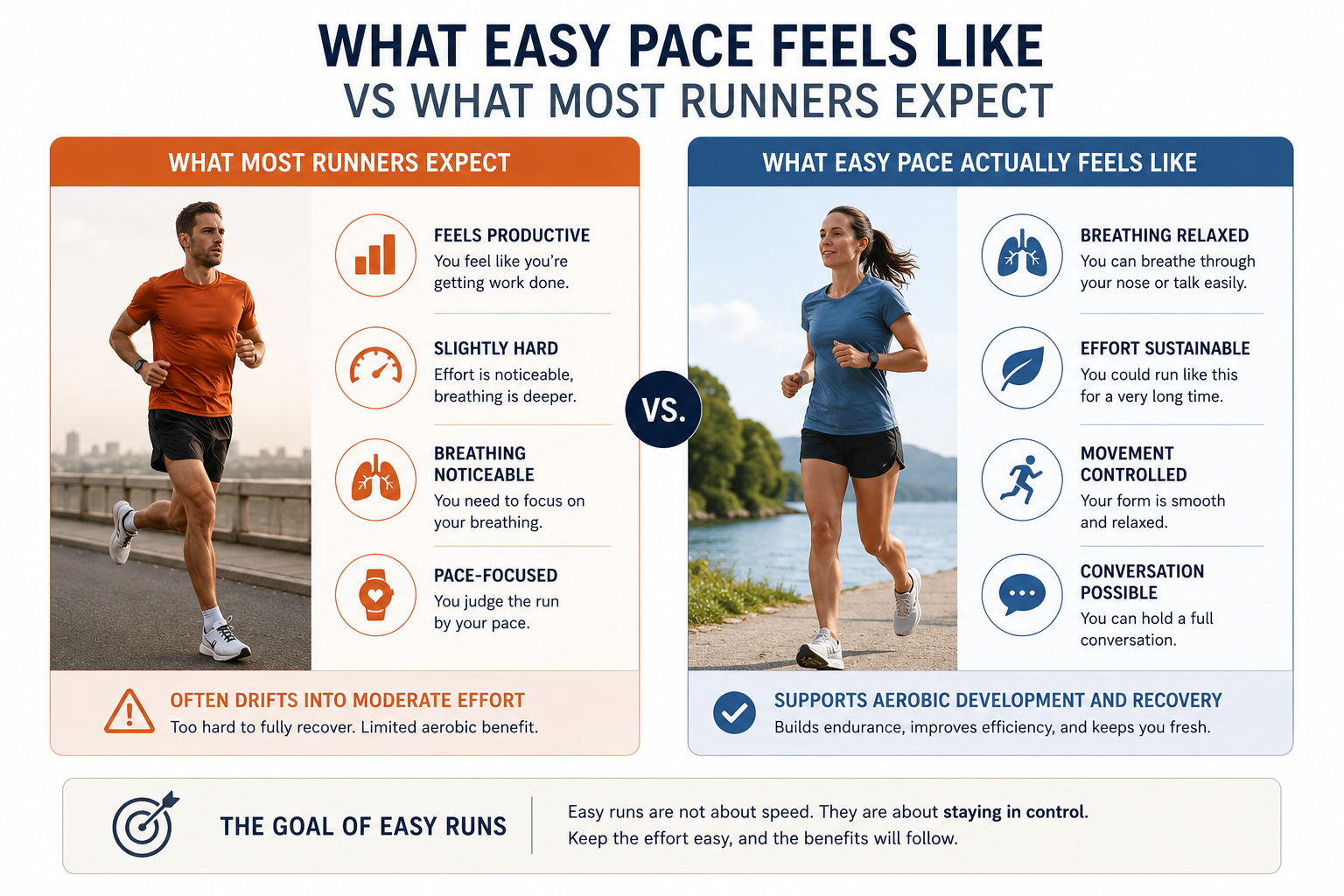
Most people unconsciously expect easy pace to still feel somewhat productive, steady, and reasonably close to normal running speed. They want the run to feel comfortable, but still “like proper training.”
But physiologically, sustainable aerobic effort often feels much quieter than that.
Pace drops noticeably. Breathing becomes calmer. Effort stabilizes. The entire run starts feeling less intense overall.
And psychologically, that often feels wrong at first.
Many runners immediately assume: this cannot possibly be effective.
But that reaction is extremely common because modern running culture quietly conditions people to associate progress with visible effort.
Easy aerobic running works differently:
Its purpose is not maximizing intensity.
Its purpose is maximizing sustainability.
That is why many runners unintentionally speed up during easy runs. They do not trust the lower effort. They try to make the run “feel more correct,” and without fully realizing it, the run slowly drifts out of true easy intensity.
This is also why What Does an Easy Run Actually Feel Like? becomes such an important concept. Sustainable aerobic running usually feels calmer, smoother, and more controlled than most runners expect before they fully understand endurance training.
Easy running often feels slower than expected.
And that is usually a sign you are finally close to the correct intensity.
There Is No Single Perfect Easy Pace
One of the biggest mistakes runners make is trying to find one exact number that defines easy running.
The problem is that easy pace is not fixed.
It changes constantly depending on:
fitness, recovery status, terrain, sleep, weather, accumulated fatigue, and overall training load.
Which means the same pace can feel completely different from one day to the next.
On some days, yesterday’s easy pace feels smooth and sustainable. On other days, that same pace quietly pushes effort too high much earlier in the run.
That variability is normal.
The mistake happens when runners try forcing pace consistency instead of effort consistency.
Once pace becomes the primary target, runners stop responding naturally to what the body is actually communicating. Breathing becomes more noticeable, heart rate drifts upward, and the run slowly stops serving its intended aerobic purpose.
This is exactly why easy running works much better when approached as an effort range rather than a fixed pace number.
Sometimes the correct easy pace will be faster. Sometimes it will be slower.
The important part is whether the effort remains controlled and sustainable for that particular day.
Effort Matters More Than Pace
If there is one idea that matters most in easy running, it is this:
Pace is secondary. Effort is primary.
Pace feels precise because it gives runners a visible number. It feels objective and easy to compare. But pace alone never tells the full story of what the body is actually experiencing internally.
Effort does.
Effort reflects:
breathing stability, cardiovascular load, accumulated fatigue, muscular tension, recovery state, and sustainability.
That is why experienced endurance runners often evaluate easy runs through control rather than speed.
A sustainable easy run usually feels:
rhythmic, relaxed, manageable, and repeatable.
Breathing stays calm enough that conversation feels natural. Movement feels smooth instead of forced. Effort remains stable instead of gradually escalating throughout the run.
If you are unsure how sustainable aerobic effort should actually feel during normal training, What Does an Easy Run Actually Feel Like? explains the key physical and psychological signals most runners eventually learn to recognize.
And if you want a more practical estimate of sustainable pace ranges based on current fitness, the Running Pace Zone Calculator can help translate recent race performances into more realistic training intensities.
Easy pace is not really about speed.
It is about maintaining sustainable physiological control.
Running Too Fast Usually Feels Surprisingly Normal
Very few runners deliberately go out and run too hard. Most of the time, the shift happens gradually and almost unnoticed.
The run starts comfortably. Breathing feels relaxed, pace feels natural, and everything seems under control. But little by little, the effort begins drifting upward. Your breathing becomes slightly more noticeable, your heart rate climbs higher than expected, and the run quietly moves away from true easy intensity.
The difficult part is that it still feels manageable.
That is exactly why so many runners spend too much time in the moderate-effort zone:
not easy enough to fully support recovery, but not hard enough to create high-quality performance adaptation either.
This is also where many runners misunderstand what easy running should actually feel like. Truly sustainable aerobic effort is usually calmer and more controlled than people initially expect.
If you are unsure what that effort should realistically feel like during a normal run, What Does an Easy Run Actually Feel Like explains where most runners unintentionally start drifting too hard.
“Too Slow” Usually Does Not Mean What Runners Think
Once runners finally slow down enough, a new fear often appears immediately:
What if this is now too slow?
This concern is incredibly common because genuinely easy aerobic effort often feels unfamiliar at first.
The pace may look unusually low on the watch. The run may feel almost suspiciously controlled. Some runners even worry that slower running is no longer “real training.”
But in most cases, they are not actually running too slow.
They are simply running at an intensity their aerobic system can finally sustain correctly.
True “too slow” running is relatively rare. It would usually involve movement becoming awkward, rhythm breaking down unnaturally, or mechanics becoming inefficient.
Most runners never reach that point.
Instead, they mistake unfamiliar aerobic restraint for ineffective training.
That misunderstanding is one reason so many runners continuously drift back toward moderate effort.
If slowing down still feels awkward psychologically or physically, How to Run Slower Without Feeling Awkward explains why that adjustment period happens and how runners gradually learn to trust lower intensity.
Easy running often feels strange before it starts feeling natural.
Easy Pace Naturally Changes From Day To Day
One reason easy running confuses so many runners is because effort and pace do not stay perfectly aligned every day.
The body changes constantly.
Sleep quality, stress, recovery status, temperature, hydration, previous workouts, and accumulated fatigue all influence how demanding the same pace feels internally.
That means the same route and same pace can produce completely different effort levels depending on the day.
Many runners struggle with this because they expect consistency from the numbers instead of consistency from the effort.
But endurance training works much better when runners allow pace to adjust naturally while effort stays stable.
This is also where heart rate can become extremely useful as a secondary feedback tool. When pace and perceived effort start disagreeing, heart rate often helps reveal whether the body is actually under more stress than expected.
If you want a clearer understanding of sustainable aerobic intensity ranges, the Heart Rate Zone Calculator for Running can help establish more realistic heart rate targets for easy and moderate effort training.
Good endurance training is not about forcing identical pace every day.
It is about maintaining appropriate physiological effort despite changing conditions.
Learning Easy Pace Is Actually A Skill
Many runners assume easy pace should feel immediately obvious.
But in reality, learning sustainable aerobic effort is something that develops gradually through repetition and awareness.
At first, most runners rely too heavily on pace numbers because effort itself feels difficult to interpret accurately.
Over time, that changes.
You begin recognizing when breathing becomes slightly too noticeable. You learn how sustainable movement actually feels. You notice when effort starts drifting upward before fatigue fully appears.
Eventually, easy pace stops being something you calculate constantly.
It becomes something you recognize.
That is one reason consistency matters so much in endurance development. The body slowly teaches the runner how sustainable effort actually behaves across different conditions and fatigue levels.
And that awareness becomes one of the most valuable long-term endurance skills a runner can develop.
What To Trust When Pace Feels Wrong
There will always be runs where the pace feels strange.
Some days the number looks slower than expected. Other days it fluctuates unexpectedly despite similar effort.
That is normal.
The important thing is learning what deserves trust when those situations happen.
Pace can change for many reasons.
Effort reflects what the body is truly experiencing internally.
So when uncertainty appears, the better questions are usually:
Is breathing controlled?
Does the effort feel sustainable?
Can this rhythm realistically continue without strain building rapidly?
Those signals matter far more than whether the watch shows the exact pace you hoped to see.
Once runners learn to trust sustainable effort instead of constantly chasing pace validation, easy running becomes much more stable psychologically.
And ironically, that is often when long-term progress finally becomes more consistent too.
Frequently Asked Questions
How slow should easy runs actually be?
Usually slower than most runners initially expect. Easy effort should feel controlled, sustainable, and calm enough that breathing remains relaxed throughout the run.
Is it normal if easy pace feels extremely slow?
Yes. In fact, that is often one of the clearest signs that runners are finally operating inside true aerobic intensity instead of drifting into moderate effort.
Can easy runs become too slow?
In most cases, not really. As long as movement feels natural and sustainable, the body is still receiving aerobic training benefit.
Why does easy pace change from day to day?
Because recovery, sleep, stress, weather, fatigue, and training load all influence how difficult the same pace feels internally.
Should I trust pace or effort more?
Effort should usually guide the run first. Pace is useful information, but sustainable aerobic training depends much more on physiological control than on fixed speed targets.
If you want your easy and recovery runs to feel smoother and reduce unnecessary strain, the shoes you use can make a difference.
You can explore options in our guide to the Best Running Shoes for Daily Training (2026).
Conclusion
Easy running is not about proving fitness through pace.
It is about creating sustainable aerobic work the body can consistently absorb and recover from over time.
That is why easy effort often feels calmer, slower, and more controlled than runners initially expect.
And once runners learn to trust that lower intensity instead of constantly fighting it, training usually becomes far more stable, productive, and sustainable long term.