
Your First Month of Running
Your first month of running is not a test of how quickly you improve. It is the period when running gradually stops feeling completely new.
The first month of running can be confusing because almost everything changes at once.
One run feels surprisingly good. The next feels much harder even though you cover the same route. Your breathing may improve quickly while your legs still complain about movements they are not used to. You can wake up one morning feeling as though running is beginning to click, then struggle through the first ten minutes two days later and wonder whether you imagined the progress.
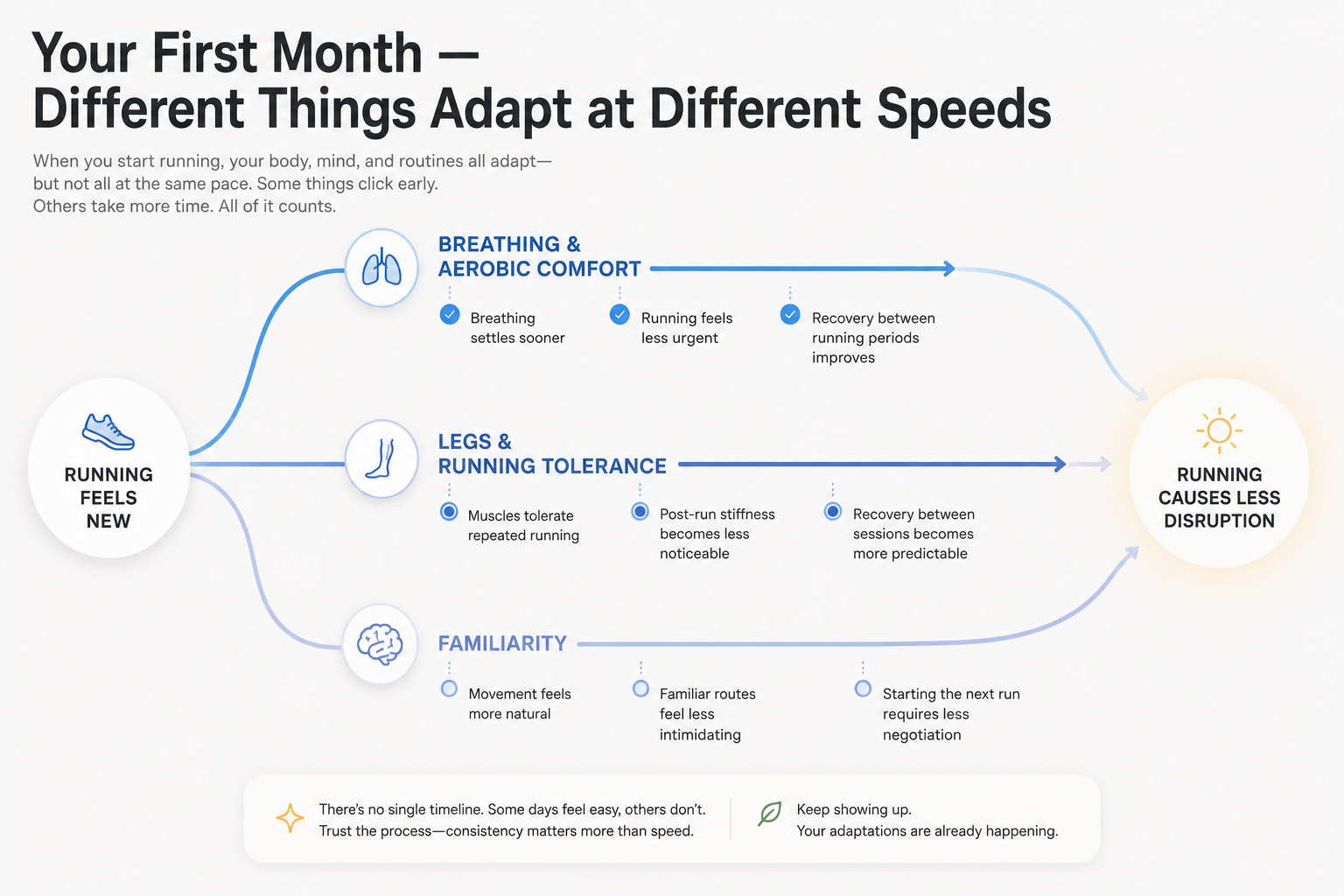
That inconsistency is normal when running is still new. Your body is not adapting as one single system. The heart and lungs respond to repeated aerobic work. Muscles become more accustomed to producing and absorbing force. Tendons and joints experience a new pattern of loading. Even the movement itself gradually becomes less unfamiliar.
Those changes do not all happen at the same speed. This is why I would be careful about treating the first month as a miniature training cycle with a result waiting at the end. Four weeks is enough time for running to begin feeling different, but not enough time to expect every run to become easier or every metric to improve in a straight line.
The more interesting changes are often quieter. Perhaps you recover your breathing sooner after a running segment. Perhaps your legs no longer feel unusual the following morning. A route that initially required several walking breaks may still require walking, but the running between them feels calmer. Most importantly, going out for another run begins to feel less like starting from zero again.
If you are genuinely beginning with no recent running background, How to Start Running From Scratch explains how to keep those first sessions manageable. But once you have started, the next challenge is slightly different. You have to give running enough time to become familiar without constantly asking it to prove that you are improving.
Your Breathing May Improve Before Your Legs Do
One of the first encouraging changes can happen surprisingly quickly.
The running portions that initially sent your breathing immediately upward may begin to feel more controlled. You still know you are exercising, but the sensation is less urgent. When you slow to a walk, your breathing settles sooner. After a few minutes of running, you may even find a rhythm that was difficult to imagine during the first session.
Then you finish the run and your legs remind you that they are on a different schedule.
Calves can feel unusually worked. The thighs may be stiff the following morning. Muscles you rarely noticed while walking can suddenly become very noticeable after running. None of this necessarily means the session was too hard. Running introduces repeated forces that ordinary daily movement may not have prepared the body to handle yet.
This difference between aerobic improvement and running-specific adaptation is important. Feeling less out of breath can make you want to extend every run immediately. Cardiovascularly, you may even feel capable of doing it. But the fact that your breathing has improved does not automatically mean the rest of the body is ready for a large increase in running.
I think this is one of the easiest ways to accidentally rush the first month. You feel fitter, so you assume you should be doing more. Instead, it can be useful to let the easier breathing exist for a while without immediately spending all of that new capacity. Repeat a session that suddenly feels easier. Let the legs experience the same amount of running again. Give the slower adaptations time to catch up with the faster ones.
If you are unsure whether the stiffness or heaviness between runs still looks like normal recovery, the Recovery Check Calculator can help put those signals into context before you automatically add more.
Early progress does not always need to appear as more running. Sometimes the first clear sign of progress is simply that the same running costs you less.
Some Runs Will Still Feel Surprisingly Hard
After a few better runs, it is easy to assume that the difficult part of starting has passed. Then one day you go out and everything feels wrong.
Your breathing rises earlier than it did last time. The legs feel heavy from the first few minutes. A pace that recently felt comfortable suddenly seems harder, and the walking break arrives sooner than you expected.
For a new runner, this can feel like lost progress because there is not yet much training history to compare it with. If you have only completed eight runs, one difficult session represents a large part of your experience.
But fitness does not reveal itself perfectly every time you run. Sleep, stress, temperature, what you ate, how much you moved the previous day and the accumulated unfamiliarity of running itself can all change how a particular session feels. Sometimes there is not even an obvious explanation.
The important thing is not to respond to one difficult run by trying to prove something on the next one. This is a lesson that remains useful long after the beginner stage, and Why You Should Not Judge Fitness From One Workout explores exactly why individual sessions can give such a distorted picture of where your fitness is going.
During the first month, I would make the comparison wider. Do walking breaks generally feel less urgent than they did at the beginning? Does your breathing recover more quickly? Are you less sore between runs? Can you repeat a familiar route with slightly less disruption to the rest of your day?
Those changes matter more than whether Tuesday happened to feel better than Saturday. A difficult run can still be part of a month in which running is becoming noticeably easier.
Early progress is rarely a sequence of better and better sessions. It is more often a gradual shift in what begins to feel normal.
Your Legs May Feel More Tired Even While Running Gets Easier
There is a slightly strange stage in the first month when you can feel more capable of running and more aware of your legs at the same time. The sessions are beginning to make sense. Breathing is less chaotic, walking breaks may be shorter, and you are no longer surprised by the basic sensation of running.
But the training is also starting to accumulate. One run on unfamiliar legs is one thing. Repeating that load several times across a few weeks is different. Calves, thighs and hips may carry a little fatigue from one session into the next even though no individual run felt particularly demanding.
That does not automatically mean you are doing too much. Some tiredness is part of the adaptation you are trying to create. The useful question is whether that fatigue settles between runs or gradually begins to follow you everywhere.
Normal early training fatigue tends to have boundaries. The legs may feel worked after running and slightly stiff the next morning, then progressively return toward normal. When it is time to run again, movement usually feels comfortable enough to begin.
Accumulating fatigue behaves differently. The legs never quite seem to reset. Ordinary walking can feel unusually heavy. The beginning of every run becomes harder rather than more familiar, and the next session starts feeling like something you are doing on top of the previous one.
That distinction matters more than soreness itself.
This is where the Training Load Check Calculator can be useful. You do not need sophisticated training metrics in your first month, but looking at several signs together can help distinguish normal adaptation from a pattern where the training is beginning to accumulate faster than you are absorbing it.
And if the answer really is that the legs need another day, nothing has gone wrong. A missed running day barely matters. What matters much more is protecting the pattern that allows you to keep coming back.
You Do Not Need to Make Every Run Longer
Once running begins to feel more manageable, distance and duration become very tempting ways to measure progress.
You ran for twenty minutes last week, so perhaps twenty-five minutes should come next. Once twenty-five works, thirty seems logical. Before long, every successful run creates an expectation that the next one should contain a little more.
But improvement does not require constant expansion. There is real value in repeating a distance or duration your body already understands.
The first time you run for twenty minutes, the session may feel unfamiliar from beginning to end. A few repetitions later, the same twenty minutes can feel completely different. Your breathing settles earlier. The movement feels less awkward. You finish with more left in reserve, and the recovery afterwards becomes almost unremarkable.
Nothing increased on paper. But your capacity changed. I think beginners sometimes miss this because running apps make progression so visible in kilometers while adaptation itself remains invisible. A longer run produces an obvious new number. Becoming more comfortable at the same workload does not.
Yet that quieter improvement is often exactly what creates the foundation for increasing later. When a familiar amount of running has become consistently manageable, adding a little more can make sense. What you want to avoid is turning progression into a rule where every successful session earns an immediate increase. How Long Does It Take to Improve Running? gives this process a wider perspective, because many of the adaptations we eventually care about develop over months rather than a handful of sessions.
During the first month, repetition is not stagnation. Sometimes doing the same run again is how your body gets the chance to become better at it.
Conclusion
Your first month of running probably will not look like a smooth progression.
Some runs will feel easier almost immediately. Others will make you wonder why something that felt manageable a few days ago suddenly feels difficult again. Your breathing may improve while your legs are still learning what repeated running feels like, and the amount of running you can comfortably tolerate may change more slowly than your enthusiasm for doing more.
That is not a problem with the process. It is the process.
The first month gives several different parts of the body their first opportunity to adapt to running repeatedly. You do not need to accelerate that adaptation by making every run longer, removing every walking break or chasing a faster pace.
Often the better sign is that running causes less disruption. You recover sooner. The legs return to normal more predictably. Your breathing settles into rhythm earlier. A session that once felt like a significant physical event becomes something you can do and then continue with the rest of your day.
None of those changes creates a dramatic personal best. But together they are beginning to create a runner.
This is why the end of the first month does not need a test. You do not have to run continuously for thirty minutes, complete 5K or prove that you are ready for harder workouts. If running is becoming easier to repeat, the month has done something useful.
From there, you can gradually begin building more. But you are no longer building on an activity that feels completely unfamiliar. You are building on running your body has started to recognize.
After a few weeks, running also becomes regular enough that comfort starts to matter more than it did on the first day. You still do not need complicated equipment, but a comfortable everyday running shoe can make repeated sessions easier to live with. Our guide to the Best Running Shoes for Daily Training 2026 looks at versatile options designed for exactly that ordinary day-to-day running rather than racing or specialized workouts.
Frequently Asked Questions
Should running feel easier after one month?
Usually something about running will begin to feel easier, but that does not mean every run will. Your breathing may become more controlled, recovery may improve or familiar running periods may feel less demanding. These changes can appear before there is a large improvement in pace or distance.
How much should I be able to run after one month?
There is no distance or duration you need to reach. Someone starting with very little recent activity may still benefit from run-walk sessions, while another beginner may already be running continuously. How reliably you can recover and repeat your running matters more than reaching a particular milestone after four weeks.
Is it normal to still need walking breaks after a month?
Yes. Walking breaks are a way of controlling running load, not evidence that you have failed to progress. As fitness and running tolerance improve, the running portions often become longer naturally and the walking portions gradually become less necessary.
Why do some runs still feel harder than others?
Running performance changes from day to day. Sleep, stress, weather, previous activity, nutrition and accumulated fatigue can all influence how a run feels. During the first month those variations can seem particularly large because you have relatively few previous runs to compare them with.
Should I run farther every week as a beginner?
Not necessarily. Repeating the same manageable amount of running can be productive because your body is still adapting to that workload. Increase when the current amount has become reliably manageable rather than because the calendar says another week has passed.
Is muscle soreness normal when starting running?
Some temporary muscle soreness or stiffness can occur when running is new. More useful than asking whether you feel anything at all is watching what happens afterwards. Normal training fatigue should generally settle rather than accumulate from session to session. Persistent or worsening pain is a different signal and should not simply be treated as something a beginner needs to push through.
What should I focus on after my first month?
Keep building the running you can already repeat. There is no urgency to introduce hard workouts simply because the first month is complete. Consistent comfortable running can continue developing aerobic fitness and running tolerance for a long time before more complicated training becomes necessary.