
When Are You Ready to Run Your First Marathon?
I’ve started noticing that most runners don’t wake up one morning suddenly deciding to run a marathon. The idea usually arrives much earlier.
It might appear after a comfortable 10K, a successful half marathon or simply after watching thousands of runners cross a finish line with huge smiles on their faces. At first, it’s just curiosity. Then, almost without noticing, curiosity becomes a question.
Am I ready? I think many runners immediately start searching for numbers.
How many kilometres should I be running each week? How long should my longest run be? What pace should I already be able to hold?
Those questions all have their place. But I honestly believe they come slightly too early. To me, this is where marathon readiness becomes surprisingly different from marathon fitness.
Fitness can often be measured. Readiness is something broader.
It’s the point where your body, your habits and your expectations all begin moving in the same direction. That’s why I don’t think the answer is ever hidden in a single workout.
It’s usually found in the consistency you’ve built over the previous months.
Marathon Readiness Begins Long Before Marathon Training
I think this is one of the biggest misconceptions surrounding the first marathon.
Many runners believe they become marathon-ready during a marathon training plan. In reality, I suspect most of that readiness has already been developing long before the plan even begins.
Every month of consistent running quietly prepares your body for the larger training volume that marathon preparation will eventually demand. Easy runs strengthen tissues that recover more quickly between sessions. Long runs gradually become less intimidating. Recovery becomes something you understand instead of something you simply hope for.
I’ve started noticing that experienced marathon runners rarely describe one breakthrough workout that convinced them they were ready.
Instead, they often describe something much quieter. Running simply became part of life.
Missing a week of training started to feel unusual. Weekend long runs became something they looked forward to rather than something they feared. Recovery routines happened almost automatically.
To me, this is where readiness becomes visible. Not when a runner completes one impressive session. When consistent training has become normal.
If you’ve been wondering why consistency matters so much more than occasional outstanding workouts, our article What Consistency Actually Looks Like Over Months of Training explores exactly why endurance is built through repetition rather than isolated achievements.
Signs You’re Ready for Your First Marathon
I’ve started noticing that runners often look for one decisive sign.
One long run. One weekly mileage target. One race result that finally confirms they’re ready.
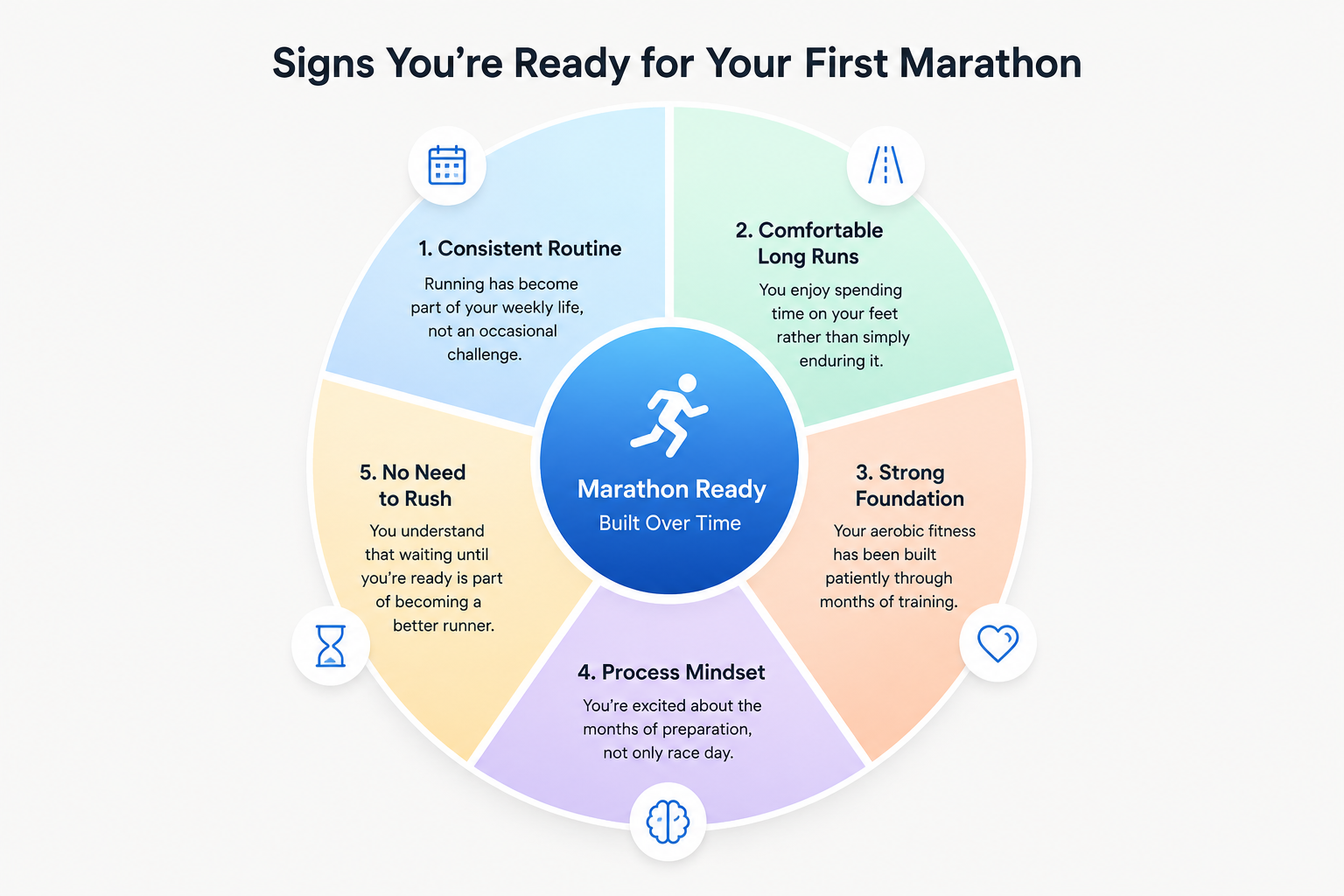
I honestly don’t think readiness announces itself that way. More often, it reveals itself through a collection of small habits that have quietly become part of your life.
Perhaps you’ve reached the point where running three or four times a week no longer feels like an achievement. It’s simply what you do. Long runs no longer dominate your weekend because you’ve gradually learned how to fit them into your routine. Missing a session feels unusual, not because you’re obsessed with training, but because running has become part of your normal rhythm.
To me, those are much stronger signs than any single workout. Another thing I’ve started noticing is that runners who are truly ready often become less interested in proving themselves.
Earlier in their running journey, every race felt like a test. Every long run needed to confirm that they were improving. Over time, that mindset begins to change.
Training itself becomes rewarding. You no longer need every session to be impressive because you understand that fitness is being built quietly in the background.
I think that’s a surprisingly important shift before marathon training begins.
The marathon asks you to trust the process for months. If you’re still searching for constant reassurance that you’re improving, the training can feel frustrating. But if you’ve learned to enjoy the rhythm of consistent running, marathon preparation starts to feel much more natural.
That’s why I don’t think marathon readiness is defined by one number. It’s defined by whether you’ve already become comfortable with the habits that marathon training will ask you to repeat for months.
If you’ve ever wondered whether your current routine is genuinely sustainable, our article How to Build a Weekly Running Structure explains why a predictable training rhythm often matters more than occasional high-mileage weeks.
What Happens If You Start Too Soon?
I’ve started noticing that runners rarely regret waiting another season before their first marathon.
The opposite is much more common. They regret rushing into marathon training before they were ready to enjoy it.
I don’t mean they fail to finish. Most reasonably healthy runners can probably complete a marathon with enough determination.
I think the bigger question is what the experience teaches them.
If marathon training arrives before you’ve built a solid running foundation, the months leading up to race day can begin to feel like survival rather than progression. Long runs become something to endure instead of something to learn from. Recovery takes longer than expected. Small aches appear more often because your body is trying to absorb a training load it hasn’t fully adapted to yet.
To me, this is where the marathon can unintentionally become discouraging.
Not because the distance is too long. Because the preparation arrived before the habits were ready to support it. Another thing I’ve started noticing is that runners sometimes mistake exhaustion for successful training.
They assume marathon preparation should constantly leave them feeling tired because the distance itself is so demanding.
I don’t believe that’s the right expectation. Good marathon training is certainly challenging, but it should still feel sustainable. You should gradually become more capable of handling the workload, not progressively less capable of recovering from it.
That’s one reason I think the best marathon plans often look surprisingly ordinary. They’re built around weeks that are repeatable. Not weeks that require heroic effort just to survive.
If you’re still learning how to recognize the difference between productive training and accumulating too much fatigue, our article How to Tell If You’re Close to Overtraining (Early Signs) explores the early signals that your body is adapting well—and the signs that it may be asking you to slow down.
Conclusion
I’ve started noticing that marathon readiness becomes surprisingly easy to recognise once we stop searching for one perfect indicator.
There isn’t a magical weekly mileage. There isn’t a single long run that suddenly transforms you into a marathon runner.
And I don’t think there ever will be. Readiness develops quietly.
It grows through ordinary weeks of consistent training. Through recovery that gradually becomes part of your routine. Through long runs that no longer feel intimidating simply because you’ve spent months preparing your body for them.
To me, this is where the marathon becomes much less about the distance itself. It’s about becoming the kind of runner who is comfortable with the process that the distance demands.
I think that’s why experienced runners often seem surprisingly relaxed before beginning marathon training. They’re not relying on motivation anymore. They’re relying on habits.
Those habits give them confidence because they’ve already proven, week after week, that they can keep showing up. Perhaps that’s the clearest sign of all.
When you’re no longer asking whether you can survive marathon training, but instead looking forward to experiencing it, your first marathon is probably much closer than you realise.
And if you’re not there yet, that’s perfectly fine too. The marathon isn’t a deadline.
It’s simply another chapter in your running journey, waiting until the foundation beneath it is strong enough to make the experience rewarding rather than overwhelming.
If you’re beginning to think seriously about your first marathon, a reliable GPS watch can make the months of preparation much easier to manage by helping you monitor long runs, recovery and overall training load. Our guide to the Best Running Watches Used by Elite Runners explains which models offer the most useful features for marathon preparation.
Frequently Asked Questions
How do I know if I’m ready for my first marathon?
Readiness is usually reflected in your habits rather than a single workout. If you’ve been running consistently for months, recover well between sessions, enjoy long runs and feel comfortable with a structured training routine, you’re likely much closer than you think.
Do I need to run a half marathon before my first marathon?
Not necessarily, but it can be extremely helpful. A half marathon gives you experience with pacing, nutrition and race-day preparation while helping you understand how your body responds to longer efforts.
Is there a minimum weekly mileage before marathon training?
There isn’t one universal number. What’s more important is that your current running volume feels sustainable and that you’ve maintained it consistently before beginning a marathon-specific plan.
Should I wait if I’m still struggling with consistency?
I think so. Marathon training builds on habits that are already established. If consistent running still feels difficult, spending another few months strengthening that routine will usually make marathon preparation far more enjoyable.
Is it better to wait another year for my first marathon?
Sometimes, yes. Waiting isn’t falling behind. If another season allows you to build a stronger aerobic base, improve your durability and arrive at the start line healthier and more confident, it’s often time very well spent.