
Most runners struggle with the same question at some point during training.
Should I stop this run… or should I keep going?
Sometimes the answer feels obvious. Sharp pain, dizziness, or sudden injury are clear warning signs. But most difficult runs are not that clear.
Usually the situation is much quieter than that. The body feels unusually heavy. Breathing never really settles. Easy pace feels strangely expensive. Something simply feels off in a way that is difficult to define precisely.
And that uncertainty creates confusion because endurance training constantly asks runners to tolerate discomfort. Running is not supposed to feel perfectly comfortable all the time.
But not every difficult-feeling run should be pushed through either.
Learning the difference between normal training discomfort and signals that the body is no longer absorbing stress productively is one of the most important long-term endurance skills.
Because smart training is not only about knowing when to push. It is also about recognizing when continuing stops helping.
Most Runs Feel Better After The First Minutes
One reason runners become confused about stopping early is that many runs naturally feel awkward at the beginning.
The body is transitioning from rest into movement. Muscles loosen gradually. Breathing stabilizes progressively. Rhythm often appears step by step instead of immediately.
This is completely normal. In fact, many genuinely good training sessions start somewhat flat before the body settles properly.
That is why experienced runners rarely panic during the opening part of a run. They understand that temporary heaviness is not automatically a problem.
The important thing is usually not: “How do I feel immediately?”
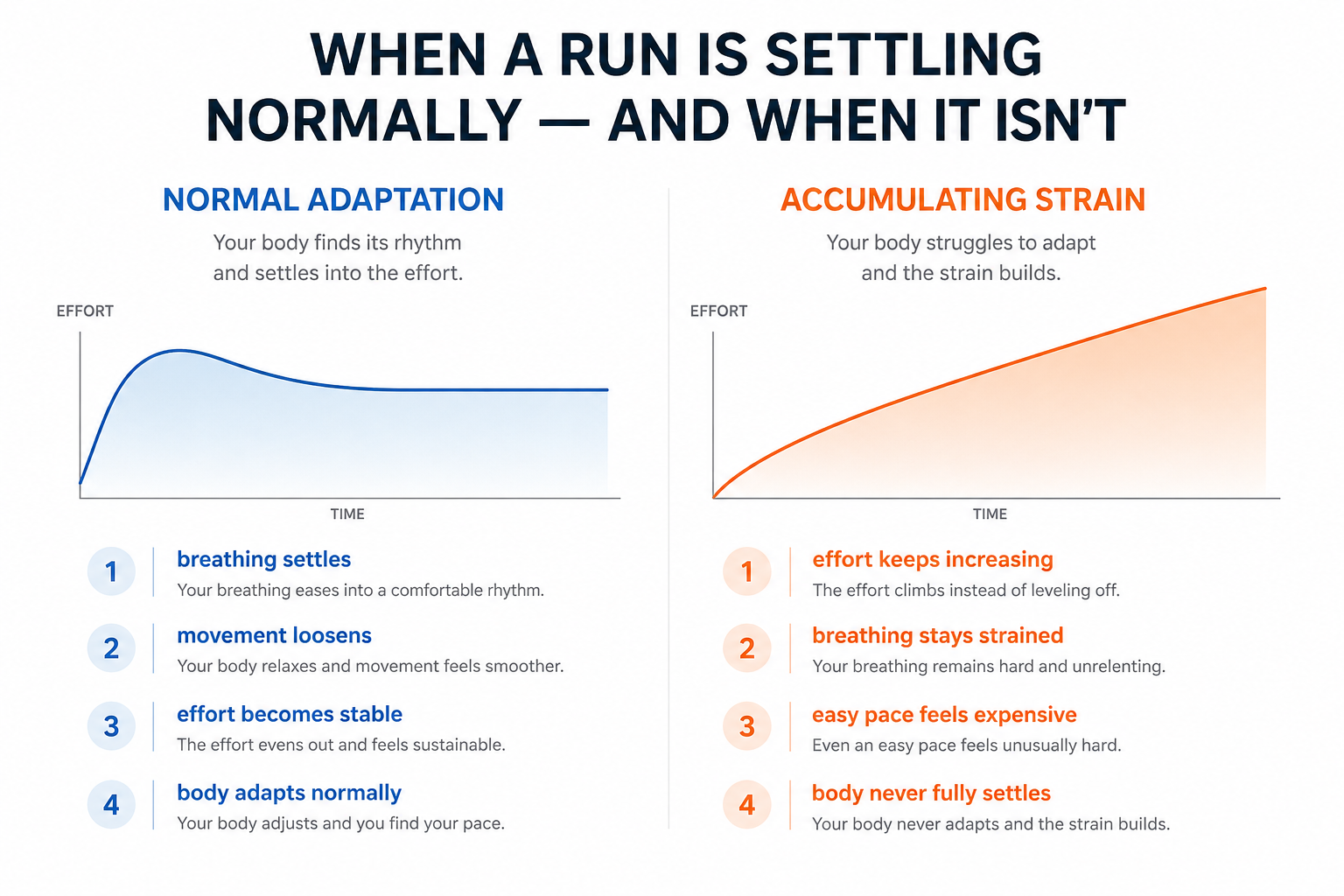
It is: “Does the body gradually become more stable as the run continues?”
Breathing settles. Movement smooths out. Effort becomes more sustainable.
This is closely connected to How to Read Your Body Before a Run (Simple Daily Check), because one of the most useful endurance skills is recognizing whether the body is warming up normally or quietly struggling underneath accumulated fatigue.
Many runs that initially feel poor become perfectly normal once the system settles.
A Run Usually Does Not Need To Feel Perfect
Another important misunderstanding is the idea that every productive run should feel smooth and enjoyable.
That is not how endurance training works. Some days the body feels slightly tired. Some days motivation feels low. Some days easy pace simply feels less fluid than usual.
That alone does not mean the run should stop. Endurance training always includes some level of discomfort because adaptation itself creates fatigue.
The important distinction is whether the discomfort remains manageable and stable — or whether it keeps becoming more strained as the run continues.
A slightly heavy body that gradually settles is very different from a body that keeps deteriorating despite low effort.
This is one reason What a Good Training Day Actually Feels Like matters so much. Productive training often feels controlled and sustainable rather than emotionally exciting or physically perfect.
Good endurance runners do not stop every time a run feels difficult. But they also do not ignore when the body clearly stops responding normally.
One Of The Clearest Warning Signs Is Rising Effort At Easy Pace
One strong signal that a run may no longer be productive is when easy effort keeps becoming more expensive despite reducing pace.
Breathing stays strained. Heart rate continues drifting upward. Movement feels progressively heavier instead of loosening. The body never fully settles into sustainable rhythm.
That matters because truly aerobic running should usually stabilize after the body warms up.
When it does not, the body is often revealing that recovery has quietly fallen behind current stress levels.
And importantly, this usually develops gradually rather than dramatically.
This is exactly the pattern behind What Happens If You Run Too Fast Too Often (And Why It Slows You Down), where hidden fatigue slowly accumulates until the body stops adapting efficiently even though training continues normally.
If easy effort itself has recently become difficult to interpret consistently, What Does an Easy Run Actually Feel Like? explains the difference between sustainable aerobic effort and subtle hidden strain much more clearly.
And if you want a more objective way to recognize when effort is drifting outside manageable aerobic intensity, the Heart Rate Zone Calculator for Running can help establish more realistic recovery-friendly ranges.
When easy effort keeps rising instead of stabilizing, the body is usually communicating something important.
Pain And Fatigue Are Not The Same Thing
This distinction matters enormously. Fatigue is expected in endurance training.
Pain is different.
Normal fatigue usually feels broad and manageable: tired legs, slower movement, slightly heavier effort, reduced sharpness.
Pain feels more localized and structurally specific.
Sharp discomfort. Altered movement. Pain that worsens with impact. A sensation that changes how the body naturally moves.
That is usually the point where continuing the run stops being productive and starts increasing injury risk instead.
This becomes especially important because many overuse injuries develop gradually rather than through dramatic single moments. Achilles irritation, knee discomfort, or lower leg issues often begin as smaller warning sensations that runners repeatedly dismiss until they become harder to ignore.
This is one reason runners who increase training volume successfully tend to become very attentive to movement quality itself. How To Run More Without Getting Injured explains why sustainable volume depends heavily on recognizing accumulating stress before breakdown becomes visible.
Good fatigue can still support adaptation. Pain that changes movement usually does not.
Sometimes Stopping Early Is The Smartest Training Decision
Many runners emotionally associate stopping early with weakness.
But often, stopping early is simply intelligent load management. Because one shortened run rarely matters long term.
What matters is whether the overall training system remains stable enough to continue adapting afterwards.
Experienced runners understand this surprisingly well. They stop evaluating training only through individual sessions and start thinking more about overall recovery continuity across weeks and months.
If continuing the run:
keeps increasing strain, worsens movement quality, or clearly pushes the body beyond recoverable fatigue, reducing load early is often much smarter than forcing unnecessary stress deeper into the system.
This is especially true during higher-volume periods where accumulated fatigue can quietly build for multiple days before becoming obvious.
What a Balanced Running Week Looks Like becomes very important here because strong endurance systems are usually built through stable recoverable stress distribution rather than constantly proving toughness during individual sessions.
Sometimes the smartest run is the one that protects tomorrow too.
The Hardest Part Is Usually Interpretation
The difficult thing about stopping early is that the body rarely gives perfectly clean answers. Most runs exist somewhere between: fully fresh and clearly injured.
That is why endurance training gradually becomes less about rigid rules and more about interpretation.
Does the body settle eventually? Does movement stay natural? Does easy effort remain sustainable? Or does the system keep deteriorating despite lowering intensity?
Those patterns usually reveal far more than emotion alone.
And over time, experienced runners stop treating every difficult-feeling run as either failure or success. Instead, they start seeing training more realistically: as an ongoing conversation between stress, recovery, and adaptation.
Frequently Asked Questions
Is it normal for runs to feel difficult at first?
Yes. Many runs feel awkward or heavy during the opening minutes before breathing and movement settle properly.
When should I stop a run early?
Usually when effort continues rising despite easy pace, movement quality changes, pain worsens with running, or the body clearly stops responding normally.
Should I stop running if my legs feel heavy?
Not automatically. Heavy legs are common in endurance training. The important question is whether the body gradually loosens and stabilizes as the run continues.
What is the difference between fatigue and injury pain?
Fatigue is usually broad and manageable. Injury-related pain is often more localized, alters movement, and worsens with continued impact.
Is stopping a run early a bad sign?
Not necessarily. Sometimes shortening or stopping a run is simply intelligent recovery management that protects long-term consistency.
If You Want Better Feedback About Effort And Recovery
Reliable heart rate and pacing data can make it easier to recognize when easy effort is remaining sustainable versus quietly drifting into excessive strain.
The goal is not obsessing over numbers.
It is understanding whether the body is continuing to absorb training productively over time.
If you want a practical comparison of the best tools available, Best Running Watches for Running (2026) breaks down the most useful options for aerobic pacing, recovery tracking, and endurance-focused training.
Conclusion
Learning when to stop a run early is not about becoming fragile or avoiding difficult training days completely.
It is about recognizing the difference between:
normal manageable fatigue and stress the body is no longer handling productively.
Because strong endurance training depends less on constantly forcing every session perfectly and more on understanding when the body is:
warming up normally, carrying temporary fatigue, or quietly asking for less load before bigger problems develop.
And often, the runners who improve most sustainably long term are not the ones who ignore every warning sign.
They are the ones who learn how to interpret them calmly before small issues become larger interruptions.