
How Fast Does Running Fitness Come Back?
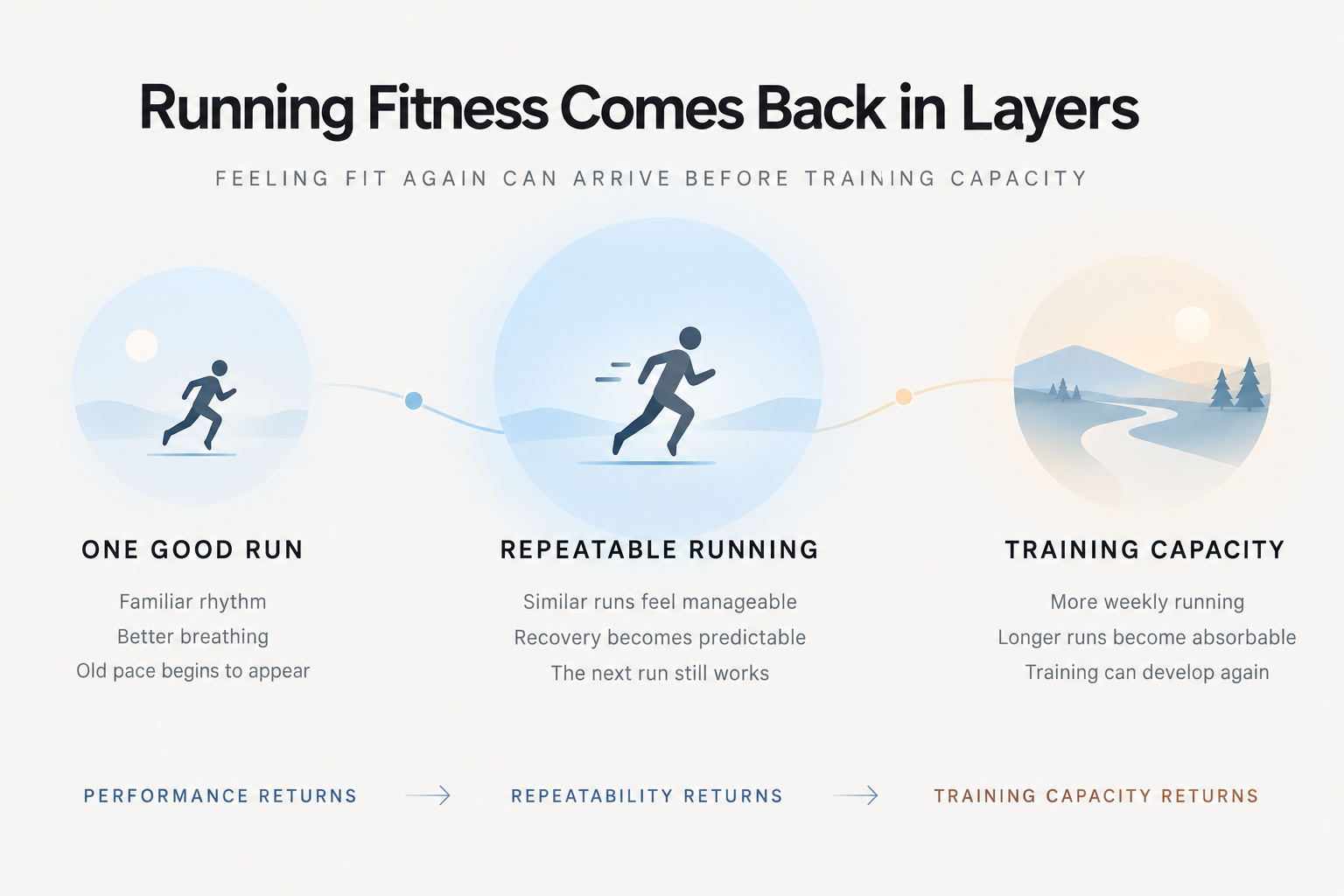
Running fitness can come back before your ability to train like your old self does.
The first signs of returning fitness can arrive surprisingly quickly. Your first run back feels awkward. Breathing rises earlier than you remember. The legs are heavier. A pace that once belonged to easy running now requires enough effort that you keep checking the watch.
Then you run again a few days later. Something is already different. The movement feels slightly more familiar. Another week passes and breathing begins settling sooner. The same route no longer feels quite as long. A pace that looked impossible during the first run starts appearing for short periods without being forced.
This can create a powerful impression. Maybe my fitness never really disappeared. And depending on how long you were away and what you did during that time, some of it may not have. But I think returning runners need to be careful with the word fitness because it makes several different things sound like one thing. Your ability to breathe comfortably while running is part of fitness. So is your running economy. So is your ability to sustain a particular pace. But there is also the ability to run again two days later.
To handle another week of running after that. To extend a long run without carrying its cost into several subsequent sessions. To absorb the kind of training that once produced your old fitness in the first place.
Those things do not necessarily return together. This is the distinction underneath How to Start Running Again After Years Away. A returning runner can rediscover the feeling of running surprisingly early while the whole system is still rebuilding its tolerance for repeated running.
That is why one unexpectedly good comeback run can be both encouraging and misleading. It may tell you that part of your fitness is returning. It does not yet tell you how much training you are ready to sustain. And ultimately, that second question matters more. Because the goal is not simply to produce one run that feels like the old days. It is to reach the point where running like that no longer feels unusual.
Some Parts of Fitness Return Faster Than Others
One reason comeback fitness can feel unpredictable is that you are not rebuilding a single ability. Different parts of running respond at different speeds. Breathing is often the first thing you notice.
The first few runs may produce an exaggerated cardiovascular response simply because running itself is unfamiliar again. As the movement becomes more familiar and aerobic fitness begins responding to regular training, that sensation can improve relatively quickly.
Running rhythm can return quickly too. You stop thinking about your stride. The movement becomes less awkward. You begin finding a comfortable cadence without consciously searching for it. Then pace starts moving. Perhaps the first comeback runs were much slower than expected, but a few weeks later the same effort is producing noticeably better numbers.
All of this can make you feel remarkably close to your previous fitness. But another part of the return is much quieter. Can you run three or four times this week and still feel normal at the end of it? Can you make one run longer without changing how the next few days feel? Can you repeat the same training next week?
This is where What Beginner Progress Actually Looks Like provides a useful mental model even for someone who is not really a beginner. Progress often appears as a reduction in what running costs you before it appears as an increase in what you can produce.
For a returning runner, I would extend that idea further. Your pace may improve before your training capacity has fully returned. That distinction matters because faster pace is extremely visible. Training tolerance is not. You notice that you can run 5:30 per kilometer again. You may not immediately notice that four runs at your old weekly frequency still leave your legs carrying more fatigue than they used to.
So I would not ask only whether your old pace is coming back. Watch what happens around it. How much recovery does that pace require? What happens when you repeat the run? Does the whole week still work? A pace returning is evidence of fitness. Being able to absorb the running that produces it is evidence of something broader.
Eventually, you want both.
Early Improvements Can Feel Faster Than They Really Are
There is another reason the first weeks of a comeback can be so convincing. The starting point is unusually sensitive to improvement. If your first run back feels awkward, inefficient and harder than expected, even a modest adaptation can create a large difference in how the next few runs feel.
Breathing settles. The stride becomes familiar. You stop wasting attention on the movement itself. The improvement is real. But not all of it represents newly rebuilt aerobic fitness. Some of what you are experiencing is simply running becoming less unfamiliar again.
This is why the first part of a comeback can produce an almost intoxicating rate of progress. A route that felt difficult two weeks ago suddenly feels ordinary. Pace improves without much deliberate effort. You begin recognizing yourself in the numbers again.
Then the rate of improvement slows. That can be disappointing if you interpreted the first few weeks as a trajectory. But nothing has necessarily gone wrong. You have simply collected some of the easier gains that came from returning to a familiar activity. From here, further improvement increasingly requires the slower process of accumulating training again.
This is where How Long Does It Take to Improve Running? becomes useful. Fitness development is easier to understand across longer periods than by extrapolating from a few unusually responsive weeks.
I would therefore be careful about turning early comeback progress into a prediction. If your pace improves substantially during the first month, that does not mean the next month should produce the same improvement. If five kilometers becomes comfortable quickly, ten kilometers does not automatically follow at the same rate.
And if three runs per week suddenly feel easy, it does not mean five will become equally easy two weeks later.
The early comeback can be steep because you are regaining familiarity as well as fitness. Later, the curve becomes quieter. That quieter phase is not where the comeback has stalled. It is often where rebuilding has actually begun to resemble training again.
Do Not Use One Good Run as Proof That Your Fitness Is Back
Eventually, most returning runners have one. The run where everything suddenly feels right. The pace is closer to what you remember. Breathing stays controlled. The legs have some spring again, and the distance that looked intimidating a few weeks earlier passes without much difficulty.
You finish and think: There it is. I’m back.
The run may genuinely show that your fitness has improved. What it cannot tell you is whether that fitness has become stable.
There is an important difference between being able to produce a performance and being ready to reproduce the training around it.
You might be capable of running ten kilometers comfortably today. That does not automatically mean you are ready to make ten kilometres your normal weekday run again. You might complete a faster session surprisingly well. That does not tell you whether adding that session every week alongside increasing mileage will leave the rest of your training equally manageable.
This is why Why You Should Not Judge Fitness From One Workout applies particularly well during a comeback. A surprisingly good run can distort your view of fitness just as easily as a surprisingly bad one.
I would look for repetition instead. Can you run well again without needing unusual recovery? Can you complete several normal runs across the week without the legs becoming progressively heavier? Can you repeat roughly the same week and have it feel more familiar rather than more expensive?
That is a much stronger signal. Running fitness can come back before your ability to train like your old self does. This is also where patience becomes easier to understand. You are not waiting because the good run was somehow false. You are giving the rest of your running time to catch up with it. One good run shows what is possible today. Repeatable running shows what has actually become yours again.
The Better Question Is How Quickly Training Becomes Repeatable Again
When people ask how fast running fitness comes back, they usually want a date. Four weeks? Eight weeks? Three months?
It is understandable. A timeline would make the comeback much easier to interpret. But two runners can be equally far from their old fitness and have completely different returns.
One stopped running but continued cycling several times a week. Another stopped structured exercise almost entirely. One is returning after two years away. Another after ten. One previously ran casually three times a week. Another spent years building high weekly mileage.
Age, previous training history, activity during the break and the amount of running you are currently able to absorb all change the answer. This is why I would be cautious about attaching too much importance to a generic number of weeks.
There is a more useful milestone. Your training becomes repeatable again. You run this week and recover normally. The next week contains a similar amount of running and does not feel more expensive.
You extend one session slightly and the rest of the week remains intact. You begin accumulating training rather than continually recovering from the fact that you have started training again.
The Recovery Check Calculator can be particularly useful during this phase because it shifts attention from how impressive today’s run felt toward what recent running is leaving behind. That is a much better way to judge a comeback than asking whether you have recovered a certain percentage of your old fitness.
You do not need to know whether you are 60 or 80 percent back. You need to know whether the running you are doing now is creating room for more running later. Once that happens consistently, progression becomes much less speculative. You can add a little distance and observe what happens. You can increase frequency when the spaces between runs no longer seem necessary in the same way.
Eventually, faster training can return because the ordinary running underneath it is stable enough to support it.
The useful question is not how quickly one good run comes back, but how quickly good running becomes repeatable again.
There may still be months of fitness to rebuild after that point. But something fundamental has changed. You are no longer repeatedly testing whether your old fitness has returned. You are training again.
Your Old Pace May Return Before Your Old Volume
There is a particularly convincing stage in a comeback when the numbers begin looking familiar again. You go out for an easy run and notice that the pace is no longer far from where it used to be.
Perhaps it is still slower.
But the difference has become small enough that the old runner suddenly feels within reach.
This can create a reasonable-looking conclusion. If the pace is almost back, perhaps the fitness is almost back too. The problem is that pace and volume ask different questions of the body.
Running a familiar pace for forty minutes tells you something about what you can produce during those forty minutes.
Running five days this week, extending the weekend run and then doing something similar again next week asks whether your body can absorb a much larger amount of repeated running.
Those capacities are related. They are not interchangeable. This is where returning runners with a strong previous running background can get ahead of themselves. The individual runs stop looking like comeback runs remarkably quickly, so rebuilding the old weekly structure begins to feel unnecessarily cautious.
But your old weekly volume was not created because you once proved that you could run every individual kilometre inside it.
It was built through repeated exposure. Week after week, your body became accustomed to that amount of running until what was once a substantial training load became normal.
You have to allow some version of that process to happen again.
The principles in How To Increase Weekly Running Volume Safely? become useful here because the next step should not be determined only by how comfortable today’s run felt. It also has to fit inside the running you are already absorbing.
That may produce a slightly strange period where you can run surprisingly well but are still running surprisingly little. I would not rush through it. Let pace return without immediately matching it with old distance. Let distance return without simultaneously restoring every old running day. Give each increase enough time to become part of normal training rather than another demonstration of what you can currently manage.
Eventually, the weekly volume begins catching up too. And when it does, something much more meaningful than an old pace has returned. You have rebuilt the ability to train.
Conclusion
Running fitness can come back surprisingly fast. And surprisingly slowly. Both can be true at the same time. Within the first few weeks, running may already feel more familiar. Breathing settles. Movement becomes smoother. Pace begins moving toward numbers you recognize.
Those improvements are real. But they do not mean every part of your old running has returned with them. The ability to run a familiar pace is one thing. The ability to recover from that run, repeat it several times during the week, extend one of those sessions and arrive at the following week ready to train again is something larger.
That is why I would not define the end of a comeback by the first moment your old pace reappears. Look for the point when running becomes ordinary again. A good run no longer feels surprising. Recovery becomes predictable. The next run does not depend on how much the previous one took from you. And gradually, you stop wondering whether your fitness is back because you are too busy training with it.
There is no need to hurry the gap between those two things.
Even equipment can remain simple while the running develops. A comfortable daily trainer can cover most of the ordinary running involved in rebuilding fitness, which is the role explored in Best Running Shoes for Daily Training 2026. Your shoes do not need to become more specialized simply because familiar pace starts returning.
Eventually, the old numbers may come back. Then the old distances. Perhaps the old weekly volume too. Some runners will eventually go beyond all of them. But the most useful milestone is quieter. Once that happens, you are no longer trying to recover a snapshot of the runner you used to be.
You have rebuilt the ability to keep becoming a runner from here.
Frequently Asked Questions
How long does it take to regain running fitness?
There is no reliable timetable that applies to every returning runner. How quickly fitness returns depends on your previous running history, how long you were away, how active you remained and how much running your body can currently absorb. Some aspects of running can begin feeling noticeably better within weeks, while rebuilding previous training capacity can take considerably longer.
Does running fitness come back faster if you were previously fit?
Previous running experience can make parts of the comeback feel faster because the movement, pacing and interpretation of effort are already familiar. How much fitness remained during the break also matters. Previous experience does not, however, guarantee that running-specific durability or old training volume will return at the same speed.
Why is my pace coming back so quickly?
Part of the early improvement can come from running becoming familiar again. Movement may become more economical, rhythm returns and aerobic fitness begins responding to regular training. Pace can therefore improve substantially before your ability to tolerate previous weekly volume has fully returned.
Can cardiovascular fitness return before my legs are ready?
Yes. This can be particularly noticeable if you remained aerobically active through cycling, walking or other exercise. Your cardiovascular system may support more running than your muscles and connective tissues are currently accustomed to absorbing repeatedly.
How do I know when my running fitness is really coming back?
Look beyond one run. Familiar pace becoming easier is encouraging, but recovery and repeatability provide additional information. If you can complete normal running, recover predictably and repeat a similar training week without accumulating increasing fatigue, your broader running capacity is rebuilding too.
Should I increase mileage when my old pace comes back?
Not automatically. Pace and weekly running volume do not necessarily return together. Allow your current volume to become repeatable before making substantial increases. If several dimensions are changing at once, the Training Load Check Calculator can help you see how those individually modest increases combine across the week.
Why did my fitness improve quickly at first and then slow down?
The first comeback weeks can include rapid improvements in familiarity, movement and running economy alongside actual fitness gains. Once those early changes have occurred, further development increasingly depends on accumulating consistent training, so progress can become less dramatic.
When can I start doing hard workouts again?
There is no specific week when speed work automatically becomes appropriate. A better sign is that ordinary running has become stable, recovery is predictable and your current weekly volume no longer feels like something you are continually rebuilding from.
Will I get back to exactly the same fitness I had before?
Possibly, but it is not something a comeback can guarantee. Age, current circumstances, training consistency and the length and nature of the break all matter. Your previous performance can provide context, but it does not need to become the definition of a successful return.