
Returning After Winter
You can return from winter aerobically fit without yet being fully adapted to regular running.
The first run after winter can be surprisingly reassuring.
You expect to feel rusty, and perhaps you do for the first ten minutes. The stride feels slightly unfamiliar, breathing arrives earlier than you remember and the pace on your watch is not particularly impressive. But then the run settles. By the time you get home, the conclusion can seem obvious: you have not lost nearly as much as you thought.
For many runners, that is probably true.
A winter away from regular running does not necessarily mean a winter without fitness. You may have walked more, spent time in the gym, skied, cycled indoors or simply remained active enough that your cardiovascular fitness never disappeared completely. Even if you did very little structured exercise, a few months away is different from returning after several years.
The difficulty is that spring gives you several encouraging signals at once. Running feels familiar quickly. The weather makes being outside easier. Daylight returns. Routes you have not seen for months suddenly become available again, and the whole experience can create a strong desire to get back to normal.
That is where I think the first few weeks deserve more patience than they appear to need.
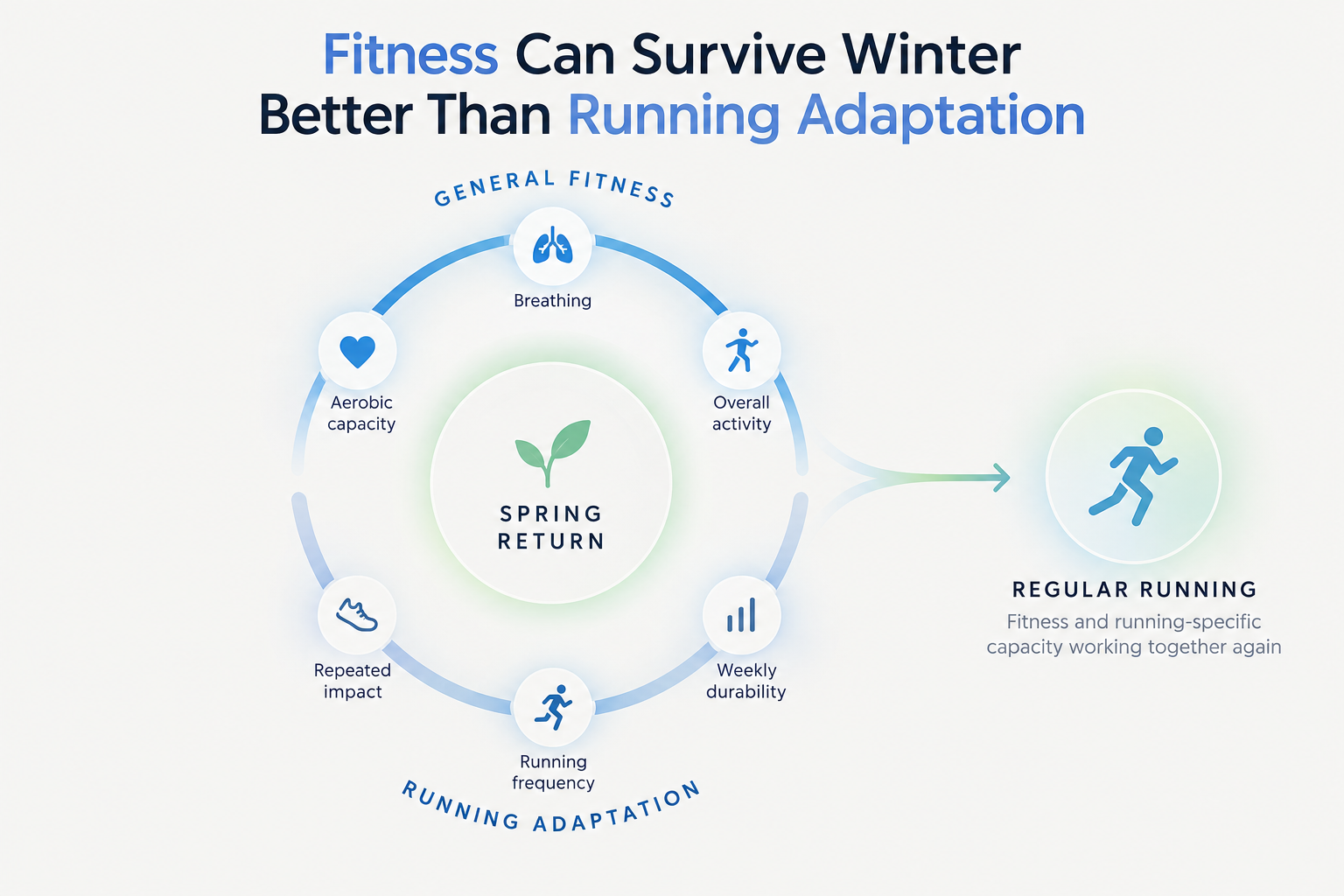
Your cardiovascular system may recognize running before your legs are fully accustomed to repeated running impact again. Your old easy pace may begin returning before your old weekly volume does. Even the fact that five or eight kilometres feels perfectly manageable says relatively little about how three or four similar runs will accumulate across the week.
This is a smaller version of the distinction explored in How Fast Does Running Fitness Come Back?: different parts of running fitness do not necessarily return together.
After winter, however, the gap can be especially easy to miss because you may never have felt particularly unfit in the first place.
You are not rebuilding running from zero. But you are rebuilding the habit of absorbing it.
Winter Fitness and Running Fitness Are Not Quite the Same Thing
A runner can arrive in spring genuinely fit and still be underprepared for regular running.
This is easiest to notice after an active winter. Perhaps you have spent months cross-country skiing, cycling indoors or doing consistent strength work. Your heart and lungs have continued receiving a substantial training stimulus, and you may even feel stronger than you did in autumn. When you return to running, there is no obvious sense of starting again.
Aerobically, you may not be.
But running asks for something that those activities cannot completely preserve. Every stride brings repeated impact through the feet, calves and legs. The tissues involved in running have to tolerate that load thousands of times during a single session, then recover well enough to do it again a few days later. Other sports can maintain an impressive amount of general fitness without maintaining exactly that capacity.
This is why the first run can be misleading in a very specific way. Your breathing may tell you that you could comfortably continue for another twenty minutes while your recent running history suggests that there is little reason to do so yet. The aerobic engine is capable of supplying more work than the running-specific system has recently practiced absorbing.
The difference becomes clearer when the runs begin accumulating. One comfortable hour may cause no problem at all. Three comfortable hours spread across the week are a different stimulus, particularly if the previous months contained very little running.
The same principle sits behind How to Tell If Your Training Load Is Too High (Without Metrics). Training load eventually reveals itself through how well the body handles repeated sessions, not simply through how difficult one session felt while you were doing it.
This does not mean you need to treat spring running as fragile or approach every increase nervously. Quite the opposite. If winter training has preserved your general fitness, you may have an excellent platform from which to return.
You simply have to give running-specific capacity a little time to catch up with the fitness you already have.
Once those two begin aligning again, the comeback often starts feeling remarkably natural.
Do Not Let the First Warm Days Set Your Training Load
There is also something about spring itself that encourages runners to do more.
A run that felt unappealing in cold darkness suddenly becomes easy to start. The roads are dry, the evenings are lighter and familiar routes begin looking inviting again. You may finish a run and genuinely want to go out again the next day, not because a training plan says you should, but because running outside feels good again.
That enthusiasm is useful. It is one of the reasons a spring return can gather momentum so naturally. But motivation can increase much faster than running capacity.
The result is not always one obviously excessive run. More often, the whole week expands almost accidentally. Tuesday becomes longer because the weather is beautiful. Thursday appears because you feel recovered. The weekend run stretches farther than planned because you finally have daylight and a route you have missed all winter. Each decision feels reasonable on its own, yet by Sunday you may have accumulated considerably more running than your recent history would suggest.
This is where Training Load Check Calculator can be useful, particularly because spring progression often hides inside several small changes rather than one dramatic increase. A little more distance, one additional running day and a slightly quicker natural pace can combine into a meaningful change in total load.
I would not try to suppress that spring motivation. It is far too valuable for that. I would simply avoid spending all of it immediately.
Let the first weeks feel slightly easier than they need to. Finish some runs knowing you could comfortably have continued. Allow a good week to become another good week before deciding that it needs to become a bigger one.
There will be plenty of time to use the fitness you brought through winter. The first job is to make running part of your week again.
Let Frequency Return Before You Make Every Run Longer
When runners return after winter, distance tends to attract most of the attention. A five-kilometre run becomes seven, seven becomes ten, and before long the individual runs begin resembling what they looked like in autumn.
There is nothing inherently wrong with that progression. But if regular running largely disappeared during winter, I think there is often more value in rebuilding the rhythm of the week before making every session substantial.
Three relatively modest runs expose the body to running three separate times. They also give you three opportunities to observe what happens between sessions: whether the legs settle normally, whether the next run feels better or heavier, and whether running is beginning to fit into the week without creating much disruption. One long run cannot provide the same information.
This is one reason How Many Times a Week Should You Run becomes particularly relevant during a seasonal return. Frequency is not simply another way of accumulating kilometres. It shapes how regularly your body encounters running and how much recovery exists between those exposures.
You might find that two runs quickly become three without any noticeable cost. Three may remain the right number for a while, or a fourth may eventually fit naturally. There is no reason to restore your autumn frequency simply because the calendar has moved into spring.
At the same time, the individual runs can remain pleasantly ordinary. They do not all need to become longer just because they are going well. Once the weekly rhythm feels established, there is much more room to decide which run should grow and which ones are useful precisely because they remain easy to absorb.
This is where seasonal returning begins to look less like a comeback and more like normal training. You stop asking whether you can still run a particular distance. You begin noticing how naturally running fits between one week and the next.
Use Effort to Recalibrate Before You Trust Your Old Pace
Pace can be one of the last pieces of autumn that still feels strangely current in your head. You remember roughly what an easy run looked like, what pace appeared on ordinary days and where the numbers began to move when you ran with a little more purpose.
Spring conditions can make those memories even more convincing. After months of cold, wind, snow or indoor training, the first calm day on dry roads can make running feel wonderfully efficient. A pace that seemed distant on the first run may suddenly appear almost by itself a week or two later.
There is no reason to resist that. But there is also no need to treat the returning number as confirmation that your old pace zones are fully relevant again.
For a while, I would let effort lead and pace follow.
An easy run should settle into something sustainable enough that breathing remains controlled and the session does not begin quietly turning into a test of returning fitness. Some days that may produce a pace surprisingly close to autumn. On others, especially as running frequency increases, the same effort may be slower. Both runs can be doing exactly what you need.
The Run Effort Check Calculator can be useful during this period because it keeps the question focused on what the run actually demanded rather than whether the final average pace looks familiar.
Over several weeks, the relationship between pace and effort usually becomes more stable. What initially required conscious restraint begins to happen naturally, and familiar speeds start appearing without the sense that you are deliberately trying to recover them.
That is a much more useful moment to trust pace again.
You have not forced the watch back toward your autumn numbers. You have allowed your current running to give those numbers meaning again.
Do Not Rush to Reintroduce Hard Training
After winter, the first sign that you are ready for harder training is not that you can run fast. It is that ordinary running has become easy to absorb again.
Once ordinary running starts feeling comfortable again, harder sessions can become tempting surprisingly quickly. If easy pace is improving and the legs are no longer complaining after every run, adding a tempo session or some intervals can feel like the obvious next step.
For runners who trained through winter in other ways, the temptation may be even stronger. The cardiovascular fitness is there, so faster running can feel perfectly manageable. A few quicker kilometres may confirm that you have retained more speed than expected.
The question is not whether you can run them. It is what happens to the rest of the week when you do.
A harder session changes more than the pace of one run. It adds a different kind of demand to a week that may still be adapting to increased running frequency and distance. If those two things are already moving upward, introducing structured intensity at the same time can make it difficult to tell which part of the training is creating fatigue.
I would rather see ordinary running become almost unremarkable first. Several weeks fit together without much negotiation. The legs recover predictably, a longer run no longer changes how the next few days feel, and running three or four times a week has stopped feeling like a new training load.
Only then does harder running have something stable to sit on.
The principle is similar to the one explored in How to Decide Between Easy, Moderate, or Hard on Any Day. A harder run makes most sense because the surrounding training can support it, not simply because you feel capable of running fast that afternoon.
And when intensity does return, it does not need to arrive fully formed. A few relaxed strides, a naturally quicker section of a familiar run or a modest controlled session can be enough to reintroduce faster movement without suddenly turning the week into spring race preparation.
That distinction keeps the return remarkably simple. First, make running normal again. Then give it somewhere to develop.
Do Not Try to Make Up for Winter
A winter break can create the feeling that something has been lost and therefore needs to be recovered. Spring arrives, the running year suddenly feels active again, and it is easy to look at the months ahead as if you are already behind.
This becomes especially noticeable when there is a summer race somewhere on the calendar. Instead of simply rebuilding regular running, you begin counting backwards. If the race is twelve weeks away, perhaps there are only four weeks available to get back into shape before proper training should begin. The return itself starts feeling like a phase that needs to be completed quickly.
But winter does not create a training debt.
The kilometers you did not run in January do not need to be added to April. The long runs you missed do not need to be compressed into the first warm weekends, and fitness does not return more effectively because you have decided it should fit a particular calendar.
What matters is what your current running can support next.
That is why Today’s Run Decision Calculator can sometimes be more useful during a spring return than looking too far ahead at a training plan. The immediate question is often much simpler: given the running you have already done and how you have recovered from it, what kind of run makes sense today?
There is a subtle shift when you begin thinking this way. Winter stops being a gap you are trying to erase. It becomes part of your training history, while spring becomes the point from which you are actually building.
If a summer goal matters, that does not make the early weeks less important. It makes them more important. A month spent establishing stable, repeatable running gives later training somewhere to go. A month spent trying to catch up can leave you entering the more specific part of training already carrying fatigue.
You cannot change how much you ran during winter. You can decide whether the first weeks of spring create capacity or consume it.
And for a returning runner, that is probably the more useful way to think about being ahead or behind.
Conclusion
Returning to running after winter does not usually feel like starting again. That is exactly why it deserves some restraint.
You may bring plenty of fitness into spring. Your breathing can be good, your movement can become familiar within a few runs and old paces may appear much sooner than expected. If you stayed active during winter, the gap between how fit you feel and how little you have recently run can be surprisingly large.
There is nothing wrong with enjoying that fitness. You simply do not need to prove all of it during the first few weeks.
Let running become part of the week again. Allow frequency to settle before every run becomes longer. Give your current effort time to establish what easy pace means now, and let harder training return when the ordinary running around it has become easy to absorb.
The practical side can remain simple as well. Most of these early spring kilometres need nothing more complicated than a comfortable, versatile daily trainer, which is the role explored in Best Running Shoes for Daily Training 2026. The training itself does not need much specialization yet either.
Most importantly, do not measure spring against the running you did not do during winter.
There is nothing to catch up.
The fitness you preserved is useful. The motivation that comes with longer days is useful. Even the memory of last season’s running is useful.
Give your body enough time to turn all of that into regular running again. Then spring stops being a comeback. It simply becomes the beginning of another period of training.
Frequently Asked Questions
How much running fitness do you lose over winter?
It depends heavily on what winter looked like. A runner who stopped structured exercise completely will return differently from someone who continued cycling, skiing, walking or strength training. General cardiovascular fitness can remain relatively good even when running-specific tolerance has declined.
Should I start with short runs after winter?
If you have done little running for several months, shorter runs can make it easier to rebuild regular exposure without creating unnecessary fatigue. They do not need to feel difficult enough to prove that they are useful. The important question is how well they fit together across the week.
Can I return to my old running pace immediately?
Your old pace may appear quite quickly, particularly if you remained active during winter. That does not automatically make it the right pace for every run. Let current effort determine the run initially and see where pace settles as regular running returns.
How many times a week should I run after a winter break?
There is no fixed number that works for everyone. Your previous running background, winter activity and current recovery all matter. Begin with a frequency you can repeat comfortably and add another running day when the existing week has become predictable.
Can cycling or skiing maintain running fitness over winter?
They can preserve substantial cardiovascular fitness and make the return to running feel much easier. What they cannot reproduce completely is the repeated impact of running, so your aerobic capacity may initially be ahead of your running-specific durability.
When should I increase my long run after winter?
Once ordinary running is being absorbed reliably, one run can gradually begin extending. There is little advantage in immediately restoring the longest distance you ran before winter. Let the long run grow inside a stable week rather than making the rest of the week recover around it.
When can I start intervals or tempo runs again?
There is no particular number of weeks you need to wait. A better sign is that regular easy running has become predictable and is no longer creating accumulating fatigue. Faster running can then return gradually without competing with several other increases at the same time.
What if I have a race coming up in summer?
The race may influence how training develops later, but it does not change what your current body is ready to absorb. Building several stable weeks first can provide a stronger foundation for race-specific training than trying to compress missed winter running into early spring.
Do I need to make up for the training I missed during winter?
No. Missed winter mileage is not a debt. Training only works through what your body can absorb now, so adding extra running simply to compensate for previous inactivity does not recover those missed weeks.