
Returning After Illness
Feeling well enough to run is not always the same as being ready to train normally again.
The first run after an illness can feel more important than it really is.
You have spent several days, perhaps longer, watching your normal training disappear from the calendar. At first, running is not particularly relevant because you simply feel unwell. Then the illness begins to pass. Energy returns, ordinary daily life starts feeling normal again and eventually you wake up thinking that you could probably run today.
That moment can create an unexpected amount of uncertainty.
If you feel reasonably good, should you simply return to the schedule? Should the first run be shorter? Does the fitness you may have lost matter yet? And if that first run feels unusually difficult, does it mean the illness has affected your fitness more than you expected?
I think the most useful way to approach the return is to separate two questions that runners naturally combine. The first is whether you have recovered enough from the illness to resume exercise at all.
The second is how much running your body is ready to absorb once you do. Those are not quite the same decision.
The first belongs partly outside normal training logic. Certain symptoms, particularly chest pain, unusual shortness of breath, fainting, palpitations or significant symptoms that persist or worsen, deserve medical attention rather than an experiment with an easy run. The same caution applies when you are unsure whether the illness itself has fully resolved.
But once returning to exercise is reasonable, there is still no need to treat the first run as proof that normal training has resumed.
You may feel perfectly healthy during everyday life and still discover that running costs more than expected. Heart rate may behave differently. The legs can feel strangely empty. A pace that was effortless before the illness may require more concentration than it should. Or everything may feel surprisingly normal.
All of those are information.
This is where Should You Run Today or Rest? (Simple Decision Framework) becomes useful, because the first decision after illness is not really about recovering lost fitness. It is about whether running today makes sense given how you currently feel.
The run that follows does not need to answer anything bigger than that. You are not testing how much fitness survived. You are finding out how your recovering body responds to running again.
The First Run Back Should Tell You Something, Not Prove Something
The first run after illness is information, not a fitness test.
Once you decide to run again, it is surprisingly easy to turn that first session into a small examination.
You choose an easy route, but you still notice the pace. You watch how quickly your breathing settles. Perhaps you glance at heart rate more often than usual. Somewhere in the background, you are comparing everything with the runner you were before getting sick.
That comparison is understandable, but it gives the first run a job it cannot really do.
A single session immediately after illness is a poor measure of what your fitness has become. Sleep may still be settling. Appetite and hydration may only recently have returned to normal. You may simply feel less energetic after several inactive days. Even the unfamiliarity of running again can make an otherwise ordinary effort feel slightly strange.
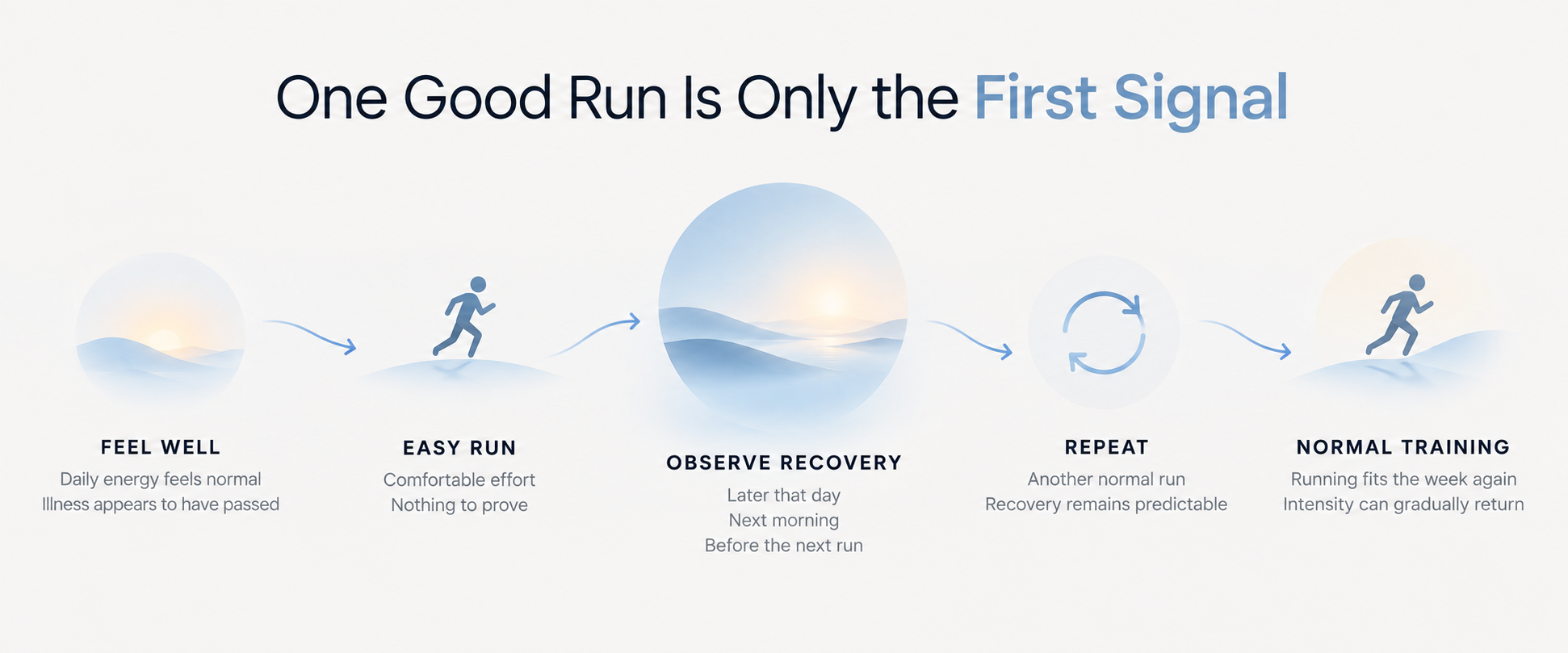
This is why I would deliberately make the first run easy to interpret. Keep the effort comfortable, avoid turning the final part into a test because you happen to feel good, and finish with enough left that the run itself is unlikely to dominate what happens afterwards.
The useful information often appears later.
How do you feel an hour or two after finishing? Does ordinary energy remain normal for the rest of the day? How do you feel the following morning? Does the run seem to have passed through the system normally, or has it brought back a level of fatigue that everyday activity had no longer been producing?
The Recovery Check Calculator fits naturally here because recovery after the session can tell you more than the pace you managed during it. At this stage, the question is not whether the run looked normal on the watch. It is whether your body treated it like a manageable return to training.
If everything feels ordinary afterwards, that is useful information. You can run again and gradually learn whether the response is repeatable. If the session leaves a disproportionate amount of fatigue or symptoms return, that is useful information too, and a reason not to progress simply because the run itself was completed successfully.
You do not need that first run to demonstrate that nothing has changed. You need it to make the next decision clearer.
Do Not Try to Recover the Missed Training
Feeling well enough to run is not always the same as being ready to train normally again.
Illness has an awkward way of making runners think about the training that did not happen.
A long run disappears. A workout gets skipped. Then another easy run goes. If the interruption lasts a week or two, the original training plan can begin looking noticeably different from what you actually completed. Once you feel better, there is a natural temptation to close that gap.
Perhaps the missed long run can move to this weekend. Maybe the faster session can return a few days later. If the first easy runs go well, the original schedule suddenly looks possible again.
But missed training does not remain somewhere waiting to be completed. The purpose of those sessions was to create a training stimulus at a particular point in a sequence of training and recovery. Once illness interrupts that sequence, simply inserting the missing sessions later does not restore the original plan. It creates a new concentration of training at the exact moment your body is also returning from being unwell.
This is one reason I would look at Build a Weekly Running Structure rather than trying to repair the old calendar. The first week back can be treated as a new training week with its own logic. What matters is how much running fits now, not how closely the schedule resembles the week you expected to have.
For a short illness, the difference may be small. A few easy runs may be enough before normal training naturally reappears. After a longer or more demanding illness, the transition may take longer. There is no need to decide in advance how many days the comeback is supposed to last.
Let the response to each run determine how quickly the structure returns. That also changes the way you think about lost fitness. Instead of trying to protect every adaptation you had before getting sick, you protect the conditions that allow training to become consistent again.
A missed week does not need to be rescued. The more useful goal is to make sure it remains only a missed week, rather than becoming the beginning of another interruption.
Let Easy Running Become Normal Before Hard Running Returns
The awkward part of returning after illness is that harder running can become possible before it becomes useful.
After a few easy sessions, you may notice that the legs have started to wake up. Pace looks more familiar, breathing feels controlled and the strange flatness of the first run has disappeared. If you had a tempo session or intervals in the schedule before getting sick, putting them back can begin to feel like the final step toward normal training.
I would give easy running a little more time to become unremarkable first.
The reason is not that faster running is inherently problematic after every illness. It is that intensity makes the response harder to interpret. If an easy run leaves you unusually tired, the signal is fairly clear. If a demanding session does the same thing, it becomes much harder to know whether you are seeing a normal response to hard training or evidence that recovery is not as complete as it seemed.
There is also little cost to waiting until several ordinary runs behave normally. Fitness does not disappear because a tempo session returns a few days later than originally planned. In fact, the easier running gives you something more valuable at this stage: evidence that your body can repeatedly tolerate exercise without symptoms returning or recovery becoming progressively more difficult.
The ideas in How to Know If a Hard Run Was Actually Productive become relevant once intensity does return. A hard session is not successful merely because you were able to complete the planned pace. It also has to fit into the training around it without creating a recovery cost that overwhelms its value.
When you reach that point, the first harder session does not need to reproduce the workout you missed. It can be shorter, more controlled and slightly less ambitious than what you were doing before the illness. If it goes well and the following days remain normal, there will be plenty of opportunities to build from there.
This is one of those moments when restraint can look unnecessarily conservative from inside the run. From the perspective of the whole training week, it often looks much more like continuity.
Watch the Days Between Runs, Not Just the Runs Themselves
One of the reassuring things about returning after illness is that the runs themselves may improve quickly. The first feels awkward, the second is better, and by the third or fourth you may be close enough to normal that there seems little reason to keep thinking about the illness at all.
But I would pay just as much attention to what happens between those runs.
When training is being absorbed normally, recovery tends to become predictable again. You finish an easy run, perhaps feel it slightly in the legs later that day, and by the time the next session arrives there is no real sense that the previous one is still demanding attention. Everyday energy remains normal and the training begins fitting back into life rather than sitting on top of it.
After illness, that pattern can sometimes lag behind the apparent improvement during the run. You may run perfectly well in the morning but feel unusually depleted later. Two individual runs can both look normal while the second leaves noticeably more fatigue than the first. The issue is not necessarily that either session was too difficult in isolation; the body may simply not be ready for the frequency with which you are asking it to repeat them.
This is where How to Tell If Your Training Load Is Too High (Without Metrics) becomes particularly useful. You do not need a single number to tell you that training is beginning to accumulate faster than you are recovering from it. The pattern across several days often makes that clear enough.
I think this is also why returning after illness benefits from resisting the urge to evaluate every run immediately. A good session is encouraging, but its full meaning is not available at the finish line. Give it time to become part of the next day, and then part of the next run.
If energy remains stable, normal recovery returns and each session seems to disappear into the week without leaving much behind, you can gradually stop treating yourself as someone returning from illness.
That transition does not need a formal test. At some point, the spaces between the runs simply start feeling normal again.
Your Pace May Return Before Your Training Capacity Does
Once recovery begins behaving normally again, pace can become very persuasive.
A familiar easy pace appears without much effort. Perhaps a few quicker kilometres feel surprisingly comfortable. If you use a watch, the numbers may already look close to what they showed before you became ill. That can create the impression that the interruption is essentially over.
In one sense, it may be. Your fitness may have survived the illness remarkably well, especially if the interruption was relatively short. But pace tells you what you can produce during a run. It does not tell you how much training you are ready to accumulate around that run.
This distinction matters because runners naturally use returning fitness. If the usual pace feels comfortable again, the next run becomes longer. If that goes well, frequency returns. Then the long run resumes, followed by the first proper workout. None of those decisions looks particularly aggressive, yet within a short period the entire training week can be back at its previous level.
The Training Load Check Calculator can be useful at exactly this point because it shifts attention away from one reassuring performance and toward what has changed across the whole week. Pace may be only one part of the increase. Distance, frequency and intensity can all be returning alongside it.
I would let familiar pace be encouraging without allowing it to make every other decision.
If an easy run naturally returns to its old speed, let it. You do not need to deliberately hold yourself back simply to make the comeback look cautious. But there is a difference between allowing fitness to show itself and immediately spending that fitness on more training.
Give the week time to catch up with the run. When familiar pace, normal recovery and repeatable training begin appearing together, there is much less reason to think of yourself as returning at all. You are simply training again.
Until then, the watch can tell you something useful. It just cannot tell you the whole story.
Conclusion
Feeling well enough to run is not always the same as being ready to train normally again.
Returning to running after illness is different from returning after an ordinary break because fitness is not the first question.
Recovery is.
Once you feel well again, it is tempting to judge the return by familiar running signals. Pace comes back, breathing settles and a few normal-looking runs can make the interruption seem finished. Sometimes it almost is.
But there is no advantage in asking the first few runs to prove that.
Let them give you information instead. Notice how running feels, but also notice what happens later that day and the following morning. Allow easy running to become repeatable before harder sessions return, and rebuild the training week from what your body is absorbing now rather than from the sessions illness removed from the calendar.
The practical side can remain uncomplicated too. Most of the return will happen through ordinary comfortable running, so a versatile daily trainer is usually all that is required. That is the kind of role covered in Best Running Shoes for Daily Training 2026, rather than equipment built around workouts you may not yet need.
Eventually, the distinction disappears. A run no longer needs to be evaluated because you recently had an illness. Recovery feels ordinary, another run fits naturally into the week and harder training no longer feels like an experiment.
There does not need to be a particular day when you declare yourself back. Training simply becomes training again.
Frequently Asked Questions
When can I start running again after being ill?
There is no universal number of days because illnesses and recovery vary considerably. The first question is whether you have recovered sufficiently for exercise to be appropriate at all. If significant symptoms persist, particularly chest pain, unusual shortness of breath, fainting or palpitations, seek medical advice rather than using a run to test whether you are ready.
Should my first run after illness be shorter?
Often that makes the return easier to interpret. A comfortable run that finishes with plenty left gives you an opportunity to observe both the session and your recovery afterwards without creating unnecessary training stress.
Is it normal to feel slower after being sick?
It can be. Running may temporarily feel less economical, energy may still be returning and several inactive days can make the first sessions feel unfamiliar. One slower run tells you very little about how much fitness you have actually lost.
What if my first run feels completely normal?
That is encouraging, but there is no need to immediately compensate by making the next run longer or harder. See whether recovery is normal and whether another ordinary run produces the same response. Repeatability provides more information than one particularly good return run.
Why is my heart rate higher after illness?
Heart rate can be influenced by many things around an illness and recovery, including reduced fitness, hydration, sleep, temperature and residual physiological stress. A single unusual reading is difficult to interpret in isolation. If an abnormal heart-rate response is persistent or accompanied by concerning symptoms such as chest discomfort, unusual breathlessness, fainting or palpitations, stop exercising and seek medical advice.
How much fitness will I lose during a week of illness?
A short interruption does not automatically erase the fitness you built beforehand. What matters more during the return is not trying to quantify exactly what was lost, but observing how normal running is being tolerated now.
Should I make up the workouts I missed while sick?
No. Those sessions belonged to a training sequence that was interrupted. Trying to compress them into the return can increase training load just as your body is resuming exercise. Build forward from your current capacity instead.
When can I start tempo runs or intervals again?
Rather than choosing an arbitrary number of days, look for ordinary running to become predictable first. Easy runs should feel manageable, recovery should behave normally and several sessions should fit together without increasing fatigue. Faster training can then return progressively.
What if I feel worse again after returning to running?
Do not treat the planned schedule as something that must continue. Step away from training and reassess the situation. If symptoms recur, worsen or include concerning cardiovascular or respiratory symptoms, medical evaluation is more appropriate than continuing to test yourself through exercise.