
Returning After Burnout
After burnout, the first thing to rebuild may not be fitness. It may be your willingness to run without needing the run to achieve something.
There is a particular kind of running break that does not begin because you cannot run.
You may still be fit. Nothing necessarily hurts. There may even be a training plan sitting on your phone telling you exactly what you are supposed to do that afternoon.
You simply do not want to go. At first, that can look like ordinary tiredness. You skip one session, then feel guilty about skipping it. The next run gets completed, but mostly because leaving another empty space in the training log would feel worse. Eventually, even runs that used to give structure to the week begin to feel like tasks that need to be cleared.
For some runners, stepping away becomes the only part that feels easy. Returning from that kind of break is different from rebuilding after winter or several months without exercise. Fitness may have declined, but recovering fitness is not necessarily the hardest part. The more complicated question is whether you are about to recreate the same relationship with running that made you want to stop.
That is why I would resist beginning with mileage, pace or a new goal. There will be time for all of them later.
The first useful question is much simpler: what kind of running would you be willing to do if it did not need to improve anything yet?
Perhaps that means twenty or thirty minutes with no workout attached. Perhaps you leave the familiar training route and run somewhere different. Maybe you stop at the point where you still feel like continuing rather than extending the session because the schedule says forty-five minutes.
The idea is not to make running permanently unstructured. Structure can be extremely useful, and Build a Weekly Running Structure exists for exactly that reason. But structure works best when it supports training rather than becoming the reason every run has to happen.
After burnout, I think that distinction deserves some space. You do not need the first runs back to demonstrate discipline. You need to find out whether running can become something you are willing to return to again.
Do Not Turn the Comeback Into Another Project
Once the first few runs begin feeling good again, an experienced runner can rebuild structure remarkably quickly.
Three runs become four. A weekly target appears. You start thinking about the long run again, then perhaps a race. Before long, there is a perfectly sensible training week on the calendar and progress is measurable again.
None of those things is inherently a problem. The difficulty is that this process can recreate the old pressure before you have had time to notice whether your relationship with running has actually changed.
Burnout often develops gradually enough that the behaviours around it once looked productive. You completed the session even when motivation was low. You protected consistency. You kept the weekly volume where it was supposed to be. A tired day became something to manage rather than a reason to reconsider the training itself.
Those habits can be valuable when they exist inside healthy training. They become less useful when every decision begins serving the plan rather than the runner.
This is why I would be careful about making the return itself into a new performance goal. There is no prize for reaching five running days again quickly, and no particular value in seeing how soon your old mileage can be restored. Even a beautifully designed comeback plan can become another obligation if success is defined by how faithfully you complete it.
For a while, Today’s Run Decision Calculator can be more useful than a rigid schedule because it brings the decision back to the present. You can still have structure, but today’s run is allowed to reflect today’s capacity rather than existing only because it was decided several weeks ago.
That does not mean waiting for perfect motivation before every session. No runner feels enthusiastic about every run, and ordinary reluctance is part of long-term training. The distinction is more about the pattern. One day of not wanting to run tells you very little. Repeatedly negotiating yourself into training while feeling relieved whenever a session is cancelled tells you something more interesting.
I think that is worth listening to during a return. The goal is not to remove discipline from running. It is to make sure discipline has something worth protecting.
Leave Some Runs With Nothing to Prove
One of the easiest ways for burnout to return is for every run to acquire a purpose.
The easy run has to build aerobic fitness. The long run has to improve endurance. The tempo session has to move threshold pace. Even recovery running can become something that needs to be executed correctly. None of those ideas is wrong, but when every kilometre has a training justification, running can gradually lose the space in which it is simply something you do.
After burnout, I think some of that space is worth deliberately bringing back.
A run can be useful without becoming evidence of progress. You can choose the route because you like it, turn around earlier because the weather is unpleasant or continue a little farther because the evening is good and the legs feel light. The watch can record the session without becoming the judge of whether it was worthwhile.
This does not mean that data itself caused the problem. Pace, heart rate and training load are useful tools when they answer questions you actually have. The difficulty begins when the numbers create questions that would not otherwise matter. A relaxed run suddenly looks disappointing because pace was slower than usual, or a perfectly enjoyable week feels incomplete because the total distance finished below a familiar number.
That is where Why You Should Not Judge Fitness From One Workout becomes relevant for a slightly different reason than usual. After burnout, the value of separating one run from your broader fitness is not only physiological. It also removes some of the pressure for every session to confirm that you are still progressing.
There will be time to care about performance again if performance is something you want.
For now, leaving a few runs without a test attached to them can reveal something more important: whether running itself still has a place in your life when the numbers stop rewarding you for doing it.
That is not wasted training. It may be the part that makes the rest of the training sustainable again.
Rebuild Choice Before You Rebuild Obligation
There is a useful difference between deciding to run and feeling that you have to run.
During normal training, the distinction often becomes invisible. You have chosen a goal, the goal requires a certain amount of work, and some sessions will happen because they are scheduled rather than because you particularly want to do them. That is part of training, and usually there is nothing unhealthy about it.
After burnout, however, returning immediately to that relationship can be too familiar.
If Monday is easy, Wednesday is a workout and Sunday is long, the week may look reassuringly normal. But it can also remove the small decisions that help you rediscover what you actually want from running now. Before long, you are once again completing a schedule that was designed by a version of you who may have wanted something different.
This is why I would allow more choice into the early weeks than you might normally tolerate in structured training. Not unlimited choice, and not the idea that every run should depend on motivation. Just enough flexibility that running does not immediately become a sequence of appointments with yourself.
Perhaps you plan three opportunities to run rather than three sessions that must be completed exactly as written. One day you run longer because it feels natural. Another day thirty easy minutes is enough. Occasionally, not running may be the better decision, without requiring you to compensate for it later in the week.
The framework in Should You Run Today or Rest? (Simple Decision Framework) can help separate that kind of adjustment from simply abandoning training whenever enthusiasm is low. Rest and flexibility still work best when they are decisions rather than reactions to guilt or avoidance.
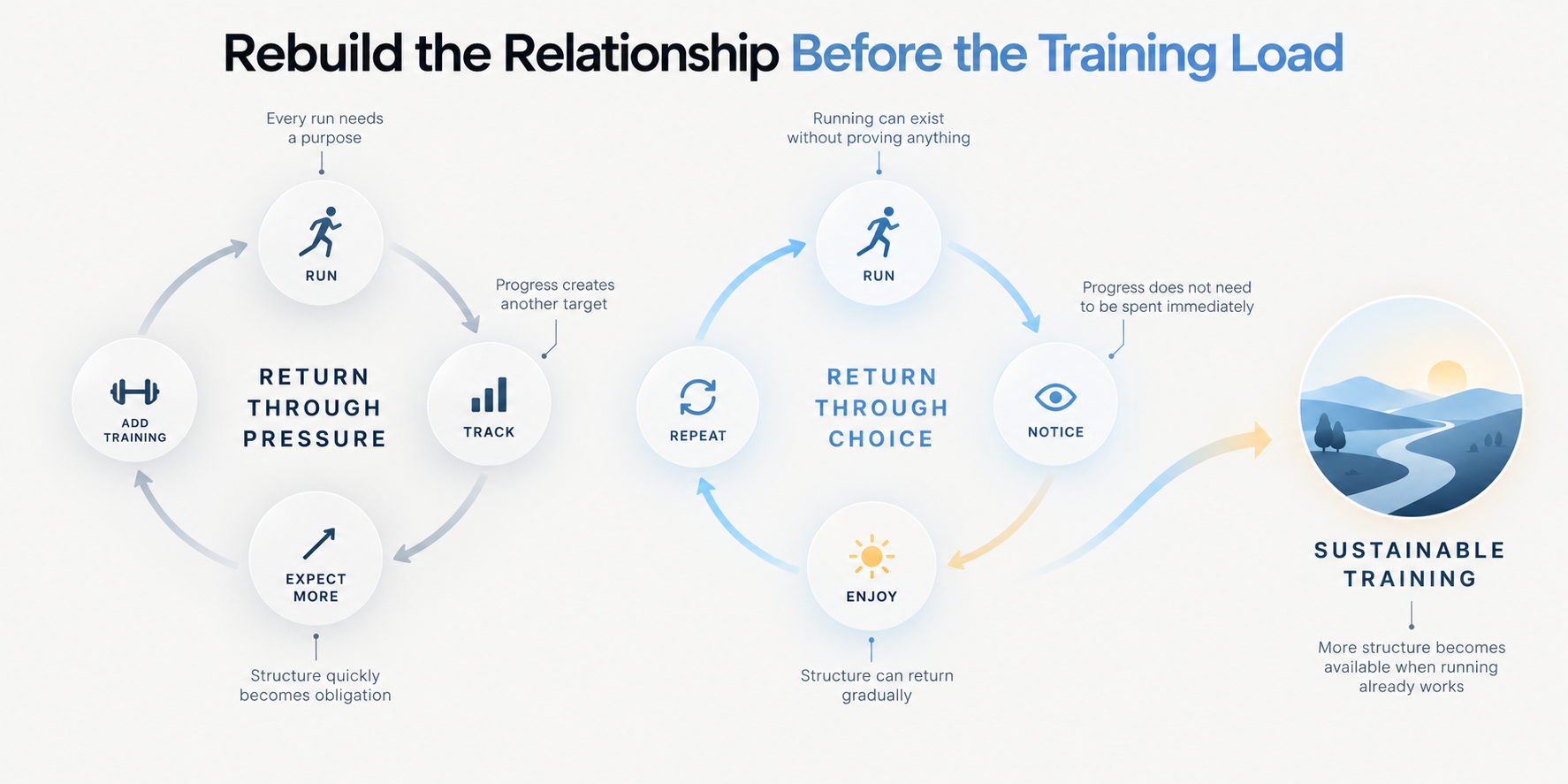
Over time, something interesting can begin to happen. The choices become less necessary because you start choosing running repeatedly anyway. A longer run returns because you miss it. A little faster running appears because moving quickly feels interesting again. Structure begins forming around behaviour that already exists rather than being imposed in the hope that motivation will eventually follow.
That is a much stronger place from which to rebuild training.
Eventually, obligation will return in small amounts. It belongs in serious training. But it works much better once running has become something you would choose even without it.
Do Not Rush to Replace Burnout With a New Goal
A new goal can make returning to running feel wonderfully clear.
You enter a race, choose a target and suddenly the week has direction again. Runs that recently felt optional now have a reason to happen. There is a long run to build, workouts to introduce and enough weeks on the calendar to create a satisfying sense of progression.
For some runners, that can be exactly what brings the enjoyment back. But I would be careful about using a goal to solve the uncertainty too early.
Goals are very good at creating motivation from the outside. A race date does not care whether you feel particularly interested in running on Tuesday; it gives Tuesday a purpose anyway. That can be helpful, but it can also hide whether the underlying relationship with training has recovered. You may become highly consistent again without ever discovering whether you actually wanted to return to that kind of consistency.
The distinction becomes clearer if you spend some time running before choosing the next target. You begin noticing which parts return on their own. Perhaps you genuinely miss the long run but have little interest in structured intervals. Maybe running four times a week feels satisfying while the old six-day schedule now seems unnecessary. You may even discover that you enjoy running more when there is no race continually turning the present week into preparation for a future one.
This is where Should Beginners Follow a Training Plan? contains a principle that applies well beyond beginners: a plan should reduce unnecessary decisions without removing the runner’s ability to respond to what is actually happening. After burnout, that balance becomes especially valuable.
None of this means racing or ambitious training should disappear. A goal that begins to feel exciting again can be a very good sign. The important difference is where it comes from.
There is a world of difference between choosing a race because you have started enjoying running and want to see where it can take you, and choosing a race because you need something powerful enough to force yourself back into training.
The calendar may look almost identical in both cases. The relationship underneath it is not.
Let Progress Return as a Consequence
A successful return is not when you can tolerate your old training again. It is when running feels sustainable enough that you want it to continue.
At some point, the runs begin joining together again.
You are no longer negotiating with yourself before every session. A missed run does not create guilt, but neither are you continually looking for reasons to miss one. Some weeks contain more running than others, yet the overall pattern has started to become recognizable.
This is where progress can quietly return without needing to become the centre of the comeback.
You may notice that an easy route is taking slightly less effort. A run that naturally lasted forty minutes begins stretching toward an hour. The longer run you stopped caring about starts becoming enjoyable again. Perhaps one afternoon you feel like running faster, not because the schedule demands a workout but because the body feels ready to move.
These changes are worth noticing. You simply do not have to spend them immediately.
The Run Effort Check Calculator can be useful here because it gives you a way to observe how running is changing without turning every improvement into a new target. If the same kind of run is becoming more manageable, that is already progress. It does not automatically require another running day, a faster pace or a larger weekly total.
I think this matters particularly after burnout because traditional signs of improvement can easily reactivate the old logic. Fitness improves, so training increases. Training goes well, so the goal becomes more ambitious. The goal becomes more ambitious, so more of the week needs to serve it. None of those steps is unreasonable, but together they can gradually recreate the environment you were trying to leave.
There is another option.
Fitness can improve while the training remains roughly the same for a while. You can become capable of more without immediately requiring more from yourself. That unused capacity creates room inside the week, and room is often exactly what was missing before the break.
Eventually, you may decide to use some of it. The long run grows, a workout returns or another race starts looking genuinely interesting. This time, however, progression is following a relationship with running that is already working.
That is a different kind of progress from rebuilding a pace or weekly mileage. After burnout, it may be the one that matters first.
Conclusion
A successful return is not when you can tolerate your old training again. It is when running feels sustainable enough that you want it to continue.
Returning after burnout is not primarily a question of how quickly you can rebuild fitness.
You may discover that fitness comes back quite easily. The body remembers running, familiar paces reappear and within a relatively short time you could probably recreate much of the training you used to do.
That does not necessarily mean you should.
The more useful part of the return is noticing what happens when running is allowed to exist without immediately becoming another project. A few runs have no performance target. The weekly structure remains flexible enough that missing one session does not create a debt. Progress appears, but you do not automatically convert every improvement into more training.
Gradually, running can become something you choose again rather than something you continually manage.
The practical side does not need much complexity during this period either. Comfortable everyday running is enough, and a versatile daily trainer can cover most of it. Best Running Shoes for Daily Training 2026 explores that kind of shoe without requiring your return to revolve around workouts or racing.
There may eventually be another training plan. There may be races, ambitious goals and weeks when discipline matters more than motivation. None of those things is incompatible with a healthy return from burnout.
The difference is that they no longer need to arrive first. You do not need to become less serious about running.
You may simply need to rebuild a version of serious running that leaves enough space for you to keep wanting to do it.
Frequently Asked Questions
How do I know if I am burned out from running?
Running-related burnout can show up as a persistent loss of interest in training, repeated reluctance to run, feeling relieved when sessions are cancelled, or experiencing the training plan mainly as an obligation. A few unmotivated days are normal and do not by themselves mean burnout. If low mood, exhaustion or loss of interest extends well beyond running or significantly affects everyday life, it is worth discussing that with a qualified health professional rather than assuming training is the only cause.
How long should I stop running after burnout?
There is no universal recovery period. Some runners may benefit from a relatively short period without structured training, while others need substantially longer before they genuinely want to return. The more useful signal is not a predetermined number of days but whether the desire to run begins returning without needing to be forced.
Should I stop running completely?
Not necessarily. For some runners, removing structured workouts, mileage targets and performance expectations is enough to change the experience. Others may benefit from stepping away from running entirely for a period. The appropriate response depends on what running currently feels like and whether continuing it is helping or reinforcing the same pattern.
Will I lose fitness if I take time off?
Some running fitness may decline, particularly during a longer break. That does not automatically make the break a mistake. Fitness can be rebuilt. If maintaining every part of your current fitness requires continuing a form of training you no longer feel able to sustain, preserving the numbers may not solve the underlying problem.
Should I track pace and heart rate when I return?
You can, but the data does not need to determine whether a run was successful. If tracking immediately pulls your attention back toward comparison, targets and performance, temporarily giving those numbers less importance may make the return easier to interpret.
Should I follow a training plan after running burnout?
Eventually, perhaps. Structure can be extremely helpful once regular running feels sustainable again. Early in the return, however, some flexibility may help you understand what kind of running you currently want and can absorb before a formal plan begins making those decisions for you.
When should I start doing hard workouts again?
There is no fixed timetable. First allow ordinary running to become something you can repeat without continually negotiating yourself into it. Faster training can return when it feels like a useful addition to running that is already working rather than a requirement for making the comeback legitimate.
Should I enter a race to motivate myself?
A race can provide enjoyable direction, but it does not have to be the mechanism that forces you to resume training. It may be more useful to let some regular running return first and see whether racing begins to feel genuinely appealing again.
Can I become a serious runner again after burnout?
Yes, but serious running does not have to mean recreating every feature of your previous training. You may eventually return to similar mileage and goals, or you may build something different. The more important question is whether the new structure remains sustainable enough to continue.