
Should Beginners Follow a Training Plan?
A beginner training plan should create consistency without turning every scheduled run into an obligation.
Starting running without a plan can feel strangely incomplete. You decide that you want to become a runner, go out for your first few runs and then realize that almost immediately you have decisions to make.
Should you run again tomorrow? Should the next run be longer? How many times should you run this week? When do you stop walking? At what point are you supposed to start running faster?
A training plan seems to solve all of this.
Monday says run. Wednesday says run-walk. Saturday says twenty-five minutes. Next week the numbers increase slightly. Suddenly, instead of negotiating with yourself every morning, you know what to do.
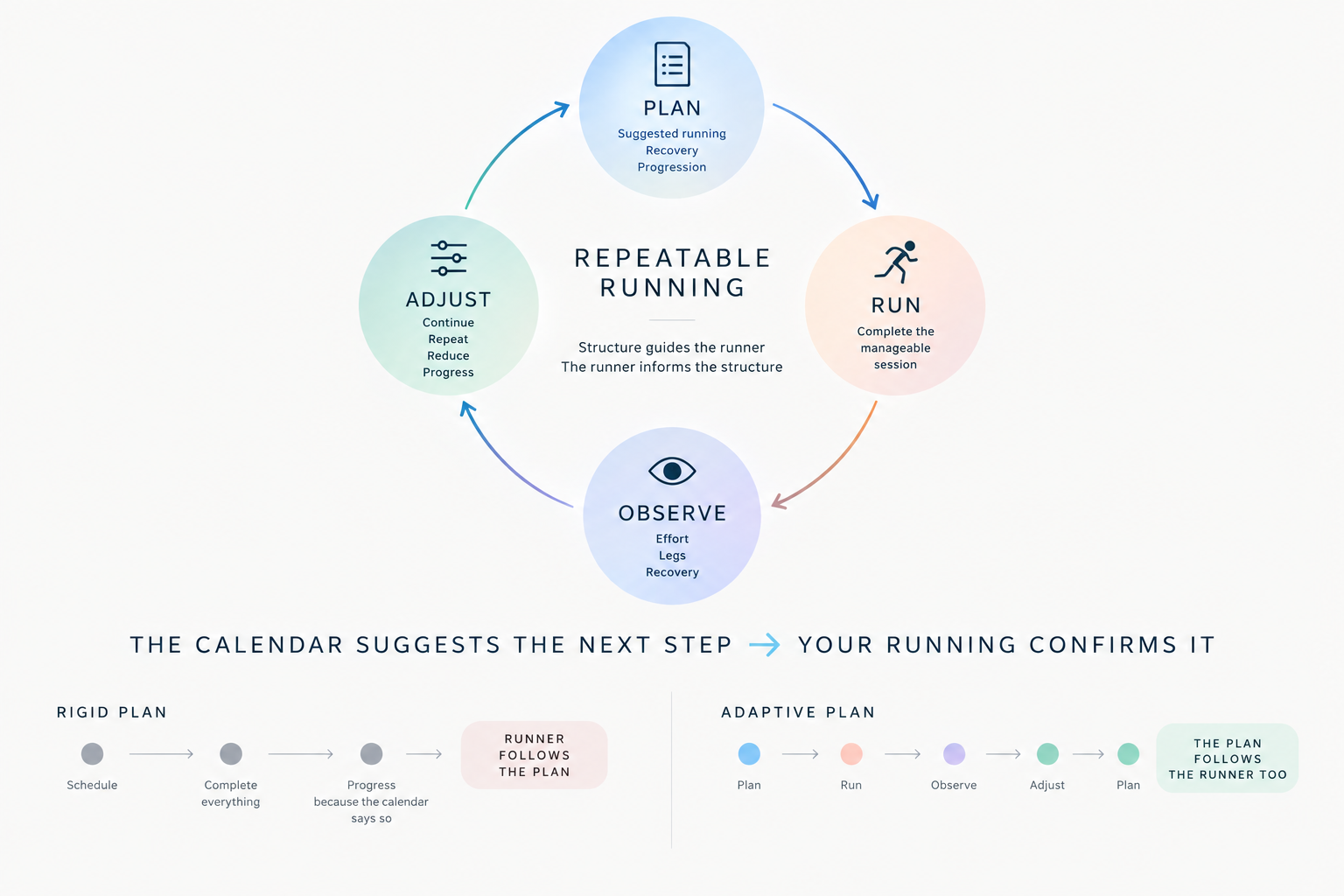
That can be extremely useful. But I think a beginner training plan becomes less useful the moment its authority becomes greater than the information coming from the runner following it.
Imagine that Saturday says thirty minutes. You slept poorly. Your calves still feel unusually tight from Thursday and the first ten minutes of running feel heavier rather than better.
The plan still says thirty minutes. It is easy to interpret completing those thirty minutes as discipline and stopping early as failing to follow the programme.
But the calendar cannot feel your legs. That is the limitation worth understanding from the beginning. A good training plan provides structure. It spaces running across the week, controls progression and removes some of the temptation to turn every good day into a bigger run.
The principles in Build a Weekly Running Structure are useful for exactly this reason: the purpose of structure is to organize training demands and recovery, not to make every individual session untouchable.
For a beginner, I would want a plan to answer a few broad questions. When do I normally run? Roughly how much running am I doing? How quickly is that amount changing?
Everything else should still have some flexibility. Because during the first months, the plan is not the only thing being developed. You are also learning what kind of runner the plan needs to work for.
A Plan Cannot Know How Quickly You Will Adapt
Beginner training plans have to make an assumption that your body cannot promise to follow. They have to predict the future.
Week one contains a certain amount of running. Week two adds a little more. Perhaps the walking breaks become shorter in week three, and by week five the continuous running periods are noticeably longer.
On paper, the progression looks beautifully logical. Your adaptation may not. You might find the first two weeks surprisingly difficult and then make a large jump in comfort during the third. Someone else may improve aerobically very quickly while their calves continue needing more time between runs. Another beginner might repeat the same run-walk pattern for several weeks before it suddenly begins to feel ordinary.
None of them is necessarily progressing incorrectly. The calendar simply cannot know in advance when a particular amount of running will become easy to absorb.
This is why I would be cautious about treating progression written into a plan as something that must happen simply because another Monday has arrived.
The principle in How To Increase Weekly Running Volume Safely? works just as well before a beginner thinks of their running in terms of mileage at all. Progression makes more sense when the current amount of running has become repeatable than when it is triggered only by the passage of time.
Sometimes that means repeating a week. Nothing has gone wrong. You are giving the adaptation more time to catch up with the schedule. At other times, a plan may feel almost too conservative. Running is going well, recovery is easy and you suspect you could move ahead faster.
Even then, I would resist jumping several stages simply because more running appears available today. The value of a plan is partly that it protects you from your good days as well as your difficult ones. It gives progression some restraint. What it should not do is pretend that every runner adapts according to the same calendar.
A plan can suggest when the next step might happen. Your running tells you whether that step has actually become useful.
A Training Plan Should Reduce Decisions, Not Remove Them
One of the best things a training plan can do for a beginner is make running less mentally expensive. Without any structure, every run creates another decision.
Should I go today? How long should I run? I felt good yesterday — should I add another kilometer? My legs are tired — am I making excuses if I stay home?
A simple plan removes much of that negotiation. You already know that Tuesday and Saturday are normally running days. You have a rough idea of how long those runs will be, and you are not inventing a new progression every time you feel particularly motivated.
That is useful structure. But there is a point where structure can become obedience. Tuesday says run, therefore you run. Thirty minutes are scheduled, therefore thirty minutes must be completed. The plan says the walking interval disappears this week, therefore you keep running even though the session has become much harder than the previous ones.
Now the plan is no longer reducing decisions. It is making them for you.
I would rather see a beginner gradually develop enough judgement to modify the edges of the plan without feeling that the plan has been broken. The Today’s Run Decision Calculator can be useful while that judgement is still developing because it brings recent training, recovery and how you actually feel today back into the decision.
Perhaps today’s thirty-minute run becomes twenty.
Perhaps you walk during a section that was supposed to be continuous.
Perhaps nothing is obviously wrong, but the legs feel unusually poor and the run moves to tomorrow.
None of those decisions destroys the structure. The next week can still look remarkably similar. This distinction matters because eventually no training plan can anticipate everything that happens around running. Work becomes busy. Sleep is poor. Travel interrupts a week. A run unexpectedly feels wonderful. Another feels terrible for no obvious reason.
A runner needs to be able to live inside that uncertainty. The plan should provide enough structure that you do not have to reinvent your training every day. But it should leave enough space for you to remain the person making the decisions. That is not failing to follow a training plan. It is beginning to learn how to use one.
Do Not Choose a Plan Because It Promises a Finish Line
Beginner plans are often built around destinations. Run your first 5K. Run continuously for thirty minutes. Complete eight weeks.
Those goals can be motivating because they make progress visible. Instead of simply hoping that running becomes easier, you can see yourself moving through a sequence toward something recognizable.
The problem begins when the destination starts determining the speed of the journey.
Suppose a plan is designed to take you from run-walk intervals to thirty minutes of continuous running in eight weeks. By week six, you can run continuously for twenty minutes, but it still feels considerably harder than the shorter periods did a few weeks earlier.
The plan now has two more weeks available. Your body does not know that. There is nothing physiologically important about arriving at thirty minutes on the final Sunday rather than two weeks later.
I think this is where some beginner plans accidentally turn a useful direction into a deadline.
Continuous running is a good example. Removing walking breaks looks like obvious progress, so there is a temptation to remove them according to the schedule even when they are still doing something useful. In How to Start Running When You Can’t Run for Five Minutes, the important transition is not reaching a particular uninterrupted duration. It is allowing the running periods to grow because they are becoming easier to handle.
The same applies to distance. A 5K plan does not make five kilometres the amount your body needs to be able to run by a particular date. It simply gives the training a destination.
Those are very different ideas. A finish line can help organize a plan. It should not be allowed to hurry the adaptation required to reach it. And for a beginner who is not preparing for an actual race, there is rarely any reason for the calendar to win that argument.
The Best Beginner Plan Has Room to Repeat Itself
A beginner training plan should create consistency without turning progression into a weekly obligation.
Progression makes training plans look purposeful. A little more running next week. A little less walking. Another few minutes added to the weekend run. Without those changes, it can seem as though the plan has stopped doing its job. But repetition is often where the useful part of beginner training is actually happening.
Imagine that you run for twenty minutes on Tuesday and twenty minutes again on Saturday. The following week looks almost identical. Nothing new appears on the calendar. Inside the runner, however, quite a lot may be changing. The impact is becoming more familiar. The movement requires slightly less conscious effort. Breathing may settle sooner. The legs may recover more quickly afterwards.
This is one reason I would be suspicious of any beginner plan that needs to become more demanding every week simply to demonstrate progress. Sometimes the best progression is to leave the training alone long enough for the runner to catch up with it. That becomes especially important when running starts going well. Feeling better creates a very natural desire to use the improvement immediately: run farther, add another day, remove the walking break. But the Training Load Check Calculator can be useful here because several individually small changes can create a much larger increase in total demand than they appear to on the calendar.
A good plan does not need to keep proving that you are improving. It can contain weeks that look almost boringly similar. In fact, those may be some of its most valuable weeks.
The purpose of repeating a week is not to wait until you are capable of surviving something harder. It is to give the current amount of running time to become familiar. Once it does, the next step often becomes surprisingly obvious. You are no longer forcing the plan forward. The plan simply has somewhere to go.
A Beginner Plan Does Not Need Many Different Workouts
Once a training plan looks official, there is a temptation to make it look like training.
An easy run appears on Tuesday.
Intervals arrive on Thursday.
The weekend gets a longer run.
Perhaps there are strides, hills or tempo running somewhere in between.
For an established runner, separating training into different demands can make sense. For someone still adapting to running itself, the distinction is much less important.
Running is already the stimulus.
You are learning to tolerate the impact, coordinate the movement, regulate effort and recover well enough to do it again. An ordinary manageable run can provide plenty for the body to adapt to without needing another purpose attached to it.
I think beginners sometimes underestimate this because repetition does not look sophisticated. Three relatively similar runs during a week can appear less like a training programme than a schedule containing several named workouts.
But complexity is not the same as structure. If you are still unsure whether today’s ordinary run should be easy, moderate or hard, How to Decide Between Easy, Moderate, or Hard on Any Day provides a useful framework for understanding those differences. That does not mean a beginner needs all three immediately.
There is plenty of time for training to become more varied. As ordinary running becomes familiar, you may naturally begin running a little longer on one day. Later, faster running can become a deliberate training stimulus rather than something that accidentally happens during every run.
The important part is that each new type of training should solve a problem that actually exists.
Do not add intervals because a training plan looks incomplete without them.
Do not create a long run simply because runners are supposed to have one.
And do not make one day harder merely to make another day easy.
At the beginning, a remarkably simple plan can be enough: running that is manageable, recovery that is sufficient, and enough repetition for the body to learn from both.
The sophistication can come later. The adaptation cannot be rushed.
Conclusion
So, should beginners follow a training plan? I think many should. Not because a plan knows exactly what your body needs eight weeks from now, but because starting to run involves enough uncertainty already.
A plan can give the week shape. It can stop every good run from becoming an excuse to do more. It can remind you that recovery belongs between running days. It can create a progression that is calmer than the one you might invent while feeling particularly motivated.
That is valuable. But the plan works best when you understand what it actually is.
It is a framework for making running repeatable. It is not a contract requiring you to complete every minute, reach every distance or progress on every date printed on the page.
Some weeks you will repeat. Some runs will become shorter. Occasionally you will walk when the plan says run. And sometimes you will feel ready for more but still leave the plan exactly where it is for another week. None of this makes the plan less successful. It may be evidence that you are beginning to understand your own training rather than simply completing someone else’s instructions.
The same simplicity applies to equipment. Beginners do not need a different shoe for every type of workout, particularly when most of the training is still ordinary, manageable running. Best Running Shoes for Daily Training 2026 looks at versatile shoes designed around exactly that kind of repeated everyday use.
Eventually, your training may become more complicated. You may develop goals that require more specific workouts. You may prepare for races. You may learn that your body responds particularly well to certain patterns of training and poorly to others.
A plan can become more precise as the questions become more precise. At the beginning, it does not need to predict the runner you will become. It only needs to help you keep running long enough to find out.
Frequently Asked Questions
Do beginners need a running training plan?
No. You can start running successfully without following a formal programme. A simple weekly structure with manageable running and sufficient recovery may be enough. A plan becomes useful when it removes uncertainty and helps prevent progression from becoming too aggressive.
What should a beginner running plan include?
A beginner plan should primarily organize running, recovery and gradual progression. It does not need many different workout types. Early running itself provides a substantial training stimulus, so simplicity can be an advantage.
How many days a week should a beginner training plan have?
There is no single number that suits every beginner. Two or three running days can provide plenty of repeated exposure at first, particularly when you are still learning how well you recover between runs. The Recovery Check Calculator can help you interpret that recovery rather than assuming another scheduled day is automatically appropriate.
Is it okay to repeat a week in a training plan?
Yes. Repeating a week can be a sensible form of progression because it gives your body more time to become familiar with the current training load. The calendar does not need to become harder every week for adaptation to continue.
What if I cannot complete a scheduled run?
One incomplete run does not mean the plan has failed. Shortening the session, adding walking or moving the run to another day may be more useful than forcing the planned session when your body is responding unusually poorly.
Should beginners follow a Couch to 5K plan?
A Couch to 5K-style plan can provide useful structure, particularly when run-walk intervals make continuous running difficult. The important part is not treating the programme’s final 5K or continuous-running target as a deadline your body must meet on schedule.
When should a beginner stop following a training plan?
There does not need to be a specific moment. As you become better at judging effort, recovery and progression, you may find that you need fewer instructions from the plan. Some runners continue using structured plans; others gradually build their own weekly structure.
Should beginner training plans include speed work?
Not necessarily. Beginners can improve considerably through consistent manageable running alone. Faster workouts can be introduced later when ordinary running has become familiar and there is a clear reason to add a different training stimulus.