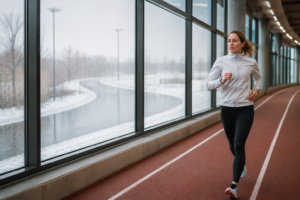
I think indoor track running creates a strange first impression. Everything looks familiar. There is still a track beneath your feet. The lanes are clearly marked. The surface feels fast and predictable. You can run intervals, easy laps, or steady efforts without worrying about traffic, weather, or uneven ground.
And yet, within a few minutes, the experience starts feeling noticeably different. The curves arrive much sooner. The laps pass more quickly. Other runners seem closer. Pace can feel easier to control, while direction changes and repeated turns become much more noticeable than they ever would on an outdoor track.
For runners who are used to roads or a standard 400-metre stadium, an indoor track can initially feel almost too compact.
I have started noticing that this is where many runners become unsure how to interpret the experience. They wonder whether indoor track running is faster, harder on the body, better for intervals, or simply a more convenient version of outdoor training. The answer is not found in one of those ideas alone.
An indoor track is its own training environment. It offers remarkable control, reliable footing, and freedom from weather. At the same time, shorter laps, tighter curves, lane differences, and repeated directional loading change how the run feels and how the body responds.
Understanding those differences makes indoor track running much easier to use well. Because the goal is not to make an indoor track behave like a road or an outdoor stadium.
The goal is to understand what this environment does especially well—and what deserves a little more attention once the laps begin adding up.
Why Indoor Tracks Feel Different
One thing I’ve started noticing is that runners often expect an indoor track to feel exactly like an outdoor one. After all, both are tracks. Both have lanes. Both are designed for running. The differences seem small until you begin moving.
The most obvious change is the size.
Many indoor tracks are 200 metres long instead of the 400 metres found outdoors. That means twice as many bends, more frequent lap counting, and a rhythm that feels subtly different from the very first kilometre.
Those repeated curves are not simply a visual difference. They ask your body to make small directional adjustments much more often. Your inside and outside legs never work in perfectly identical ways through a bend, and although each individual curve feels insignificant, hundreds of them during a longer session gradually become part of the training load.
I’ve started noticing that runners often describe indoor track running as feeling surprisingly smooth while also feeling unexpectedly repetitive.
I think those two impressions come from the same source. The surface is remarkably consistent. The movement pattern is remarkably repetitive.
Unlike roads, there are almost no unexpected interruptions. Unlike trails, there are very few surprises. Everything encourages a steady rhythm that can make structured workouts feel exceptionally controlled.
To me, this is one of the biggest strengths of an indoor track. It removes many external distractions while preserving the natural feel of running on a track rather than on a treadmill. That balance makes it a unique training environment rather than simply a substitute for something else.
This idea connects naturally to Why Treadmill Running Feels Different, because both environments remove some variables while introducing others, changing how the run feels without fundamentally changing the purpose of the workout.
Which Workouts Work Best On An Indoor Track?
One thing I’ve started noticing is that an indoor track rewards consistency. The controlled environment removes many of the small interruptions that naturally occur outside. There are no traffic lights, no changing weather, and no unexpected hills. Once you settle into your rhythm, it becomes remarkably easy to repeat the same effort lap after lap.
That makes certain workouts feel almost perfectly suited to an indoor track.
Tempo runs are a good example.
Holding a comfortably hard effort for twenty or thirty minutes becomes much simpler when nothing interrupts your rhythm. Instead of constantly adjusting to changing conditions, you can focus entirely on your breathing, cadence, and pacing.
Interval sessions benefit for the same reason.
The predictable environment makes it easier to compare repetitions, recoveries, and pacing from one session to the next. Small improvements become much easier to notice because fewer outside variables are influencing the workout.
I’ve started noticing that indoor tracks are also excellent for winter easy runs. When roads become icy or snow-covered, many runners instinctively slow down or shorten their stride without even realizing it. On an indoor track, your natural running mechanics remain much closer to what they would be on a normal road or stadium surface.
That consistency allows the workout to stay true to its original purpose. I honestly believe this is one of the greatest strengths of indoor track running. It allows the quality of the session to remain remarkably stable, even when the weather outside changes completely.
To me, that makes an indoor track much more than a winter convenience. It becomes a place where structured training can continue almost exactly as planned throughout the entire season.
This idea connects naturally to Best Types of Workouts for a Treadmill, because both environments excel when the goal is to protect the quality and consistency of a workout rather than simply finding somewhere to run.
Why Indoor Tracks Feel Different
Natural Running
Controlled Environment
with the consistency of a controlled environment.
The Small Things Worth Paying Attention To
I honestly believe that one of the biggest advantages of an indoor track is also one of the few things that deserves a little respect. The repeated curves. A single bend is insignificant. Hundreds of bends during a long session are something else.
Because most indoor tracks are 200 metres long, you spend a much larger proportion of every run negotiating turns than you would on a standard outdoor track. That means your body repeats the same subtle movement pattern over and over again.
Most runners never notice it during one workout. Over weeks of training, however, those small asymmetries can gradually become part of the overall training load.
I’ve started noticing that experienced runners naturally reduce this effect in simple ways. When the facility allows it, they occasionally change running direction during easy runs or warm-ups. Others alternate lanes between workouts, allowing the body to experience slightly different turning radii over time.
The goal is not to eliminate the curves. They are simply part of indoor track running.
The goal is to avoid asking exactly the same muscles, tendons, and joints to absorb precisely the same movement pattern every single session. I think this is another example of how good training often comes from paying attention to small details rather than making dramatic changes.
Indoor tracks are remarkably forgiving. They simply reward a little variety over the course of an entire training season. To me, this is why indoor track running works best as part of a balanced programme. It offers consistency when consistency is valuable, while occasional outdoor running naturally restores the wider range of movement patterns that different roads and surfaces provide.
This idea connects naturally to Can You Train for a Marathon on a Treadmill?, because both indoor tracks and treadmills can build excellent fitness while still benefiting from occasional exposure to more varied outdoor conditions.
Indoor Tracks Are More Than A Winter Alternative
One thing I’ve started noticing is that runners often think of an indoor track as something they use only when the weather leaves no other option. I don’t think that gives it enough credit.
An indoor track offers something neither roads nor treadmills can provide on their own. It preserves the natural mechanics of running freely through space while removing many of the interruptions that outdoor conditions inevitably introduce.
That combination makes it remarkably useful for structured training.
Easy runs remain relaxed. Tempo sessions become wonderfully consistent. Intervals can be repeated with impressive precision.
At the same time, the repeated curves remind us that no training environment is perfect. Each one asks the body to solve a slightly different problem. I honestly believe this is why experienced runners rarely argue about which surface is best. Instead, they choose the environment that best serves today’s workout. Sometimes that means heading outside. Sometimes it means stepping onto a treadmill. And sometimes the indoor track becomes the ideal middle ground between the two.
To me, this is where indoor track running becomes far more than a seasonal convenience. It becomes another reliable place where good training can happen.
If you’re looking for another controlled training environment during the winter months, Is Treadmill Running As Good As Outdoor Running? explains which sessions naturally suit treadmill running.
If you’re choosing footwear that performs comfortably on synthetic tracks, roads, and treadmills alike, our guide to the Best Running Shoes for Daily Training compares versatile models designed for everyday training.
Conclusion
Indoor track running combines many of the strengths of outdoor running and treadmill training. It offers consistent footing, predictable conditions, and uninterrupted running while preserving the natural feeling of moving through space.
That makes it an excellent environment for structured workouts, winter training, and runners who value consistency without giving up the mechanics of normal running. I think the most important thing to remember is that an indoor track is not trying to imitate another environment. It offers its own strengths.
Understanding those strengths allows you to use the facility for what it does exceptionally well instead of expecting it to behave like something else. That is usually how the best training decisions are made. Not by asking which environment is superior. But by asking which environment gives today’s workout the greatest opportunity to succeed.
Frequently Asked Questions
Are indoor tracks usually 200 metres long?
Most indoor athletics tracks are 200 metres in length, although some facilities may use different layouts. The shorter lap means more frequent curves than on a standard 400-metre outdoor track.
Is an indoor track better than a treadmill?
They serve different purposes. An indoor track preserves natural running mechanics, while a treadmill provides maximum control over pace and incline. The better choice depends on the goal of the workout.
Are indoor tracks good for tempo runs?
Yes. The predictable surface and uninterrupted environment make indoor tracks an excellent place for sustained tempo efforts and other structured sessions.
Should I worry about the repeated curves?
Not usually. For most runners they are not a problem, but if you train frequently on a 200-metre track, varying lanes or occasionally changing direction during easy running (where facility rules allow) can help reduce repetitive loading.
Can I do marathon training on an indoor track?
Absolutely. Many marathon workouts—including easy runs, tempo sessions, and intervals—work very well indoors. Mixing in some outdoor long runs and race-pace sessions can help prepare you for the conditions you’ll encounter on race day.