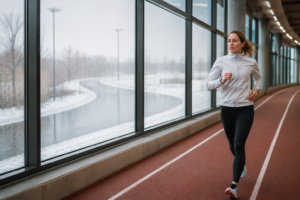
One thing I’ve started noticing is that many runners leave an indoor track with the same thought.
“I wasn’t actually faster… but it certainly felt like I was.” It is an interesting sensation. The pace on your watch may be almost identical to what you normally run outdoors. Your heart rate may stay within the same range. The workout itself might be no different from any other steady run.
And yet, the entire experience somehow feels quicker. I honestly believe that feeling has very little to do with fitness. Instead, it comes from the environment around you.
Indoor tracks remove many of the small interruptions that naturally slow your perception of rhythm. There is no wind to push against. The surface remains perfectly consistent. Temperature barely changes. Every lap looks almost identical, allowing your stride to settle into a remarkably steady pattern.
At the same time, the shorter 200-metre circuit means laps pass twice as often as they would on a standard outdoor track.
Corners arrive more frequently. Markers appear more often. Progress feels constant. None of these factors necessarily make you physically faster. They simply make steady running feel more fluid.
Understanding that difference helps explain why an indoor track can sometimes feel surprisingly quick—even when your body is working at exactly the same effort as it would outside.
Your Brain Experiences Speed Differently Indoors
One thing I’ve started noticing is that running speed is not only something your muscles produce. It is also something your brain interprets.
When you run outdoors, your surroundings are constantly changing. Trees, buildings, hills, traffic, and distant landmarks all move past at different speeds. Your eyes continuously process new information while your body quietly adjusts to the environment around you.
An indoor track is very different. The surroundings barely change. The lighting remains the same. The surface stays identical. Every lap follows an almost perfectly predictable pattern. That consistency allows your attention to shift away from the environment and towards the rhythm of your running itself.
I’ve started noticing that many runners settle into a comfortable cadence more quickly indoors. Without constantly reacting to changing conditions, each stride begins to feel almost automatic. The frequent lap markers reinforce that sensation.
Every couple of hundred metres you pass another line, another bend, another reference point. Progress appears more often than it does on a 400-metre outdoor track or on an open road, creating the subtle impression that the run is moving along more quickly.
I honestly believe this is one of the reasons indoor tracks often feel faster without actually making you faster. The pace may be identical. The experience becomes smoother. To me, this is another reminder that running is never just about physiology. It is also about perception.
The way your brain experiences a workout can be very different from what the stopwatch is measuring.
This idea connects naturally to Indoor Track Running Explained, because the shorter lap length and highly consistent environment influence not only your movement, but also the way the entire session feels from beginning to end.
Why The Same Pace Can Feel Faster Indoors
What Your Brain Notices
What The Run Feels Like
The experience becomes smoother.
Feeling Faster Is Not The Same As Running Faster
I honestly believe this is where many runners unintentionally confuse perception with performance. An indoor track often makes running feel smooth, controlled, and almost effortless. That sensation is real. It simply doesn’t always mean your body is producing a higher level of performance.
A perfectly even surface reduces the small adjustments your muscles constantly make outdoors. There is no headwind disrupting your rhythm. Temperature remains comfortable. Every lap looks familiar, allowing you to settle into a consistent stride much earlier in the session.
All of those factors can make the same pace feel easier. I’ve started noticing that runners often interpret this as becoming faster overnight. In reality, what has often improved is the quality of the running environment rather than the runner.
The effort feels more efficient because fewer external variables are competing for your attention. That doesn’t diminish the value of an indoor track. Quite the opposite.
A controlled environment can be an excellent place for tempo runs, threshold sessions, or interval workouts precisely because it removes distractions that would otherwise interrupt your rhythm. I think this is where indoor tracks become especially valuable. They don’t create fitness by themselves. They simply allow your existing fitness to express itself with fewer interruptions.
To me, that is a subtle but important distinction. The faster feeling belongs to the environment. The adaptation still belongs to the work you complete.
This idea connects naturally to Indoor Track vs Outdoor Running, because both environments can build excellent fitness even though they create very different running experiences.
A Faster Feeling Can Be A Useful Training Tool
One thing I’ve started noticing is that runners sometimes become suspicious when a workout feels easier than expected. If the pace feels smooth, they assume something must be wrong.
I don’t think that is necessarily true. Sometimes a well-designed training environment simply allows you to focus on running instead of everything happening around you.
An indoor track removes many of the small distractions that constantly compete for your attention outdoors. The predictable surface, controlled temperature, and uninterrupted rhythm allow you to settle into your pace more naturally.
That smoother experience is not misleading. It is simply different. I honestly believe this is one of the reasons indoor tracks work so well for structured training.
When the environment demands less attention, you can devote more of your concentration to holding the intended effort, refining your running form, and completing the session exactly as planned.
That doesn’t make every workout easier. It makes every workout easier to execute well.
I’ve started noticing that experienced runners rarely judge a session by how fast it felt. Instead, they ask whether the workout achieved its purpose.
That small change in perspective removes much of the confusion surrounding indoor track running. To me, this is the real lesson. Feeling faster is enjoyable.
Training better is what ultimately improves performance.
If you’re wondering why indoor tracks create such a different running experience, Indoor Track Running Explained explores the characteristics of the environment in more detail.
If you’re choosing shoes that perform equally well on indoor tracks and roads, our guide to the Best Running Shoes for Daily Training compares versatile models designed for both surfaces.
Conclusion
Indoor tracks often feel faster than outdoor running. Not because they magically increase your fitness. But because they remove many of the small interruptions that influence how running feels.
The predictable surface, controlled environment, and steady rhythm allow many runners to settle into their pace more comfortably than they would outside.
I think the important thing to remember is that a smoother experience and a faster performance are not always the same thing. The feeling belongs to the environment. The improvement comes from the training you complete within that environment.
Once you understand that difference, the indoor track becomes much more than a place that makes you feel quick.
It becomes another place where consistent, purposeful training can quietly make you a stronger runner.
Frequently Asked Questions
Why does running on an indoor track feel faster?
Indoor tracks provide a consistent surface, controlled conditions, and frequent visual reference points. These factors can make your running rhythm feel smoother, even if your actual pace is unchanged.
Am I actually faster on an indoor track?
Not necessarily. You may perform slightly better because the environment is more controlled, but the sensation of speed is often greater than the actual improvement in pace.
Does an indoor track improve running performance?
An indoor track doesn’t directly make you faster, but it provides an excellent environment for completing structured workouts consistently and with fewer interruptions.
Why do laps seem to pass so quickly indoors?
Most indoor tracks are 200 metres long, so you reach bends, lap markers, and split points twice as often as on a standard outdoor track. This creates a stronger sense of progress throughout the run.
Should I use an indoor track for tempo workouts?
Yes. The consistent surface and predictable conditions make indoor tracks an excellent choice for tempo runs, threshold sessions, and interval training where maintaining an even effort is important.