I think most runners have slightly mixed feelings about treadmill running. On one hand, it is practical. It removes weather, darkness, ice, traffic, and complicated route planning. You can control pace, incline, temperature, and duration with a level of precision that outdoor running rarely allows.
On the other hand, it can feel strangely different. The belt moves underneath you. The scenery does not change. There is no wind, no corners, no small terrain shifts, no natural sense of moving through space. Even when the workout is physically demanding, some part of the experience can feel less like running outside and more like running in place.
That is where the question usually begins. Is treadmill running actually as good as outdoor running?
The answer is more interesting than a simple yes or no. A treadmill can absolutely build fitness. It can support easy runs, tempo work, recovery runs, and even long runs when outdoor conditions are poor. But it is not identical to outdoor running, and I think the most useful way to understand it is not to ask whether it is better or worse.
The better question is what treadmill running does well, what it does differently, and where outdoor running still provides something the treadmill cannot fully replace.
Why The Treadmill And The Road Challenge Your Body Differently
One thing I’ve started noticing is that runners often compare treadmill running and outdoor running as if one of them has to be superior. I don’t think the body sees it that way.
It simply responds to the demands placed upon it.
When you run outside, your body is constantly making small adjustments. The surface changes slightly with every step. Wind alters the effort. Gentle turns, small hills, uneven pavement, and tiny variations in rhythm all require your muscles and nervous system to make continuous corrections. Most of those adjustments happen without you ever noticing them.
A treadmill removes many of those variables. The surface remains consistent. The pace can stay perfectly steady. There is no headwind to overcome and no downhill section encouraging you to speed up. Every step becomes remarkably predictable. That does not make treadmill running easier. It makes it different.
I honestly believe this is why some runners describe treadmill sessions as mentally repetitive, while others find them surprisingly comfortable. The physical work may be very similar, but the environment changes how that work is experienced.
I’ve started noticing that many runners expect the two forms of running to feel identical. When they don’t, they assume one must be less effective. More often, the body is simply responding to two slightly different challenges.
This idea connects naturally to Why Good Training Often Feels Boring, because controlled repetition is not automatically a weakness. In many situations, it is exactly what allows the body to absorb training efficiently.
Does Treadmill Fitness Transfer to Outdoor Running?
I think this is the question most runners are really asking. Not whether treadmill running feels the same. Whether it builds the same kind of fitness.
One thing I’ve started noticing is that runners often care much more about the environment than their bodies do.
We notice the changing scenery, the wind, the small hills, and the feeling of moving through the landscape. Running outside is a richer experience, and I honestly believe that is one of the reasons so many people enjoy it so much.
Your body is much less sentimental.
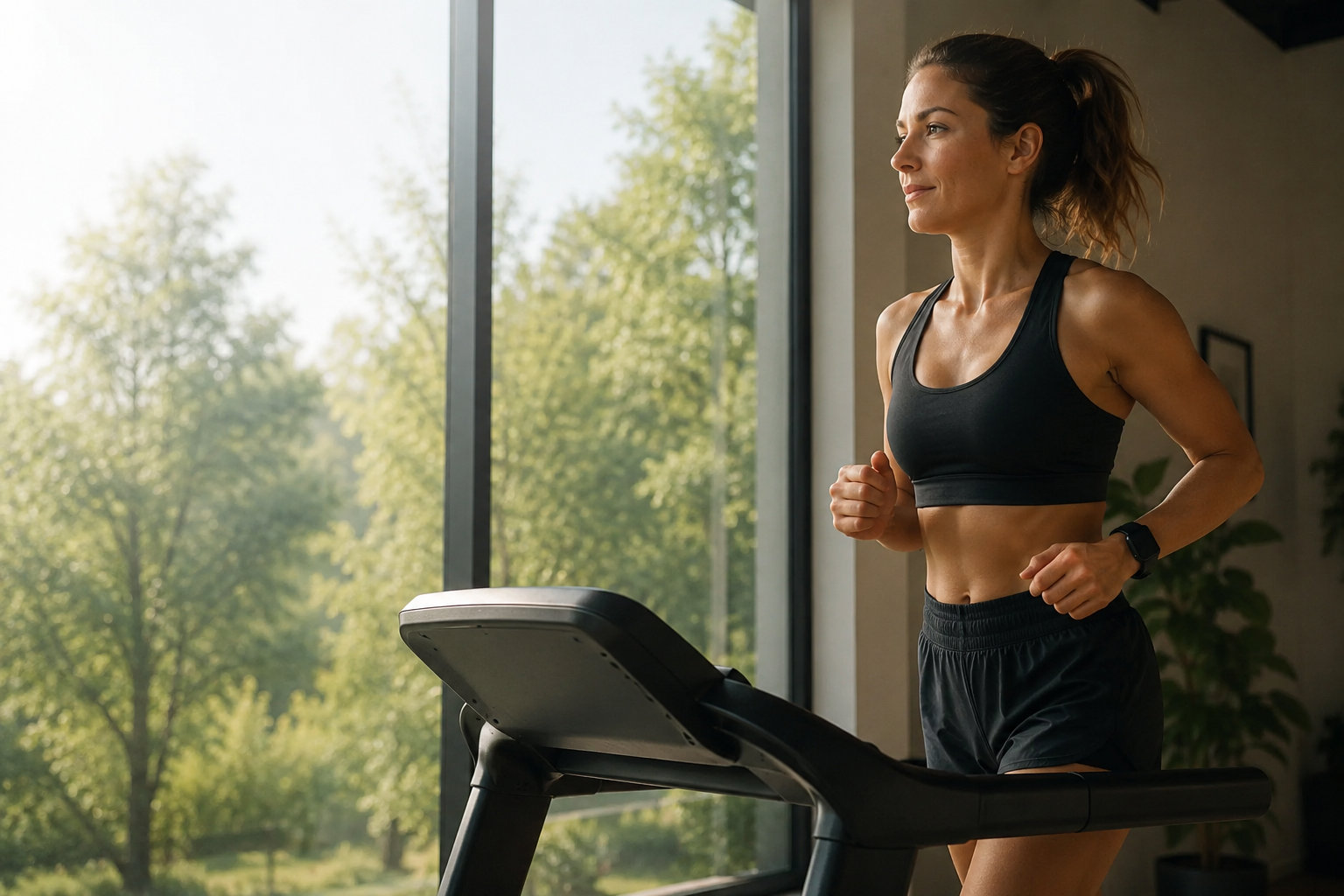
It responds to duration, effort, and training load. Whether that workload comes from a quiet forest trail, a rainy city street, or a treadmill facing a gym window matters surprisingly little to the systems responsible for building aerobic fitness.
The scenery changes the experience.
The workload changes the body.
That is why treadmill running transfers so well to outdoor running. Your heart, lungs, and aerobic system are responding to the work itself, not to the view outside.
This is why a treadmill can successfully support almost every part of a running plan. Easy runs continue building aerobic capacity. Tempo sessions still improve your ability to sustain faster efforts. Long runs still develop endurance. Recovery runs still encourage circulation and adaptation.
Where the difference begins to appear is not usually in fitness itself. It is in running skill.
Outdoor running gradually teaches your body how to react to changing terrain, uneven surfaces, wind, corners, small hills, and the countless tiny adjustments that happen naturally during every run. Those adjustments become part of your movement without you ever thinking about them.
A treadmill asks much less of that system. I’ve started noticing that runners who spend part of the winter training indoors often return outside with fitness that feels almost unchanged. What usually takes a few runs to come back is not endurance.
It is familiarity. The body simply needs a little time to reconnect with the small movement patterns that outdoor running naturally provides.
To me, this is why treadmill running works so well without completely replacing outdoor running. One develops fitness with remarkable consistency. The other develops the same fitness while also refining the practical skills needed for running in an ever-changing environment.
This idea connects naturally to How to Build Endurance for Running, because endurance is created by repeated aerobic training, regardless of whether that training happens indoors or outdoors.
When A Treadmill Can Actually Be The Better Choice
One thing I’ve started noticing is that runners often feel slightly guilty about choosing the treadmill. As if running indoors somehow counts less. I don’t think that idea survives very long once you start looking at what the session is actually trying to achieve.
Imagine you have an easy run planned. Outside, the temperature is close to freezing, the wind is strong, and every intersection interrupts your rhythm. By the time you finish, the run has required far more concentration and effort than the training plan intended.
Now imagine the same run on a treadmill. The pace stays controlled. The environment remains stable. You finish the session feeling exactly as fresh as an easy run was supposed to leave you.
Which run better matched the purpose of the day? I honestly believe the treadmill often wins that comparison. The same is true for many tempo sessions.
When the goal is maintaining a steady effort for twenty or thirty minutes, removing unnecessary interruptions can actually improve the quality of the workout. Instead of constantly adjusting for hills, traffic, or changing weather, you can simply focus on running at the intended effort.
That does not make treadmill running superior. It makes it extremely good at certain jobs. I’ve started noticing that experienced runners rarely think in terms of indoor versus outdoor. They think in terms of choosing the environment that best matches today’s purpose. Sometimes that purpose is precision. Sometimes it is adaptability. Both have value.
To me, this is where the treadmill stops feeling like a compromise and starts feeling like another useful tool in a runner’s training.
This idea connects naturally to How to Decide Your Effort Mid-Run (Without Metrics), because the quality of a session is determined by how well it matches its purpose, not by where it happens.
What You Notice vs What Your Body Uses
What You Experience
What Your Body Uses
What Improves
The workload changes the body.
The Best Surface Is Usually The One That Lets You Train Consistently
I think one of the biggest changes in a runner’s mindset happens when they stop thinking about treadmill running and outdoor running as competing options. Because they rarely are.
Every training plan is made up of different purposes. Some days are about building aerobic volume with as little unnecessary stress as possible. Some days require precise pacing. Others benefit from changing terrain, variable conditions, and the natural rhythm of running outdoors.
The environment is simply another part of that decision. I’ve started noticing that experienced runners rarely ask whether the treadmill is “real running.” Instead, they ask a much simpler question. What does today’s session need?
If the answer is precision, consistency, and controlled effort, a treadmill may be the better choice.
If the answer is preparing for race conditions, adapting to hills, practicing pacing in changing environments, or simply enjoying the experience of running outside, then the road naturally becomes the better classroom.
Neither choice is automatically better. Each one simply teaches the body something slightly different. To me, this is where treadmill running becomes much easier to appreciate. It is not replacing outdoor running, it is supporting it.
The runners who continue improving for years are usually not the ones who insist on only one environment. More often, they are the ones who quietly learn how to use each environment when it provides the greatest benefit.
If you’re unsure how hard your treadmill session should actually feel, the Running Pace Zone Calculator can help estimate appropriate pace ranges for easy runs, tempo sessions, and intervals. And if you’re looking for footwear that works equally well indoors and outdoors, our guide to the Best Running Shoes for Daily Training compares versatile models that handle both environments comfortably.
Conclusion
Treadmill running and outdoor running are far more similar than many runners imagine. Both can build aerobic fitness. Both can improve endurance. Both can support almost every type of training session.
The biggest differences are not found in your heart or your lungs. They are found in the environment around you.
A treadmill offers remarkable consistency. Outdoor running offers constant variation. Neither is automatically better, because each challenges the body in a slightly different way.
I honestly believe that asking whether one is better than the other is often the wrong question. A better question is whether today’s environment helps you complete today’s training as it was intended. Because successful runners are rarely defined by where they run. They are defined by how consistently they keep showing up, no matter where the next run happens.
Frequently Asked Questions
Is running on a treadmill as effective as running outside?
For building aerobic fitness, endurance, and cardiovascular health, treadmill running is highly effective. The training stimulus is very similar when effort and duration are comparable.
Should I set the treadmill to a 1% incline?
A slight incline is often recommended to better approximate the energy cost of outdoor running, particularly at moderate to faster speeds. However, it is not essential for every run, especially easy recovery sessions.
Is treadmill running easier than outdoor running?
Not necessarily. The physical effort can be very similar, but treadmill running removes variables such as wind, terrain changes, and frequent pace adjustments, making the experience feel different rather than easier.
Can I train for a race entirely on a treadmill?
You can build most of the necessary fitness on a treadmill, but spending some time outdoors before race day is usually beneficial to adapt to pacing, terrain, weather, and the practical feel of running on roads.
When is a treadmill the better choice?
A treadmill is often ideal when weather is unsafe, when you need highly controlled pacing for workouts, or when maintaining consistency is more important than dealing with changing outdoor conditions.