
You finish another easy run and open your watch almost automatically. The pace looks a little faster than it did a few months ago. Your heart rate seems slightly lower.
Maybe that means your easy runs are improving. Or maybe it doesn’t.
I think this is one of the most misunderstood parts of running progress. Because easy runs rarely improve in a way that feels obvious at first.
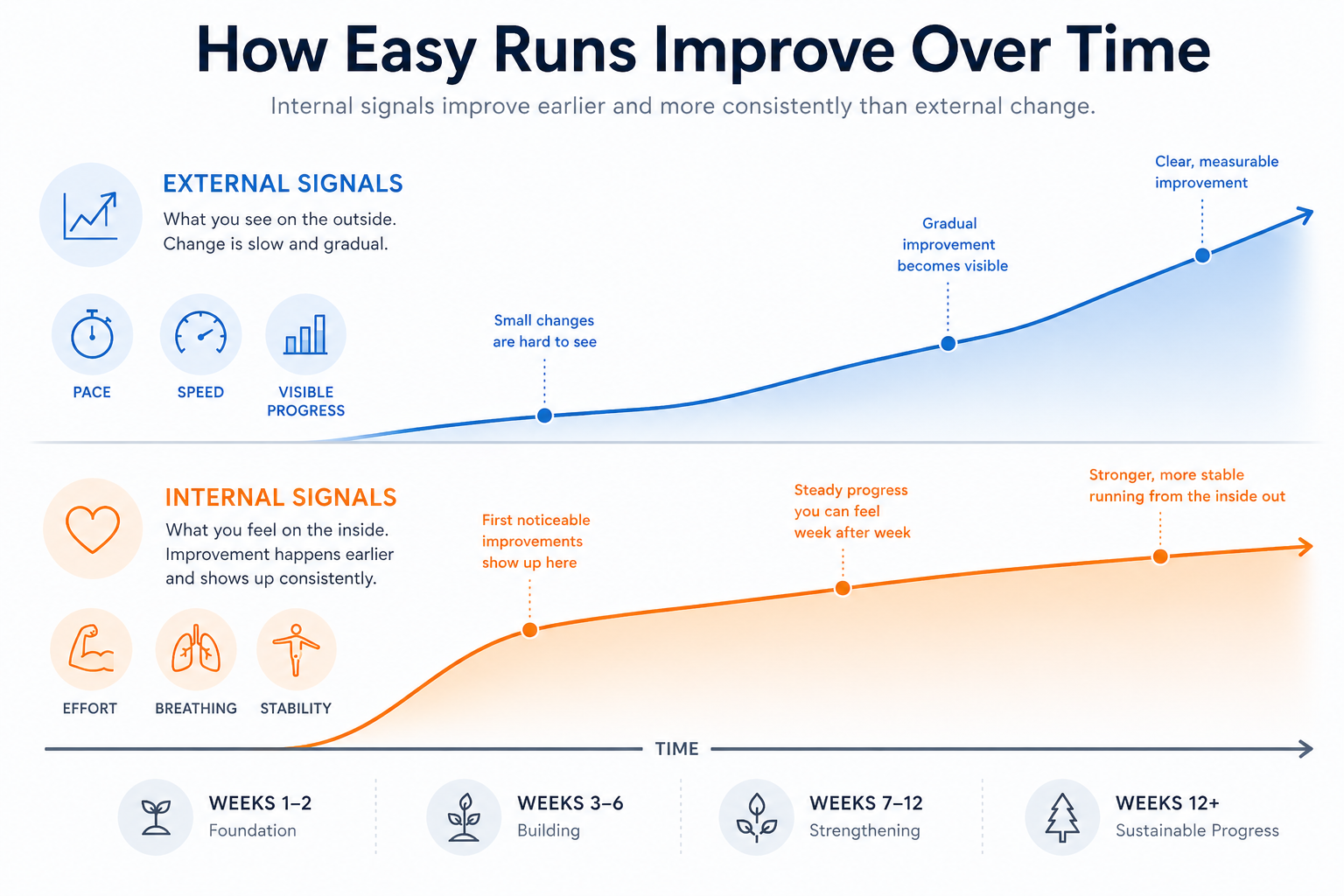
Most runners expect improvement to appear as faster pace, lower heart rate, or better numbers on a watch. And sometimes it does. But I’ve started noticing that the earliest signs of progress often feel much less dramatic than that. The run settles sooner, breathing feels calmer and recovery happens more naturally.
The entire experience feels less demanding than it used to. In other words, the run becomes easier before it becomes faster.
And honestly, I believe many runners miss these changes because they are looking for performance signals while the body is quietly improving somewhere else.
Learning to recognize those quieter signs can tell you far more about your aerobic development than pace alone ever will.
Modern running watches allow you to track pace, distance, heart rate, cadence, VO2 max and much more during workouts.
If you’re choosing one for training, see our guide to the Best Running Watches for Running (2026).
Improvement Usually Feels Smaller Than You Expect
One reason easy-run progress is so easy to miss is because it rarely feels dramatic.
Most runners imagine improvement arriving as a breakthrough. A noticeably faster pace. A much lower heart rate. A run that suddenly feels effortless. In reality, aerobic development is usually much quieter than that.
Your body becomes slightly more efficient. Your movement becomes a little more economical. The same effort creates slightly less strain than it used to. None of those changes demand attention. They happen gradually enough that you can easily miss them while they are happening.
I think this is why many runners become frustrated during periods when they are actually improving. The body is adapting, but the adaptations do not always feel impressive from the inside.
This is closely related to How to Tell If Your Running Is Improving, because progress often appears long before it feels obvious.
The First Improvements Usually Appear In Effort
Most runners look at pace first. I honestly believe that is often the wrong place to start. If you want to understand whether your easy runs are improving, pay attention to how the effort feels.
Run a familiar route. Let the pace settle naturally. Then ask yourself a few simple questions. Does the run feel calmer than it used to? Does your breathing settle earlier? Do you spend less energy maintaining the same rhythm?
These changes may seem insignificant, but they are often the first signs that your aerobic system is becoming more capable. Over time, I think many runners realize that easy runs usually become easier before they become faster.
The feeling changes first. The numbers often follow later.
Efficiency Often Shows Up As Stability
Eventually, the numbers do begin telling part of the story. But even then, improvement is not always about seeing lower heart rate or faster pace.
Sometimes it appears as stability.
Your heart rate drifts less throughout the run. Your breathing remains more controlled. The effort stays consistent from beginning to end instead of gradually becoming harder. This is not something you usually notice during a single session.
It becomes visible when you step back and look across several weeks of training. That is one reason Heart Rate vs Pace is such an important concept. True efficiency is rarely about chasing a specific number. It is about how your body responds to the same workload over time.
And perhaps the clearest sign of all is what happens after the run is over.
When easy runs are improving, they become easier to repeat. Recovery happens more naturally. The run fits into the week with less disruption and less accumulated fatigue. To me, this is where easy running starts doing exactly what it is supposed to do.
Not proving fitness. Building it.
This connects closely with How to Know If You’re Recovering Properly Between Runs, because improving easy runs are often reflected in recovery quality just as much as running performance.
Faster Is Not Always Better
At some point, most runners start paying attention to pace. That makes sense.
When the watch begins showing slightly faster numbers at the same route, it is tempting to assume improvement has arrived. Sometimes it has. But not always.
I think this is where easy running becomes surprisingly easy to misunderstand. Because pace can improve for two very different reasons. The first is genuine aerobic development. Your body becomes more efficient, allowing you to move faster at the same effort.
The second is much simpler. You are working harder. From the outside, both situations can look identical. The pace is faster. The watch looks encouraging. The run appears successful. But internally, they are very different experiences.
This is exactly why What Does Easy Pace Actually Mean matters so much. Easy running is not defined by speed. It is defined by purpose.
And the purpose is to keep effort controlled enough for adaptation to remain sustainable.
Sometimes Progress Only Looks Like Progress
One of the easiest mistakes runners make is confusing faster running with better training. Your easy pace improves. But your breathing becomes noticeably heavier. Recovery takes longer. The following day’s run feels slightly harder than it should.
The numbers suggest progress. The body suggests something else.
I honestly believe many runners drift away from productive easy running without ever making a conscious decision to do so. The change happens gradually.
A little faster here. A little more effort there. Eventually, the run still carries the label “easy,” but the physiology underneath has quietly changed.
This is closely connected to What Happens If You Run Too Fast Too Often, because training balance is often lost through small decisions rather than dramatic mistakes.
The body rarely cares what we call a run. It responds to the effort we actually produce.
One useful way to evaluate aerobic development is to monitor heart rate drift over time. If the same easy run produces less drift than it did a few months ago, it often suggests that your aerobic system is becoming more efficient. You can estimate this using our Easy Run Drift Calculator.
What Real Easy-Run Progress Usually Looks Like
The interesting thing about genuine improvement is that it often feels almost unremarkable. Nothing dramatic happens. You simply begin noticing that things work a little better. Your breathing settles naturally. The rhythm of the run feels easier to maintain. Recovery becomes more predictable.
Easy days fit more comfortably into the rest of the training week.
To me, this is where many runners finally understand what aerobic development actually looks like. Not excitement. Not breakthrough moments. Not spectacular watch data. Just a growing sense that the same effort creates less disruption than it used to.
As your volume increases, managing effort becomes more important.
A reliable heart rate monitor helps you keep easy runs controlled and avoid building hidden fatigue over time — see Best Heart Rate Monitors for Running (2026).
Conclusion
Easy runs rarely announce their progress. Most of the important changes happen quietly.
The run settles sooner. The effort feels more natural. Recovery becomes more reliable. The entire system starts feeling a little more stable than it did before.
That is why pace alone rarely tells the whole story. Real improvement is not simply moving faster.
It is being able to repeat the same training with less strain, less fatigue, and more consistency.
Over time, I think many runners realize that this is what easy running was building all along. Not impressive workouts.
A stronger foundation underneath every workout that follows.
Frequently Asked Questions
How do I know if my easy runs are improving?
Look beyond pace. Improvements often appear first in effort, stability, breathing control, and recovery quality.
Should my easy pace become faster over time?
It often does, but only if effort remains similar. Faster pace alone does not automatically mean better aerobic fitness.
Is heart rate a useful indicator?
Yes. Patterns across weeks are usually more meaningful than any individual run.
Why do my easy runs still feel ordinary if I am improving?
Because aerobic adaptation is gradual. Many improvements happen internally before they become obvious in pace or performance.
What is the best sign that an easy run is improving?
A growing ability to complete and repeat easy runs while feeling controlled, stable, and well recovered afterward.