
The Biggest Beginner Running Mistakes
Most beginner running mistakes are not caused by doing something obviously wrong. They come from asking for the next adaptation before the current one has settled.
Most beginner running mistakes do not look like mistakes when you make them.
That is part of the problem. You finish your first few runs and discover that you can already do more than you expected. Perhaps twenty minutes becomes thirty. The walking breaks become shorter. The route that seemed intimidating last week suddenly feels manageable.
Naturally, you respond to the improvement. You run a little farther. The next time, a little faster. Running feels good, so you add another day. Nothing about this seems reckless. You are not sprinting until you collapse or doubling your mileage overnight. You are simply doing slightly more because your body appears to be telling you that slightly more is available.
And often it is. But being capable of doing more and being ready to absorb more are not quite the same thing. That distinction sits underneath many of the problems beginners eventually encounter.
Running creates adaptation surprisingly quickly in some places. Breathing can improve. Confidence grows. A familiar distance stops feeling intimidating. Yet muscles, tendons, feet and lower legs may still be accumulating experience with a movement they have only recently begun repeating thousands of times.
Your motivation can adapt even faster. That creates an unusual situation where the part of you deciding how much to run can move ahead of the parts actually absorbing the running.
This is why the starting principle in How to Start Running From Scratch is deliberately conservative: find an amount of running your body is ready to repeat rather than the greatest amount you can complete today.
The difference may seem small during one run. It becomes much larger across several weeks. The biggest beginner mistakes tend to appear in that gap.
Not because beginners are careless. Because early progress makes doing more feel like the obvious thing to do. And sometimes the better response to improvement is simply to let yourself have improved.
Trying to Make Every Run Better Than the Last One
Once you can measure running, progression becomes almost irresistible.
Yesterday you ran three kilometers. Today you manage three and a half. The next run comes around and repeating three kilometers can suddenly feel like going backwards.
So you look for something to improve. A little more distance. A slightly faster average pace. Fewer walking breaks. Perhaps the same route completed without stopping. This creates a quiet expectation that every run should somehow outperform the previous one.
The problem is that adaptation does not require constant escalation.
Your body learns from repetition too. Running the same manageable distance several times gives muscles, tendons and the cardiovascular system repeated exposure to a demand they already know how to handle. What changes is not necessarily the workout on paper, but what it costs you to complete it.
This is why How Far Should Beginners Run? treats distance as the result of a run rather than a target that should continually control it. A distance becoming ordinary is progress even when the number itself has not moved.
The same applies to pace. And frequency. And continuous running time. If you improve all of them whenever an opportunity appears, the training demand can keep moving just far enough ahead that you never really experience adaptation settling underneath you.
I think this is one of the easiest beginner mistakes to make precisely because it feels so productive. You are improving. You are motivated. Why would you deliberately repeat something you already know you can do?
Because being able to do something once is different from having adapted to doing it regularly. There is enormous value in reaching the end of a familiar run and realizing that it required less from you than it did two weeks ago.
You do not have to convert that spare capacity into another kilometer immediately. Sometimes keeping the run unchanged is how you discover that the runner has changed.
Running Too Fast Because Slow Running Feels Wrong
Beginners are often told to run slowly. The advice sounds simple until you try to do it.
At very low speeds, running can initially feel awkward. Your stride becomes shorter. The rhythm you naturally found when you started moving disappears. Walking might seem almost as fast, and you begin wondering whether this can possibly count as useful running.
So you speed up slightly. The movement feels better. Unfortunately, the effort may not. Ten minutes later, breathing has become much more noticeable. The run is still sustainable, but only because you are willing to work for it. By the final part, what was supposed to be ordinary running has quietly become a moderately hard session.
Do that repeatedly and another beginner pattern develops: almost every run feels roughly the same. Not truly hard. But never genuinely easy either.
This matters because a pace can look slow without being easy for the person running it. As we explored in How Fast Should Beginners Run?, there is no universal beginner pace that separates sensible running from running too fast. The useful pace is the one that allows the effort to remain controlled.
And sometimes even very slow continuous running cannot do that yet. This is where beginners can make a second mistake inside the first one: refusing to walk because walking feels like evidence that the run has failed.
It has not. A short walking period can reduce the demand far more effectively than forcing yourself into an increasingly awkward shuffle. Once breathing settles, you can run again with much better control.
The important distinction is not running versus walking. It is manageable effort versus accumulating struggle. If almost every run ends with you waiting for it to be over, I would not assume that this is simply what beginner running is supposed to feel like.
There is a good chance you are practising running hard more often than you realize. And becoming better at tolerating difficult running is not the same thing as learning how to run easily.
Increasing Distance and Frequency at the Same Time
A single change to running can feel very small. You add five minutes to a run. Or you add one extra running day to the week.
Neither sounds particularly dramatic.
But beginner training rarely changes in isolated units. If three thirty-minute runs become four thirty-five-minute runs, you have not merely added five minutes or one running day. Weekly running has moved from ninety minutes to 140.
The individual runs may still feel perfectly manageable. The week is doing something quite different. This is where early enthusiasm can make progression difficult to read. You feel better, so you run a little longer. Because recovery also seems better, you run more often. Perhaps your natural pace is improving at the same time.
Three forms of progression have quietly arrived together. If the legs become persistently heavy a week later, it is difficult to know which change created the problem.
That is why the principle in How To Increase Weekly Running Volume Safely matters particularly at the beginning. Progression becomes much easier to understand when you change one meaningful part of the training and then give yourself enough time to see what happened.
If you add another running day, the existing runs do not also need to become longer. If you begin extending your normal distance, frequency can remain where it is.
You are not wasting fitness by holding the other variables steady. You are making the response visible.
I think this is an important distinction because beginners are often warned against doing too much, but too much is rarely one enormous run that was obviously a bad idea. It is more often several individually reasonable decisions sitting on top of one another.
Five extra minutes seems reasonable. Another running day seems reasonable. A slightly quicker pace seems reasonable. Together, they can create a training week your body has never encountered before.
Progress does not become slower when you separate those changes. It becomes easier to absorb — and much easier to understand.
Adding More Running Because You Feel Good Today
Good runs are persuasive.
You leave home expecting an ordinary session and everything feels unusually light. Breathing settles immediately. The legs are responsive. The distance you planned seems almost too short.
So you keep going. Five extra minutes becomes ten. Perhaps you add another loop because it would be a shame to waste such a good day.
There is nothing inherently wrong with occasionally running farther because you feel good. Part of becoming a runner is learning to respond to your body rather than treating every session as a rigid prescription.
The beginner mistake is slightly different. It is assuming that feeling good during the run tells you everything you need to know about how much running you should do.
It does not. A run has a second life after you stop. The additional distance still has to be absorbed. Your legs still have to recover from the extra loading, and the next planned run still arrives whether today’s extension felt effortless or not.
This is why Training Load Check Calculator can become useful when several good sessions tempt you to keep adding more. The interesting question is not whether each individual run felt manageable, but whether the amount of running accumulating across the week still fits your current capacity.
There is another subtle problem here. If every good day automatically becomes a bigger day, you remove some of the best evidence that your training is working.
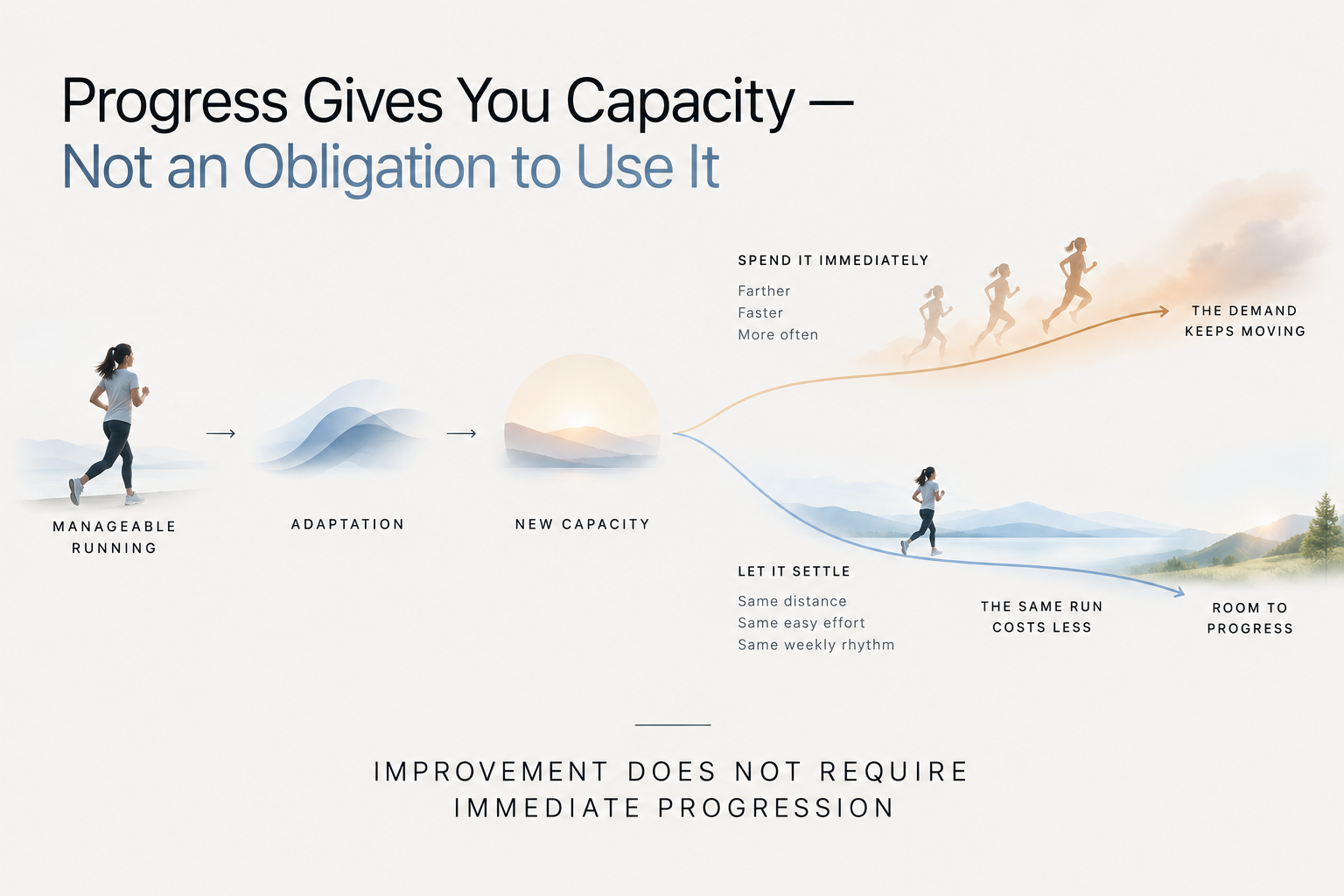
Feeling unexpectedly good at the end of a normal run is not unfinished business. It may be adaptation. You planned thirty minutes because thirty minutes used to be enough. Now you reach thirty and realize that you could comfortably continue.
You have two choices. Spend the new capacity. Or keep it. The second option can feel strangely unsatisfying at first. You stop while the legs are still good and return home knowing there was more available.
But that feeling is valuable. It means the run did not take everything you were capable of giving it.
Progress gives you new capacity. You do not have to spend all of it immediately.
There will be plenty of opportunities to run farther. Sometimes the smartest response to a great run is simply to let it remain a great run.
Treating Every Difficult Run as a Problem to Fix
Beginners often become very attentive to how running feels.
That is useful. You are learning a new physical language, and sensations that experienced runners barely notice can still seem significant. Heavy legs, higher breathing, an awkward first kilometre or a pace that suddenly feels slower than usual can all make you wonder whether something has changed.
The mistake is not noticing these things. It is assuming they all require a response.
A difficult run can immediately trigger an investigation. Maybe you need more rest. Maybe yesterday’s run was too long. Maybe your shoes are wrong. Maybe your fitness has stopped improving.
Or perhaps you should change the training plan before the next session. Sometimes one of those explanations is correct. But sometimes Tuesday was simply a difficult run.
Running performance is noisy. Sleep, stress, weather, accumulated fatigue, terrain and dozens of smaller influences can change how a session feels without saying anything particularly important about your overall progress.
This is where Why You Should Not Judge Fitness From One Workout becomes such an important beginner lesson. Fitness is a trend underneath individual performances, not a verdict delivered after each one.
The distinction becomes clearer once you have more running history. One difficult run surrounded by several normal ones is mostly an observation. Three or four runs becoming progressively harder while recovery deteriorates is a pattern.
Those two situations deserve very different amounts of attention.
Beginners sometimes react so quickly to the first situation that they never allow the second kind of information to develop. Every unusual run causes another adjustment, and soon the training itself is changing more frequently than the body has any chance to adapt to it.
I would rather collect evidence. Notice the difficult day. Keep an eye on what happens next. If the next run feels normal again, there may be nothing to solve.
If the pattern continues, then the Today’s Run Decision Calculator can help frame the more useful question: given the fatigue, recovery and recent training you are actually carrying today, does another normal run still make sense?
Learning to run is partly learning which signals deserve action. Not every bad run does. And once you stop demanding that every session confirm your progress, running becomes much easier to interpret.
Conclusion
The biggest beginner running mistakes rarely begin with obviously bad decisions.
Most begin with progress. You finish a run feeling better than expected, so you go a little farther.
Running starts feeling more natural, so the pace increases. Recovery improves, so another running day appears in the week. One difficult run interrupts the pattern, so you change something again.
Every decision can make sense on its own. The problem appears when improvement is immediately converted into another demand.
Running adaptation needs periods when nothing on the training plan seems to be changing. The distance stays the same. The number of running days stays the same. You stop trying to make the pace faster.
Meanwhile, the body changes underneath all of it.
The same distance requires less recovery. The same effort produces more speed. Your breathing settles sooner. A run that once occupied the rest of the day becomes something you complete before getting on with everything else.
That is not stalled progression. That is progression becoming established.
This is also why beginner running does not require complicated equipment. Most of the work is simply repeated, manageable running, and a comfortable daily trainer is usually far more useful than trying to match different shoes to workouts that do not need to exist yet. Best Running Shoes for Daily Training 2026 looks at versatile options designed for that kind of everyday running.
There will eventually be good reasons to run farther. There will be good reasons to run faster. There may be good reasons to run more often.
But improvement does not create an obligation to do any of them today. Sometimes the best thing you can do with new capacity is leave a little of it unused.
Then come back and run again.
Frequently Asked Questions
What is the biggest mistake beginner runners make?
Trying to progress too many parts of running too quickly is one of the most common underlying problems. Distance, pace and frequency can each look like small changes, but together they can substantially increase the amount of training the body has to absorb.
Do beginners usually run too fast?
Many do, partly because genuinely slow running can initially feel awkward. The useful question is not whether your pace looks slow compared with another runner, but whether the effort remains controlled throughout the run. If every ordinary run gradually becomes difficult, your normal pace may be too demanding.
Is it bad to increase distance every run?
Not every successful run needs to become the starting point for a longer one. Repeating a familiar distance allows you to notice whether that distance is becoming easier to absorb. Once it feels consistently manageable and recovery is predictable, increasing it slightly becomes easier to understand and absorb.
How quickly should beginners increase their running?
There is no progression rate that works perfectly for every beginner. Previous activity, current running frequency, duration and recovery all matter. Rather than increasing training according to the calendar alone, look for evidence that your current amount of running has become repeatable before adding another demand.
Should beginners push through difficult runs?
Not simply because the run was planned. There is a difference between normal running discomfort and a session that is becoming progressively worse. At the same time, one unusually difficult day does not necessarily mean your training needs to change. Look for patterns rather than treating every difficult run as a problem.
Is walking during a run a beginner mistake?
No. Walking can be an effective way to reduce effort and allow another manageable period of running afterwards. Particularly when continuous running still becomes difficult quickly, walking can help keep the whole session more controlled.
Should I stop a run while I still feel good?
Sometimes, yes. Finishing with more available does not mean the run was incomplete. Particularly for beginners, regularly finishing manageable sessions can be more useful than extending every good run until it finally becomes difficult.
How do I know if I am doing too much running?
Look beyond whether you can complete the individual sessions. Persistent heavy legs, worsening recovery and several runs becoming progressively harder can be more meaningful than one difficult day. The distinction is explored more fully in How To Know If You Are Running Too Much?, where the focus is on patterns accumulating across training rather than one isolated session.