
How Far Should Beginners Run?
Distance is the result of a beginner run, not the target that should control it.
Distance is one of the first numbers running gives you.
You leave home, start the watch and before long there is a kilometer on the screen. Then two. Perhaps you had imagined running five, but after three kilometers your breathing is noticeably harder, your legs are getting tired and the remaining distance suddenly feels much more important than it did when you started.
So you keep going. After all, five kilometers sounds like a proper run.
Three kilometers can somehow feel unfinished. I think this is one of the easiest traps to fall into when you begin running. Distance is so clear and measurable that it quickly becomes a definition of what the session was supposed to be.
But your body does not experience kilometers. It experiences time spent running, cardiovascular demand, repeated ground contact and the effort required to keep moving.
Two kilometers of controlled run-walk may therefore be a much more appropriate training session than five kilometers that gradually turns into something you have to endure.
This becomes even more obvious when you are still at the stage described in How to Start Running When You Can’t Run for Five Minutes. If continuous running itself is developing, asking how many kilometres you should cover is almost the wrong question.
You might run for ninety seconds, walk, run again and finish the session having covered only a modest distance. That does not make the session incomplete. You accumulated running your body could handle. You practised the movement. Your legs received repeated running-specific loading. Your aerobic system had to respond. And, importantly, you stopped with enough capacity to recover and do it again.
For one beginner, that may produce two kilometers. For another, it may produce four. Neither number tells us very much without knowing what those kilometers cost.
That is why I would not give a beginner a minimum distance that qualifies as a run. Start with an amount of running you can control. Let the distance be whatever happens while you do it.
Time Can Be More Useful Than Distance at First
There is a practical reason distance can be awkward for beginners. It changes meaning depending on how you cover it.
Three kilometers on a flat path at a genuinely easy effort is one experience. The same three kilometers on rolling terrain can create considerably more work. Add walking breaks and the relationship changes again. Run a little too fast at the beginning and the final kilometre may feel completely different from the first.
Yet the watch still reports three kilometers. Time gives you another way to think about the session. Instead of deciding that you need to reach a particular point on the map, you might simply go out for twenty or thirty minutes and allow running and walking to fit naturally inside that period.
The session now has an end that does not depend on covering more ground. That can be surprisingly helpful. If running feels good, you may accumulate slightly more distance. If you need longer walking periods, you cover less. A hill slows you down without creating the feeling that you are falling behind some invisible kilometre target.
The duration remains roughly the same while the body determines how much running fits inside it. This shifts your attention toward something more useful than kilometers: what the session actually cost.
Was breathing mostly controlled? Did the running periods remain manageable? Did you finish with something left rather than spending the final minutes trying to complete a number?
If those sensations are still difficult to interpret, the Run Effort Check Calculator can help you judge the session from effort rather than distance. That is particularly useful early on, when pace and kilometers can make a perfectly appropriate beginner run look smaller than it really was.
This does not mean beginners should ignore distance. Distance becomes useful information. You can notice that a familiar thirty-minute session gradually carries you farther even though you are not deliberately trying to make that happen. Walking breaks become shorter. Your comfortable running pace improves. More of the session is spent running.
Now distance is describing adaptation rather than demanding it. I think that distinction is important. A beginner does not need to earn progress by reaching farther down the road every time.
Sometimes the better run is simply twenty-five controlled minutes that happen to finish at 3.2 kilometers instead of forcing another 1.8 kilometers because five sounded like the distance you were supposed to run.
Let time define the container. Then let your current ability decide how much distance fits inside it.
Do Not Turn 5K Into the First Definition of Running
Five kilometers has an unusual place in beginner running.
It is short enough to sound achievable, there are countless 5K events and training plans built around it, and it is often treated as the first proper running distance. That can quietly turn 5K from a future milestone into an immediate expectation.
If you run three kilometers, you may start thinking about the two kilometers you did not run rather than the three you actually did. But there is nothing physiologically special about reaching five. Your body does not suddenly receive a better training stimulus when the watch changes from 4.99 to 5.00 kilometers.
What matters is what happened before that point. If the first three kilometers were controlled and the final two required increasingly heavy breathing, deteriorating movement and determination simply to finish the number, those extra kilometers changed the character of the session.
Occasionally discovering your limits is not disastrous. It just does not need to become the way you build running fitness. This is where distance can create a slightly different problem from time. Once you have decided to run 5K, stopping at 4K can feel like quitting. With a thirty-minute session, by contrast, slowing down or adding a walking break does not necessarily threaten the goal at all.
For beginners, I prefer that flexibility. There will be plenty of time later to make distance meaningful. Running your first continuous 5K can be a satisfying milestone precisely because it represents something your body has gradually become capable of doing.
You do not need to rehearse the full distance badly in order to get there. Run shorter distances well. Recover from them. Come back and do it again.
When those shorter runs have become easy to absorb, distance can begin to grow. The principles in How To Increase Weekly Running Volume Safely matter even when the numbers are still small: you want additional running to grow out of what your body already tolerates rather than continually extending the session until you discover the limit.
As those repetitions accumulate, the distance you can cover comfortably begins to expand without every run needing to become longer than the one before it. Five kilometers can still be a destination. It just does not need to control the journey there.
Do Not Increase Distance and Frequency at the Same Time
Once a beginner run starts feeling comfortable, there are two obvious ways to do more.
You can run farther. Or you can run more often.
Both increase the amount of running your body experiences, even though they look quite different on the calendar. Imagine that you have settled into three manageable runs each week. The runs are becoming easier, recovery is predictable and naturally you start thinking about progression.
You could extend one of those runs. You could add a fourth running day.
What I would be cautious about is doing both simply because everything currently feels good. The reason is easy to miss.
A slightly longer run adds more repeated steps to one session. An additional running day adds another entire exposure to running while also removing some of the recovery space that existed between sessions.
Combine the two and the weekly change can become much larger than either decision appears on its own.
This is where How Often Should Beginners Run? becomes the other half of the distance question. How far you run cannot really be separated from how often you run, because together they determine how much running the body has to absorb across the week.
A beginner running three kilometers twice per week is experiencing six kilometres of running.
Run those same three kilometers three times and weekly distance has increased by fifty percent without any individual run becoming longer.
That is why I would rather see progression happen through one variable at a time. If your current frequency works well, allow one run to become slightly longer and see what happens.
Does recovery remain normal? Do the other runs still feel good? Does the following week begin without residual fatigue?
If so, the additional distance has probably found somewhere useful to live. Later, frequency may increase too.
But there is no need to make every sign of improving fitness an invitation to change everything at once. Sometimes the most productive thing you can do with a running distance that has become easy is simply run it again.
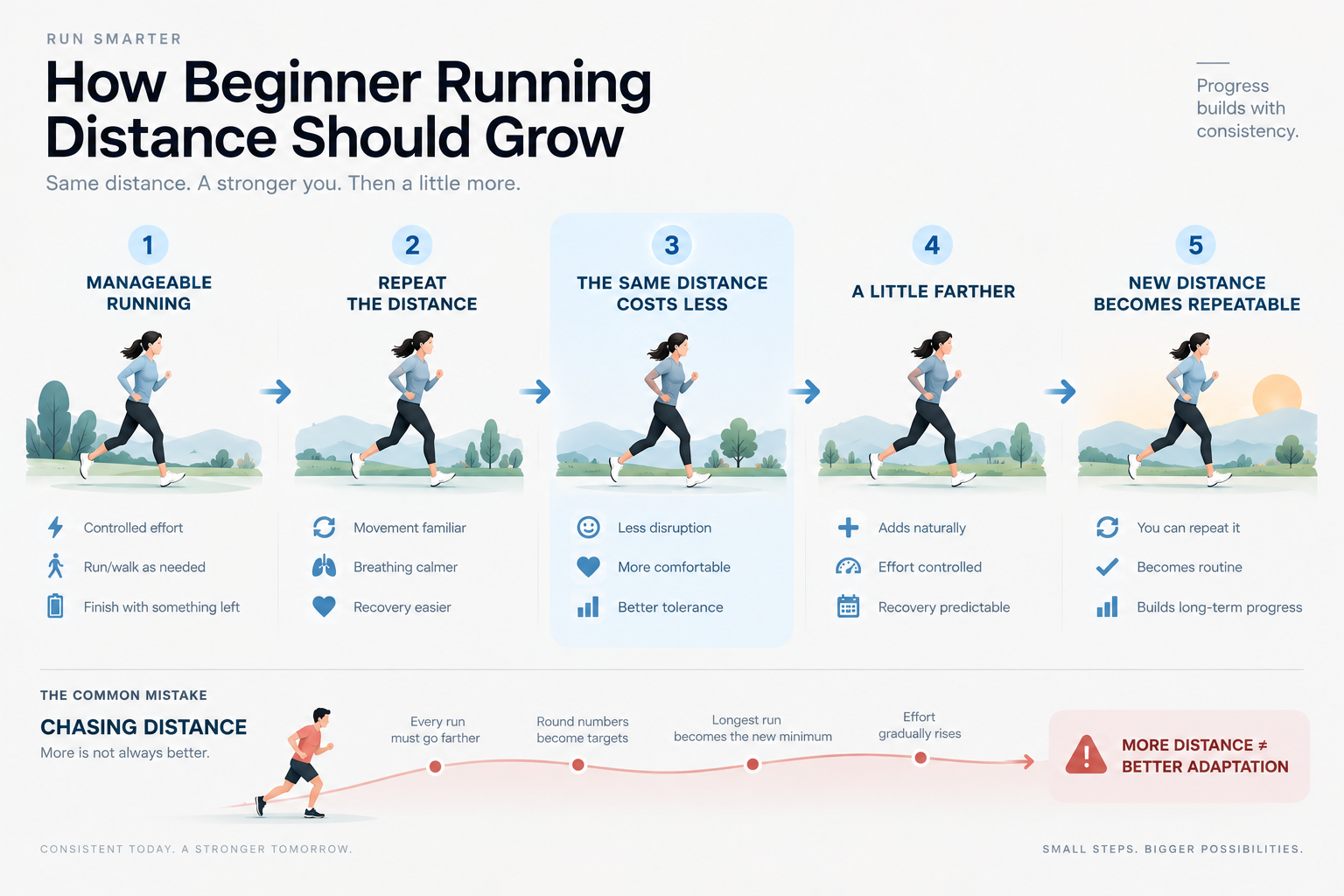
Let Your Regular Distance Become Easier Before It Becomes Longer
There is a form of progress that distance makes surprisingly easy to overlook. You run the same route. The watch shows almost the same number. Nothing obvious has increased. But the run has changed.
Perhaps the first kilometer no longer feels awkward. Your breathing remains quieter on the small hill that used to make you slow to a walk. The final ten minutes feel similar to the first ten instead of becoming progressively harder.
You finish, and the run simply leaves less behind. For a beginner, I would value that enormously. It means the body is learning to absorb the distance you are already giving it.
This is why every successful run does not need to earn an extra few hundred meters the next time. If three kilometers currently creates an appropriate training stimulus, repeating three kilometers gives the body another opportunity to adapt to that stimulus. Eventually, you may notice that the distance has become almost unremarkable. That is a good moment to consider extending it.
The change does not need to be dramatic. You might continue for another few minutes rather than deciding that three kilometers must immediately become four. The point is not to reach the next round number. It is to discover whether a little more running can be added without changing the character of the session.
This is also where Your First Month of Running — What to Expect becomes useful context. Early progress often appears as less disruption rather than more performance. The same running can become easier to absorb before there is any reason to make it faster or longer.
I think that is one of the healthiest ways to let distance develop. First, a particular distance feels substantial. Then it becomes manageable. Eventually, it becomes ordinary. Only then does going farther begin to feel less like completing a challenge and more like continuing a run that was already going well.
Distance has increased. But adaptation came first.
Your Longest Run Does Not Need to Define Your Normal Run
Eventually, almost every beginner has a run that goes better than expected. Perhaps the weather is good, the route is flat and your legs feel unusually light. You reach the point where you normally stop and realize there is no obvious reason to stop yet.
So you continue. Three kilometers becomes four. Four becomes five. You finish with your longest run so far.
That can be a satisfying moment, but it also creates a subtle new expectation. Once you have run five kilometers, three kilometers can suddenly feel like going backwards.
It is not. Your longest run tells you something about what you were capable of on one particular day. It does not automatically tell you what every ordinary run should now become.
This distinction becomes increasingly important as running develops. Some days can be a little longer. Others can remain deliberately short. A shorter run may fit better between two busier days, create less fatigue or simply provide another manageable exposure to running without asking very much from you.
You do not lose the ability to run five kilometers because Tuesday’s run was only three.
In fact, allowing different runs to have different sizes is the beginning of something that later becomes a normal part of training structure. How Long Should a Long Run Be? explores that distinction once running is more established, but the underlying idea already matters for beginners: not every run needs to reproduce your maximum distance.
I would treat the first unexpectedly long run as information rather than a new minimum.
Enjoy it. Recover from it.
Then allow the next run to be whatever amount makes sense.
Over several weeks, you may notice that the distance that once represented an unusually good day gradually becomes something you can run without much consequence.
That is when the baseline has genuinely moved. Not when you first reached the distance. When you became ready to repeat it.
Conclusion
Distance becomes important in running.
Eventually, you may plan a 5K, prepare for a 10K or deliberately make one run longer because it serves a particular purpose in your training.
But a beginner does not need to start there. At first, distance is better treated as something the run produces.
You go out for a manageable amount of time. You run at an effort you can control. You walk when walking helps keep that effort under control. Then you finish with enough left that recovery does not become the dominant part of the next few days.
Whatever distance appears on the watch is the distance that session happened to contain. Over time, that number often begins moving almost by itself.
You spend more of the session running. The same route requires fewer walking breaks. A distance that once felt substantial stops creating much fatigue. Eventually, continuing a little farther does not noticeably change the character of the run.
That is when distance becomes useful progression. Not because you forced yourself to reach the next kilometre. Because your existing kilometers became easier to absorb. There will still be shorter runs. There will be days when you cover less than you did the week before. Your longest distance will occasionally move forward and then remain there for a while.
None of that interrupts progress. The useful question for a beginner is therefore not how far a proper run should be.
It is how much running you can do today while remaining ready to benefit from the next one.
Let that amount become familiar. Then let distance grow from there.
As beginner runs gradually become longer, comfort starts to matter across more repeated steps. That does not mean you need a specialised shoe for a particular distance. A comfortable, versatile daily trainer is usually the simpler place to start, and our guide to the Best Running Shoes for Daily Training 2026 explains the kinds of shoes designed for regular everyday running.
Frequently Asked Questions
How far should a beginner run?
There is no minimum distance a beginner needs to cover. For someone completely new to running, a few kilometres of controlled run-walk can provide plenty of useful training. The appropriate distance depends on how long you can run comfortably, how much walking you need and how well you recover afterwards.
Is 2 km enough for a beginner run?
Yes. Two kilometres can be a completely appropriate beginner session, particularly when running itself is still unfamiliar. The training effect does not suddenly become meaningful only after reaching a particular round number.
Should beginners run by time or distance?
Time can often be easier to manage at first because it gives the session a clear boundary without forcing you to reach a particular point. A twenty- or thirty-minute session can contain whatever combination of running and walking is appropriate that day.
Is 5K too far for a beginner?
Not necessarily. Some beginners can comfortably cover 5K quite early, particularly with walking included. The problem comes when 5K becomes a distance you feel obligated to complete even after the effort has stopped being controlled.
How do I know when I am ready to run farther?
A good sign is that your current distance has become consistently easy to absorb. The run remains controlled, recovery is predictable and adding a little more running does not make the rest of the week noticeably harder. If you are unsure whether a recent increase is settling well, the Training Load Check Calculator can help you look at the accumulated training rather than judging the decision from one successful run.
Should every beginner run be the same distance?
No. Some runs can be shorter and occasionally one may naturally become longer. Your longest run does not need to become the minimum distance for every session that follows.
Should I try to run farther every week?
There is no need. Repeating the same distance while it becomes easier is itself adaptation. Increase distance when the current amount is consistently manageable rather than because another week has passed.