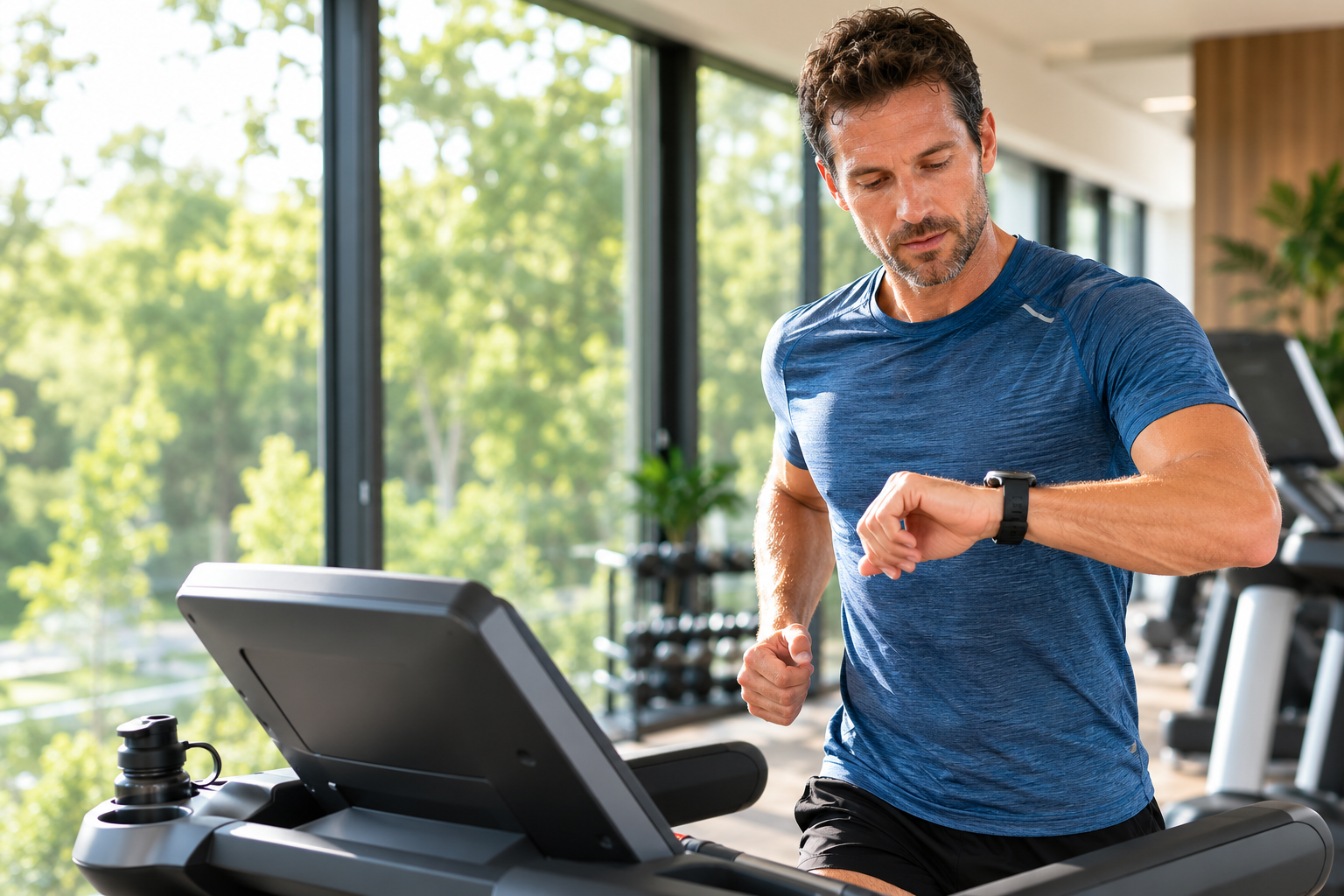
One thing I’ve started noticing is that runners rarely question treadmill accuracy until something feels wrong. The display says one pace. Your watch says another. Your breathing suggests something else entirely.
Suddenly, a simple indoor run becomes a small argument between three different sources of information. It can be surprisingly frustrating, because treadmill running feels like it should be precise. The belt is moving at a set speed. The screen gives you exact numbers. There are no hills, no traffic lights, no wind, and no GPS signal bouncing between buildings.
And yet, the numbers do not always agree. I think this is where many runners become too focused on finding the one correct device. They want to know whether the treadmill is right, whether the watch is right, or whether their effort is lying to them.
The better answer is usually more nuanced. Treadmills can be accurate enough to guide good training, but they are not perfect measuring instruments. Calibration, belt wear, speed changes, incline, footpod settings, GPS limitations, and even how the treadmill is maintained can all affect what the numbers show.
That does not mean treadmill data is useless. It means the data needs to be interpreted. Because in training, the most useful number is rarely the one that looks most precise. It is the one that helps you complete the right workout at the right effort.
Accurate For What?
I think one of the reasons treadmill accuracy causes so much confusion is that runners often use the word “accurate” without defining what they actually mean. Are we talking about speed? Distance? Calories? Or whether the workout creates the intended training effect?
Those are not the same question. A treadmill may display a pace that is a few seconds per kilometre faster or slower than your running watch. At the same time, it can still provide an excellent workout that perfectly matches the purpose of the session.
Likewise, two treadmills standing next to each other in the same gym may not report exactly the same numbers if they have been calibrated differently or maintained to a different standard. I’ve started noticing that runners often become disappointed when they discover that treadmills are not laboratory instruments. I honestly believe that expectation is slightly unrealistic.
Like any piece of fitness equipment, a treadmill is designed to be a reliable training tool rather than a scientific measuring device. A well-maintained commercial treadmill is usually impressively consistent, while an older home treadmill may gradually drift as the belt stretches and components wear over time.
The important thing is that consistency and absolute accuracy are not always the same thing.
If your treadmill consistently reports the same pace every time you use it, your training can still be remarkably effective, even if the actual speed is not mathematically perfect. To me, this is where treadmill data becomes much easier to trust.
You stop asking whether every number is absolutely correct.
You begin asking whether the treadmill is giving you reliable information that allows you to repeat and compare your training over time. That is usually the more useful definition of accuracy.
This idea connects naturally to Treadmill Pace vs Outdoor Pace, because the value of pace lies less in matching another device perfectly and more in helping you produce the intended training effort consistently.
Why Your Watch And Your Treadmill May Disagree
One thing I’ve started noticing is that runners often assume one device must be right and the other must be wrong. In reality, they are usually measuring different things.
A treadmill estimates how fast the belt is moving beneath your feet.
Your watch estimates how your body is moving through space.
When you run outdoors, those two ideas are almost the same. On a treadmill, they become surprisingly different.
A GPS watch cannot rely on satellites indoors, so it switches to estimating pace and distance using your arm movement, stride patterns, accelerometers, or, in some cases, a connected foot pod. Those estimates can be remarkably good, but they are still estimates.
The treadmill has its own limitations. It assumes the belt is moving at exactly the programmed speed. If the machine is slightly out of calibration or the belt has stretched over time, the displayed pace may no longer perfectly match reality.
Neither device is necessarily lying. They are simply approaching the same question from different directions.
I’ve started noticing that experienced runners rarely panic when they see a small disagreement between devices. Instead, they look for consistency over time. If the treadmill behaves similarly from one workout to the next, and your watch shows stable trends across many runs, both pieces of information can still be extremely useful.
I honestly believe this is where many runners become unnecessarily frustrated. They spend too much time trying to decide which number is correct and too little time asking whether either number changes the purpose of today’s workout.
Most of the time, it doesn’t. To me, this is one of the quiet lessons of training with technology.
Devices measure. Runners interpret.
That is an important difference.
This idea connects naturally to Why You Should Not Judge Fitness From One Workout, because one unexpected number—whether it comes from a watch or a treadmill—rarely tells the whole story on its own.
Why Treadmill And Watch Numbers Can Disagree
Treadmill
Running Watch
Runners interpret the pattern.
When Accuracy Actually Matters
I honestly believe that runners sometimes worry about treadmill accuracy more than their training requires.
A treadmill displaying 5:02 per kilometre instead of 5:00 is unlikely to change the outcome of an easy aerobic run.
What matters is that the session remains easy. Likewise, a tempo run performed at a pace that is a few seconds different from outdoors can still produce exactly the training stimulus you were aiming for.
The body is remarkably tolerant of small measurement differences. It is much less tolerant of consistently training at the wrong intensity. I’ve started noticing that the importance of accuracy depends on what you are trying to achieve.
If you are completing an easy run, being within a comfortable effort range is usually far more important than matching an exact pace.
If you are preparing for a race and using specific pace targets, then checking that your treadmill is reasonably well calibrated becomes more valuable. Even then, small differences are rarely worth worrying about unless they are consistent and significant.
I think this is where many runners accidentally focus on precision instead of usefulness. A perfectly calibrated treadmill cannot rescue a poorly planned workout. Likewise, a treadmill that is slightly inaccurate does not suddenly make a well-designed training session ineffective.
The quality of the training still comes first. To me, this is one of the most reassuring things about endurance training. The human body is not a laboratory instrument. It adapts within ranges rather than exact numbers.
That is why small differences between devices usually matter much less than many runners imagine.
If your treadmill consistently helps you complete the right sessions at the right effort, it is already doing the most important part of its job.
This idea connects naturally to How to Set Treadmill Incline Properly, because both treadmill calibration and incline are simply tools that help create the intended training stimulus rather than goals in themselves.
The Best Measurement Is The One You Understand
One thing I’ve started noticing is that experienced runners become less interested in finding the perfect device. Instead, they become much better at understanding the limitations of every device they use.
They know that a treadmill estimates speed.
A watch estimates movement.
A heart rate monitor reflects the body’s response.
Each one contributes a different piece of the picture. None of them tells the whole story on its own.
I honestly believe this is where confidence gradually replaces uncertainty. Instead of becoming frustrated when two numbers disagree, you begin asking why they disagree. Often the explanation is surprisingly ordinary—a slightly different treadmill calibration, accumulated fatigue, a different pair of shoes, or simply the normal variation that exists in every measurement.
The disagreement itself is rarely the problem. Misunderstanding what the numbers represent usually is.
I’ve started noticing that runners who enjoy long-term improvement rarely chase perfect data. They look for reliable trends instead. If the treadmill behaves consistently, your effort feels appropriate, and your training continues moving in the right direction, then the exact number on the display becomes much less important.
To me, this is one of the quiet lessons technology teaches us.
The goal is not to remove every uncertainty.
The goal is to make good decisions despite small uncertainties.
That is how successful training usually works.
If you’re trying to compare treadmill pace with your normal outdoor running, Treadmill Pace vs Outdoor Pace explains why the same number can create a different experience. And if you’re wondering whether treadmill running itself builds the same fitness as running outside, Is Treadmill Running As Good As Outdoor Running? explores how your body responds to workload rather than the environment.
If you’re looking for a running watch that provides reliable indoor tracking and consistent training data, our guide to the Best Running Watches Used by Elite Runners compares models that perform particularly well for treadmill and outdoor training alike.
Conclusion
Modern treadmills are generally accurate enough to support excellent training. Some are more precise than others. Some gradually drift as they age.
And no treadmill is likely to match every other device perfectly all the time. I think that is perfectly acceptable.
Because training has never depended on perfect measurements. It depends on applying the right workload consistently, interpreting the information you receive sensibly, and understanding that every device is simply another tool helping you make better decisions.
A treadmill does not need to be perfect. It needs to be reliable enough that you can trust it to guide your training from one session to the next. That is usually all the accuracy a runner really needs.
Frequently Asked Questions
Are modern treadmills accurate?
Most modern treadmills are accurate enough for everyday training, especially commercial models that are regularly maintained. Small differences between machines are normal and rarely affect the quality of a workout.
Why does my watch show a different pace than the treadmill?
Indoors, your watch estimates pace using sensors such as accelerometers or a foot pod, while the treadmill measures belt speed. Because they use different methods, small differences are expected.
Should I trust my treadmill or my GPS watch?
Neither should automatically be considered more accurate. Each measures different aspects of the run. Looking for consistent trends over time is usually more useful than focusing on one isolated reading.
Can treadmill calibration change over time?
Yes. Belt wear, maintenance, and mechanical components can all affect calibration. A well-maintained treadmill is more likely to provide consistent results than one that has not been serviced for a long time.
Does a small pace difference matter?
Usually not. For most easy runs and tempo sessions, matching the intended effort is far more important than whether the displayed pace differs by a few seconds per kilometre.