
You head out for an easy run expecting it to feel much like the previous ones.
The route is familiar. The pace settles naturally. Nothing about the day seems unusual. But after a few minutes, you start noticing something interesting.
The effort feels normal. Maybe even slightly easier. Then you glance at your watch. Your heart rate is lower than you expected. At first, that sounds like good news. Maybe your fitness has improved. Maybe your aerobic system is adapting exactly as planned.
But then another question appears. How much does a lower heart rate actually mean?
I think this is where many runners become confused. Because heart rate is constantly changing. Sleep, temperature, fatigue, hydration, stress, and fitness can all influence the number you see on a given day.
Sometimes a lower heart rate reflects meaningful progress. Sometimes it is simply normal variation.
Learning the difference is what makes heart rate useful in the first place.
If you want to stay consistent during tempo runs, having reliable pace feedback helps — especially when effort feels slightly off. A good running watch makes it easier to stay controlled without constantly second-guessing.
If you’re comparing options, our guide to the Best Running Watches Used by Elite Runners (And Why Simpler Often Wins) breaks down what actually matters.
Why Heart Rate Can Drop Without You Feeling Different
One of the reasons heart rate can be confusing is that it does not measure performance directly. It measures your body’s response to the work you are doing.
That may sound like a small distinction, but it changes how you interpret the number completely.
If you want a practical starting point for understanding your own training ranges, you can use the Heart Rate Zone Calculator for Running to estimate zones based on recent race performance rather than relying entirely on age-based formulas.
What makes heart rate interesting is that it can change before your perception changes.
I think many runners expect improvement to feel obvious. They expect easier breathing, lighter legs, or a noticeably different running experience. But the body often adapts more quietly than that. Your cardiovascular system becomes slightly more efficient. Oxygen delivery improves. The same workload requires slightly less effort from the heart itself.
The watch may notice those changes before you do.
This is very similar to what happens when pace improves but effort doesn’t. The numbers begin moving first, while perception takes longer to catch up.
But improved fitness is not the only explanation.
Heart rate is remarkably sensitive to the conditions surrounding a run. Sleep quality, hydration, temperature, stress, and accumulated fatigue can all influence how your body responds on a particular day.
That is why Heart Rate vs Pace remains such an important concept. Pace tells you what happened. Heart rate helps explain how your body experienced it.
And learning to separate those two things is often what turns heart rate from an interesting number into a genuinely useful training tool.
The Difference Between Real Adaptation and Daily Variation
The difficult part is not seeing a lower heart rate. The difficult part is knowing whether it actually means anything.
A single run can be influenced by dozens of factors. Better sleep, cooler weather, lower stress, extra recovery, or simply a particularly good day can all produce a lower heart rate than usual.
That does not automatically mean your fitness has changed. Real adaptation usually behaves differently. Instead of appearing once, it starts repeating itself.
You notice slightly lower heart rates across multiple weeks. Easy runs feel a little more stable. The same effort produces similar results again and again.
Nothing dramatic happens. The pattern simply becomes harder to ignore.
I think this is where many runners accidentally give too much importance to individual data points. A single low heart rate feels meaningful because it stands out. But one number, by itself, rarely tells the whole story. The body tends to reveal progress through consistency rather than surprises.
That is why How to Tell If Your Running Is Improving is ultimately less about finding impressive numbers and more about recognizing repeating patterns.
Over time, I think many runners realize that adaptation rarely announces itself with one exceptional run.
It usually arrives as a growing sense of predictability. The same effort. The same route. The same training.
And gradually, a body that responds a little more efficiently than it used to.
Heart rate on its own rarely tells the whole story. Looking at how heart rate changes throughout a run often provides additional context. Our Easy Run Drift Calculator helps estimate whether effort remained stable from start to finish.
Why Lower Heart Rate Is Not Always a Positive Signal
One of the biggest mistakes runners make is assuming that lower always means better. Sometimes it does. Sometimes it doesn’t.
A lower heart rate only becomes meaningful when you look at it in context.
I think this is where heart rate data becomes genuinely interesting, because the number itself is rarely the whole story. Imagine two easy runs with exactly the same heart rate.
In the first run, everything feels smooth. Your breathing is relaxed. The effort feels controlled. The rhythm settles naturally.
In the second run, your legs feel flat. The pace feels strangely difficult. The entire run feels harder than the number on the watch suggests.
The heart rate may be identical. The physiological reality is not. This is one reason heart rate should never be interpreted in isolation. The body is always providing context alongside the data.
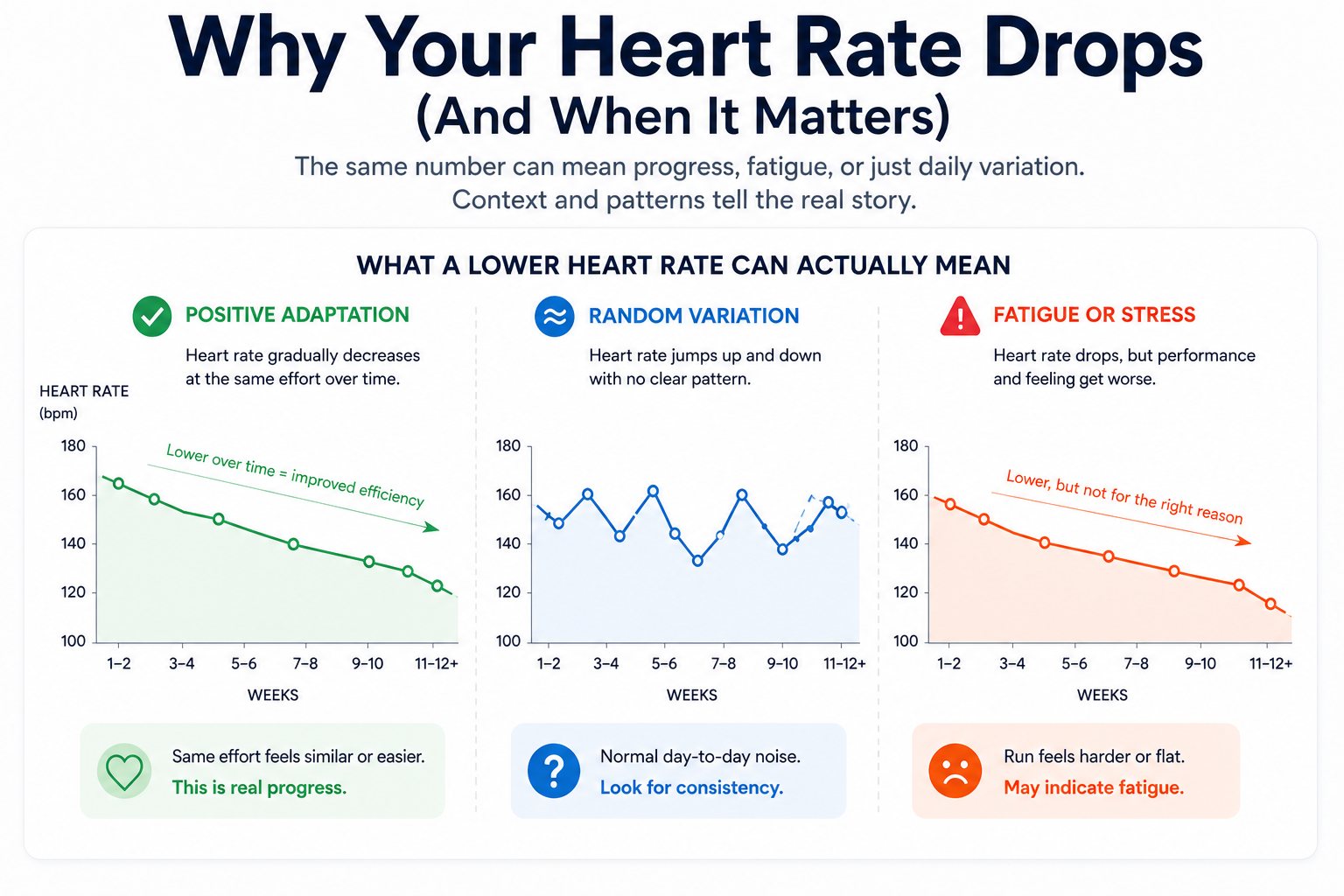
When heart rate drops and the run feels easier, more stable, and more repeatable, it often points toward positive adaptation.
But when heart rate drops while the body feels heavy, disconnected, or unusually unresponsive, the explanation may be completely different.
Fatigue, accumulated training stress, poor recovery, or even temporary suppression of the body’s normal response can all produce surprisingly low numbers.
To me, this is where many runners start learning the difference between collecting data and interpreting data.
The watch provides information. The body provides meaning.
And the most useful conclusions usually come from listening to both.
This often overlaps with Why You Feel Slower Even When You Are Improving, because performance, perception, and physiology do not always move in perfect alignment from one day to the next.
Heart rate is a signal, not a verdict.
It needs context to mean anything.
How to Read This in Your Own Training
Perhaps the most useful thing you can do is resist the urge to draw conclusions from a single run.
I think this is where many runners accidentally create confusion for themselves. One unusually low heart rate feels important. One unusually high heart rate feels concerning.
But the body rarely reveals meaningful changes through isolated data points. It reveals them through patterns.
If you begin noticing slightly lower heart rates at similar effort levels across multiple weeks, that becomes much more interesting. Especially if the runs also feel stable, controlled, and repeatable.
That combination often points toward genuine improvement in efficiency.
This idea sits at the heart of What Counts as Progress in Running, because meaningful progress is usually less dramatic than people expect. It tends to appear as small changes that continue showing up again and again.
On the other hand, a sudden drop in heart rate is usually best treated as information rather than confirmation.
I honestly believe this is one of the most valuable lessons runners can learn from training data. Not every number requires a conclusion. Sometimes the smartest response is simply curiosity.
How did the run feel? How did recovery look afterward? What happened during the next few sessions?
Over time, I think many runners realize that interpreting heart rate becomes much easier once you stop looking for answers in individual runs and start looking for patterns across entire weeks of training.
Because adaptation rarely announces itself in a single workout.
It usually reveals itself through consistency.
Conclusion
A lower heart rate is not valuable because the number itself is lower. It is valuable because it may reveal something about how your body is adapting.
I think this is where many runners gradually change the way they look at training data. At first, every number feels important. A lower heart rate feels like success. A higher heart rate feels like a problem.
But over time, the individual numbers become less interesting than the patterns behind them.
A single run can be influenced by almost anything. Adaptation is different. Adaptation repeats itself.
The same effort starts feeling more stable. The same pace requires slightly less strain. Similar patterns begin appearing across multiple weeks instead of a single session.
That is when a lower heart rate starts to matter. Not because it confirms progress by itself. But because it becomes part of a larger story your body has been telling for a while.
And honestly, I believe that is one of the most useful ways to think about heart rate. Not as an answer. As a clue that only becomes meaningful when viewed in context.
Frequently Asked Questions
Is a lower heart rate always a sign of better fitness?
No. It can indicate improved efficiency, but it can also reflect fatigue, stress, or external factors. Context matters more than the number itself.
How long should I track heart rate before drawing conclusions?
Look for patterns across multiple runs over several weeks. Single runs are not reliable indicators of progress.
What if my heart rate drops but the run feels harder?
This often points toward fatigue or reduced readiness rather than improvement. Pay attention to how your body feels alongside the data.
Should I adjust my training based on one low heart rate run?
No. Wait for consistency before making decisions. Training should respond to trends, not isolated data points.
If you want your easy and recovery runs to feel smoother and reduce unnecessary strain, the shoes you use can make a difference.
You can explore options in our guide to the Best Running Shoes for Daily Training (2026).