
You finish a run and notice something small but confusing. The pace is slightly faster than usual, maybe by ten or fifteen seconds per kilometer. But it didn’t feel any easier. Your breathing was the same, your effort felt unchanged, and if anything, you were just as aware of the work as always.
It creates a strange question. If you are improving, shouldn’t it feel easier?
This is one of the moments where many runners start doubting their progress. But in reality, this pattern is not a warning sign. It is often one of the clearest signals that your training is working exactly as it should.
If you want to stay consistent during tempo runs, having reliable pace feedback helps — especially when effort feels slightly off. A good running watch makes it easier to stay controlled without constantly second-guessing.
If you’re comparing options, our guide to the Best running watches for running breaks down what actually matters.
Why Pace and Effort Don’t Improve at the Same Time
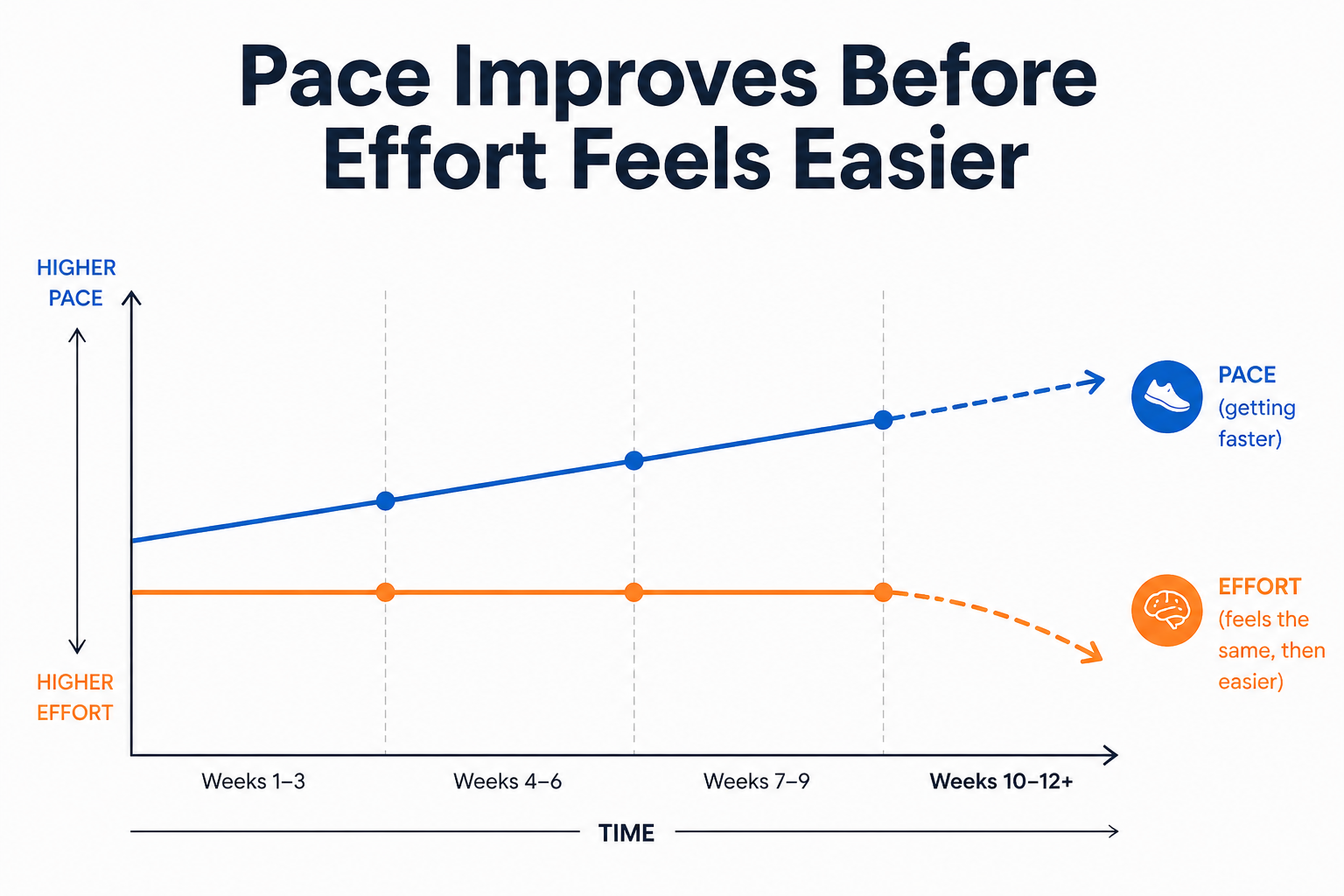
When your body adapts to training, it does not upgrade everything at once. The first thing that improves is your ability to produce more output at the same internal cost.
In simple terms, you can run faster without feeling better.
This happens because efficiency improves before perception does. Your muscles become more economical, your stride becomes slightly more stable, and your cardiovascular system delivers oxygen more effectively. But your brain still interprets effort in a familiar way.
This is why two runs can feel almost identical, even if one is objectively faster. The internal signal stays stable while the external result shifts.
If you have ever wondered what does easy pace actually mean, this is where the concept becomes more precise. Easy pace is not defined by how fast you move, but by how stable the effort feels.
The Hidden Layer of Progress Most Runners Miss
Most runners expect improvement to feel obvious. They expect easier breathing, lighter legs, or a sense of effort dropping over time.
But progress often shows up differently.
It shows up as consistency. It shows up as stability.
And sometimes, it shows up as speed that quietly increases without changing how the run feels.
This is why relying only on feeling can be misleading. Your perception of effort adapts slower than your physiology. The body becomes more capable before the mind recognizes the change.
If you have ever questioned how to tell if your running is improving, this is one of the most reliable indicators. Not dramatic breakthroughs, but subtle shifts where the same effort produces better outcomes.
Where This Shows Up in Real Training
This pattern is most visible in easy runs and steady efforts.
You go out expecting a typical easy run. The breathing settles, the rhythm feels familiar, and nothing stands out. But when you look at the data afterward, the pace is slightly faster than what used to feel the same.
This is not accidental.
It means your aerobic system is becoming more efficient. Your body is learning to sustain the same effort level at a higher output.
It also explains why runners sometimes struggle with why easy runs feel too hard. They expect effort to drop first, but in reality, pace often shifts first. The feeling catches up later.
Progress does not always feel easier.
Sometimes it feels the same — but produces more.
Why Effort Stays the Same Even When You Improve
Effort is not just physical. It is also interpretive.
Your brain builds a model of what a certain level of running should feel like. When your body improves, the brain does not immediately update that model. It continues to interpret the effort using familiar patterns.
This creates a lag.
You are running more efficiently, but it still feels like the same level of work. Over time, as your brain recalibrates, the effort may start to feel easier. But that comes later.
This is also why understanding heart rate vs pace in running becomes important. Heart rate often reveals that internal effort remains stable even when pace changes. It shows that improvement is happening beneath the surface.
What You Should Do When You Notice This
The instinct is often to push harder. If you are already faster, it feels natural to try to accelerate the progress.
But this is where many runners disrupt their own adaptation.
If effort is stable, that is exactly where you want to stay.
This is the foundation of building endurance correctly. When pace improves without increased effort, it means your system is adapting efficiently. Forcing additional intensity at this point often breaks that process.
If you want to understand how this fits into a bigger picture, it connects directly to how to build a weekly running structure. Progress is not created by constantly increasing intensity, but by allowing adaptation to settle before adding more load.
Conclusion
When your pace improves but effort does not, it does not mean something is missing. It means something is working.
Your body is becoming more efficient before your perception adjusts. The output changes first. The feeling follows later.
Instead of chasing a different sensation, the better approach is to recognize the pattern. Stable effort combined with improving pace is one of the clearest signs that your training is moving in the right direction.
It is quiet progress, but it is real.
Frequently Asked Questions
Shouldn’t running feel easier if I’m improving?
Not immediately. In many cases, improvement shows up as better performance at the same effort. The feeling of ease usually comes later, after your brain recalibrates.
Is it a good sign if my pace improves but heart rate stays the same?
Yes. This typically means your aerobic efficiency is improving. You are producing more speed without increasing internal load.
Should I increase intensity when I notice this?
No. Stable effort with improving pace is a sign to maintain your current structure, not to push harder.
How long does it take for effort to start feeling easier?
It varies, but perception usually lags behind physiological improvement. It may take several weeks of consistent training for effort to feel noticeably easier.
If you want to support this kind of controlled progress more precisely, using a reliable heart rate monitor can help you stay within the right effort zones.
A comparison like Best Heart Rate Monitors for Running can help you choose one that fits your training style.