Why Beginners Run Too Fast
Beginners often run too fast not because they are trying to run hard, but because they have not yet learned what easy running feels like.
Most beginners do not leave home intending to run hard. They simply start running.
The first few steps feel awkward, then the body finds a rhythm. The stride opens slightly. Arms begin moving naturally. For a moment, this feels like the speed running is supposed to happen at.
Then breathing starts changing. Not dramatically at first. You notice that speaking would require some effort. A few minutes later, breathing needs more attention. The legs are still moving perfectly well, so you continue.
By the final part of the run, you are working. This can happen without ever feeling as though you deliberately increased the pace.
I think that is why telling beginners to just run slower misses something important. They may already believe they are running slowly.
The watch says 7:00 per kilometer. Other runners are passing them. Perhaps walking would barely be slower. From every external reference point, this looks like slow running.
Physiologically, it may be nothing of the sort. As we explored in How Fast Should Beginners Run?, pace only becomes meaningful when you know what producing that pace costs the runner. Seven minutes per kilometre can be an easy jog for one person and a sustained moderate effort for another.
For a beginner, there is another complication. The speed at which running initially feels mechanically natural may be faster than the speed at which running feels aerobically comfortable.
Slow down enough and the movement becomes strange. Your stride shortens. Rhythm disappears. You begin to feel as though you are deliberately holding yourself back.
Speed up slightly and running feels smoother again. So you do. Then the cardiovascular cost catches up.
This creates one of the defining contradictions of early running: the pace that feels most like running may not yet produce an effort that feels easy.
The solution is not simply more discipline. Part of becoming a runner is learning another movement entirely. How to run without automatically turning running into work.
Slow Running Is a Skill Beginners Have Not Learned Yet
Experienced runners can make slow running look almost automatic.
They shorten the stride slightly, keep the body relaxed and settle into a rhythm that can continue for a very long time. The pace may be far below what they are capable of running, yet the movement still feels completely natural.
A beginner does not necessarily have that range yet. There may be a relatively narrow window between walking and the speed where running begins to feel coordinated. Once you enter that window, momentum encourages you forward. A slightly longer stride feels smoother. A little more speed improves the rhythm.
Unfortunately, each small adjustment also increases the demand. This is why trying to slow down can sometimes make a beginner feel worse rather than better. You become overly conscious of every step. The movement feels artificial, and you may start shuffling simply because you have decided that easy running must happen below a certain pace.
I would not try to manufacture an unnaturally slow running style just to satisfy the number on the watch.
If slowing down no longer makes the effort meaningfully easier, walking is often the cleaner solution. Walk until breathing settles. Then run again at a relaxed rhythm.
The approach in How to Start Running When You Can’t Run for Five Minutes works for exactly this reason. Walking is not only a response to being unable to continue. It can create the separation between running periods that allows each one to remain controlled.
Over time, something interesting happens. The gap between walking and comfortable running begins to change. You become better at producing relaxed movement at lower speeds. Shorter strides no longer feel quite so unnatural. Your breathing responds less dramatically when you begin running, and the pace that once immediately pushed the effort upward can eventually become ordinary.
In other words, you are not simply developing the fitness to run faster. You are developing the skill to run slower. That sounds almost backwards. For a beginner, it can be one of the most important running skills to acquire.
Beginners Often Mistake Effort for Progress
There is another reason faster running can feel right at the beginning.
You can feel it working. Breathing becomes stronger. The heart beats faster. The legs begin to tire. When the run ends, there is a satisfying sense that you have done something substantial.
A genuinely easy run can feel almost suspicious by comparison. You finish with energy left. Breathing returns to normal quickly. Perhaps you even wonder whether the session was long or hard enough to improve anything.
For someone new to endurance training, effort is an intuitive way to measure value.
Harder feels like more training. Faster looks like more progress.
Neither relationship is quite that simple.
A large part of early running development comes from accumulating running that the body can absorb and repeat. The session does not need to produce obvious exhaustion before it can contribute to adaptation.
This is where What an Easy Run Should Feel Like becomes useful. Easy running is not defined by the absence of physiological work. It is an intensity low enough that the work remains controlled while you accumulate it.
That distinction takes time to trust. If you have spent your first few weeks finishing every run noticeably tired, slowing down can initially feel as though you have stopped training properly. You may even finish an easier run and immediately want to add another kilometre because there seems to be too much left in the tank.
But having something left is not evidence that the run failed. It may be evidence that you finally controlled it.
This is one of the mental shifts that gradually changes beginner running. You stop asking whether the session was hard enough to count and start noticing whether the effort was appropriate for what you wanted the run to do.
The Run Effort Check Calculator can help with that distinction because it asks you to interpret the character of the run rather than judge it from pace alone.
Eventually, an easy run stops feeling unfinished. It simply feels easy. And once you trust that easy running can still be productive, there is much less reason to turn every run into proof that you worked hard enough.
The Watch Can Quietly Pull You Into Faster Running
Even when you are not deliberately chasing pace, the watch can make it difficult to ignore. You glance down and see 7:12 per kilometer.
A few minutes later it says 7:05. Then 6:58. Nothing dramatic has happened, but 6:58 somehow feels better than 7:12. So you maintain it.
This is one of the peculiar effects of running with live pace data. A number that was supposed to describe your movement can quietly become a target.
Beginners are particularly vulnerable to this because they do not yet have many internal reference points. An experienced runner often knows roughly what easy running feels like before looking at the watch. A beginner sees the number first and then starts deciding what the run should feel like around it.
Heart rate can create exactly the same problem from the opposite direction. Instead of trying to keep pace high enough, you start trying to keep heart rate low enough. The run becomes a continuous sequence of small corrections based on whatever number happens to be on the screen.
This is why the idea in Should Beginners Track Heart Rate? extends beyond heart rate itself. Running data becomes much more useful when it helps you interpret an experience you are already learning to recognize rather than constantly directing that experience.
There is a simple experiment worth trying.
Hide pace.
Run a familiar route at an effort that feels deliberately manageable. Let breathing and movement settle without checking whether the resulting speed looks good.
Then look at the data afterwards. The first surprise may be how variable the pace was.
A small hill slowed you down. A downhill section made you faster. Perhaps the final kilometre was quicker even though you never consciously increased the effort.
That variability is not a problem. It is what happens when effort controls pace rather than pace controlling effort. Over repeated runs, you begin building something much more useful than the ability to hold an arbitrary number.
You develop an internal reference for easy running. Eventually you can glance at the watch and understand the number without immediately obeying it.
That is when pace data starts becoming genuinely useful. The watch returns to describing the run. You return to running it.
Faster Running Can Feel Better Before It Feels Harder
There is another reason beginners drift toward faster running that has very little to do with ambition.
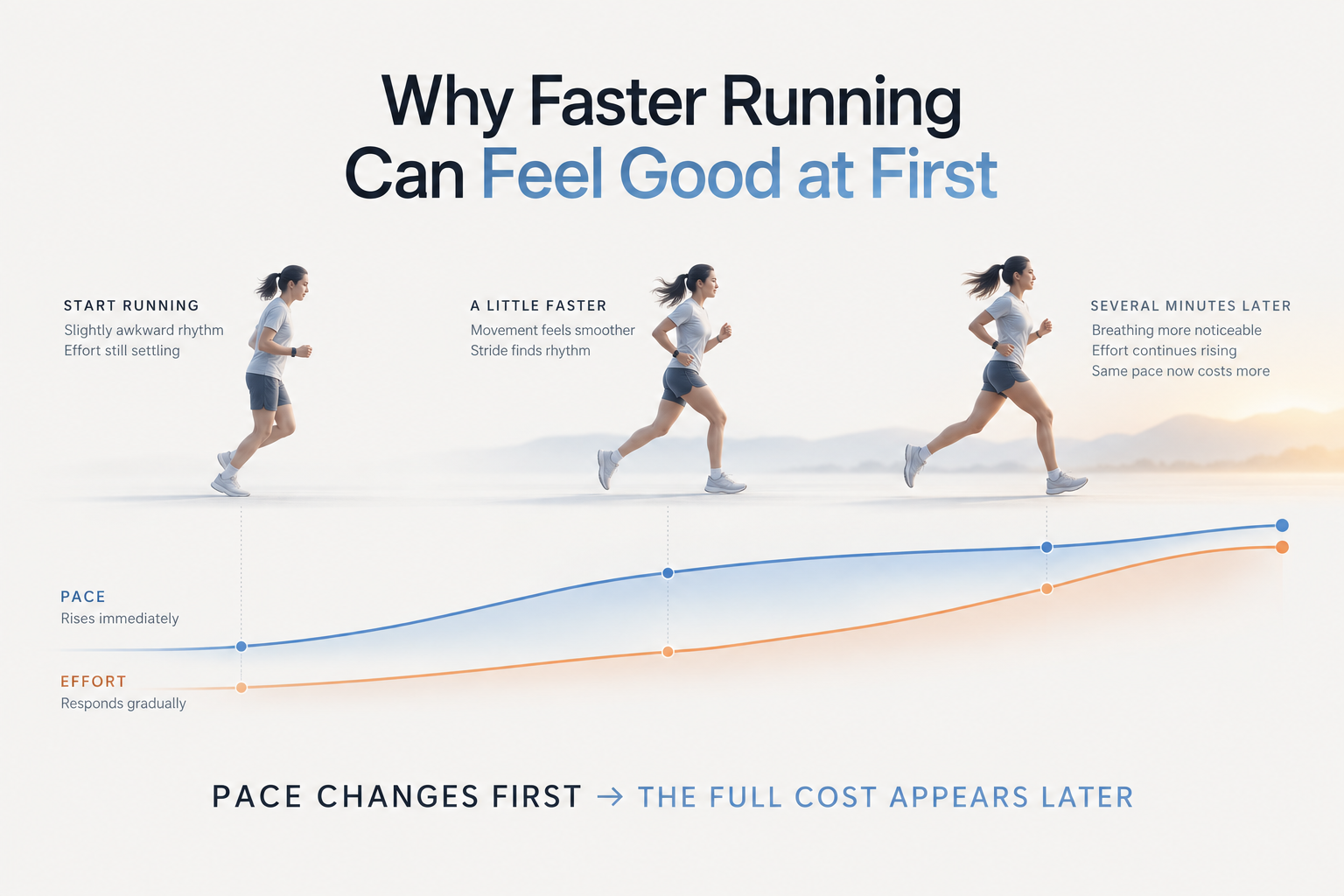
The faster pace can genuinely feel better. You start slowly and the movement feels slightly awkward. Then you increase the pace. Your stride opens, momentum improves and suddenly everything seems to click.
For a while, the faster pace may even feel easier. This is where perceived effort can be deceptive. The mechanical sensation changes immediately. The cardiovascular cost does not.
Heart rate takes time to respond. Breathing may remain comfortable for the first few minutes. Fatigue has not accumulated yet. So the body gives you a short period where the quicker rhythm feels smoother without immediately revealing what maintaining that rhythm will cost.
Ten or fifteen minutes later, the picture is different.
Breathing has moved upward. The legs are working harder. The pace that initially felt wonderfully natural now requires concentration to maintain.
Nothing suddenly went wrong. You simply discovered the difference between a pace that feels good to enter and an effort that remains manageable to sustain.
I think this is why the beginning of a run can be such a poor place for a beginner to decide how fast the whole run should be. The first minutes have not given you enough information yet.
Let the effort settle. Give breathing time to respond. Notice whether the pace still feels natural once you have been running for a while rather than only during the moment when you accelerated into it.
The Easy Run Drift Calculator can later make this relationship visible in the data. A run can begin with a seemingly comfortable combination of pace and heart rate, then gradually require greater cardiovascular effort even though the speed barely changes.
That does not mean every rise in heart rate is a problem. It means sustainability reveals something that the first few minutes cannot.
An easy pace is not simply the speed that feels smooth when you find it. It is a speed whose effort remains under control after you have stayed there.
Running Too Fast Can Make Every Run Feel the Same
If this pattern continues, something slightly strange happens to the training.
There is very little contrast. You go out for an ordinary run and settle into the pace that feels natural. The first part is comfortable enough, the middle becomes more demanding, and by the end you know you have been working.
Two days later, you do roughly the same thing again. The route may change. The pace may vary slightly. But physiologically, the experience is remarkably similar.
Almost every run lands somewhere in the middle. Too demanding to feel genuinely easy.
Not hard enough to be a clearly intentional hard session. This can work for a while, particularly when you are new to running and almost any consistent running provides a training stimulus. But as running becomes more established, the lack of contrast starts to matter.
Easy running has a particular advantage: you can accumulate it without requiring a large amount of recovery afterwards. If every run carries more effort than necessary, each session takes slightly more from the next one.
That can affect frequency too.
A beginner may conclude that three runs per week are already all they can recover from when the real issue is not necessarily the number of running days. The ordinary runs themselves may simply be too demanding. The relationship discussed in How Often Should Beginners Run? becomes easier to interpret once the runs between those recovery days are genuinely manageable.
This is also where learning to run slowly begins opening the door to faster running rather than preventing it. Once easy actually feels easy, a faster effort has somewhere to go.
You can feel the difference. Breathing changes deliberately rather than accidentally. Pace rises because you decided to make the run harder, not because every run naturally drifted there. Afterwards, you can return to easy running and recover from the additional demand.
That is the beginning of training having structure. Before that, I would not worry much about creating different workouts.
Create different efforts first. Learn what it feels like to finish a run without having gradually turned it into work. Then, when you eventually choose to run faster, faster running will actually be something different.
Conclusion
Beginners run too fast for surprisingly understandable reasons. Faster running can feel mechanically smoother.
A harder run can feel more productive. The watch makes faster numbers look like better numbers.
And when you have not yet developed a clear internal sense of easy effort, the pace your body naturally chooses can be more demanding than you realize.
None of this means you need to become obsessed with running as slowly as possible. That can create a different version of the same problem. If you spend the whole run staring at pace, shortening your stride unnaturally and trying to stay below an arbitrary number, the number is still controlling the experience.
The better skill is learning what happens when effort remains manageable. Breathing settles rather than continually escalating. The first comfortable rhythm is still comfortable twenty minutes later.
You finish because the planned run is over, not because continuing has become increasingly unpleasant. And afterwards, the run leaves relatively little behind.
Beginners often run too fast not because they are trying to run hard, but because they have not yet learned what easy running feels like.
That skill develops with repetition. Eventually, you discover that you can move naturally without automatically turning the run into work. Slower running stops feeling artificial. You begin recognizing when pace is drifting upward before the watch tells you.
And something else happens. You become faster.
Not because every ordinary run was used to practise speed, but because the body becomes better at running. The same manageable effort gradually produces more pace.
That is also why beginner footwear does not need to be built around speed. A comfortable, versatile daily shoe is enough for most of this learning process, and Best Running Shoes for Daily Training 2026 looks at shoes designed for exactly that kind of repeated everyday running.
Slowing down is not the absence of running skill. Learning how to stay relaxed at a lower effort is part of developing it. There will be time to practice running fast. First learn how not to run fast accidentally.
Frequently Asked Questions
Why do beginner runners run too fast?
Often because the speed at which running initially feels coordinated is faster than the effort they can comfortably sustain. Beginners also have less experience recognizing easy effort, while pace numbers and the feeling of working hard can make faster running seem more productive.
How do I know if I am running too fast?
Notice what happens as the run continues. If breathing steadily becomes harder, movement becomes less relaxed and the final part requires significantly more concentration than the beginning, your pace may be too demanding for an ordinary easy run.
What if running slowly feels awkward?
That is common when you are new to running. You do not necessarily need to force an extremely slow shuffle. If slowing down makes the movement awkward without sufficiently reducing effort, short walking periods can help lower the demand before you begin running again.
Should I ignore pace when I start running?
You do not need to ignore it completely, but it can be useful to stop treating live pace as a target. Try running some sessions by manageable effort and reviewing the pace afterwards. Over time, this helps you connect the number with an effort you already recognize.
Is it better to run slowly or walk?
Whichever allows you to control the overall effort. Walking is not inferior to extremely slow running when continuous running is still too demanding. A combination of relaxed running and walking can produce a much more sustainable beginner session.
Why does a faster pace sometimes feel easier?
A slightly faster speed can improve rhythm and make the movement feel mechanically smoother. The additional cardiovascular demand may take several minutes to become obvious, however. A pace that feels good when you accelerate into it is not necessarily an effort that will remain comfortable throughout the run.
Will running slowly make me a slower runner?
No. Manageable running allows you to accumulate repeated aerobic and running-specific training without making every session highly demanding. As fitness and running economy improve, the pace produced at the same effort can become faster naturally.
When should beginners start running faster?
Once ordinary running is genuinely manageable and recovery is predictable, faster running can gradually become useful. There is no need to rush into structured speedwork. First create enough separation between easy and harder effort that faster running actually represents a different training demand.