
Why Rest Days Matter More Than You Think
A rest day is not a day when training stops. It is part of the process that allows the previous training to become useful.
One of the strangest things about becoming a runner is how quickly a day without running can start to feel unproductive. At first, simply getting out for a run feels like an achievement. Then running becomes more familiar.
You finish a session feeling good. The following morning your legs are not particularly sore. Perhaps you even feel as though another easy run would loosen them up. So you start wondering what the rest day is actually doing.
Nothing hurts. You have enough energy. You could run. Why not? This is where I think the idea of recovery becomes slightly misleading.
We often notice recovery only when we clearly need it. Heavy legs, soreness and general fatigue make the argument obvious. Rest feels justified because something needs to recover.
But a rest day does not become useful only when you feel tired. Running creates a demand on the body, and the response to that demand continues after the run has finished. Muscles and connective tissues have absorbed repeated impact. Energy has been used. The nervous system has coordinated thousands of remarkably similar movements. Your body has been given information about what it needs to become better prepared to do again.
The absence of soreness does not mean all of that work is complete. This distinction is especially important for beginners because your cardiovascular fitness can sometimes make running feel available before the rest of the body is equally accustomed to repeated running.
You may genuinely feel capable of another run. That does not automatically mean another run is the most useful thing you can do.
This is one reason What Is a Rest Day in Running (And How To Do It Right)? matters beyond simply deciding whether a rest day should contain complete inactivity. The more important idea is understanding what recovery is doing inside the structure of training.
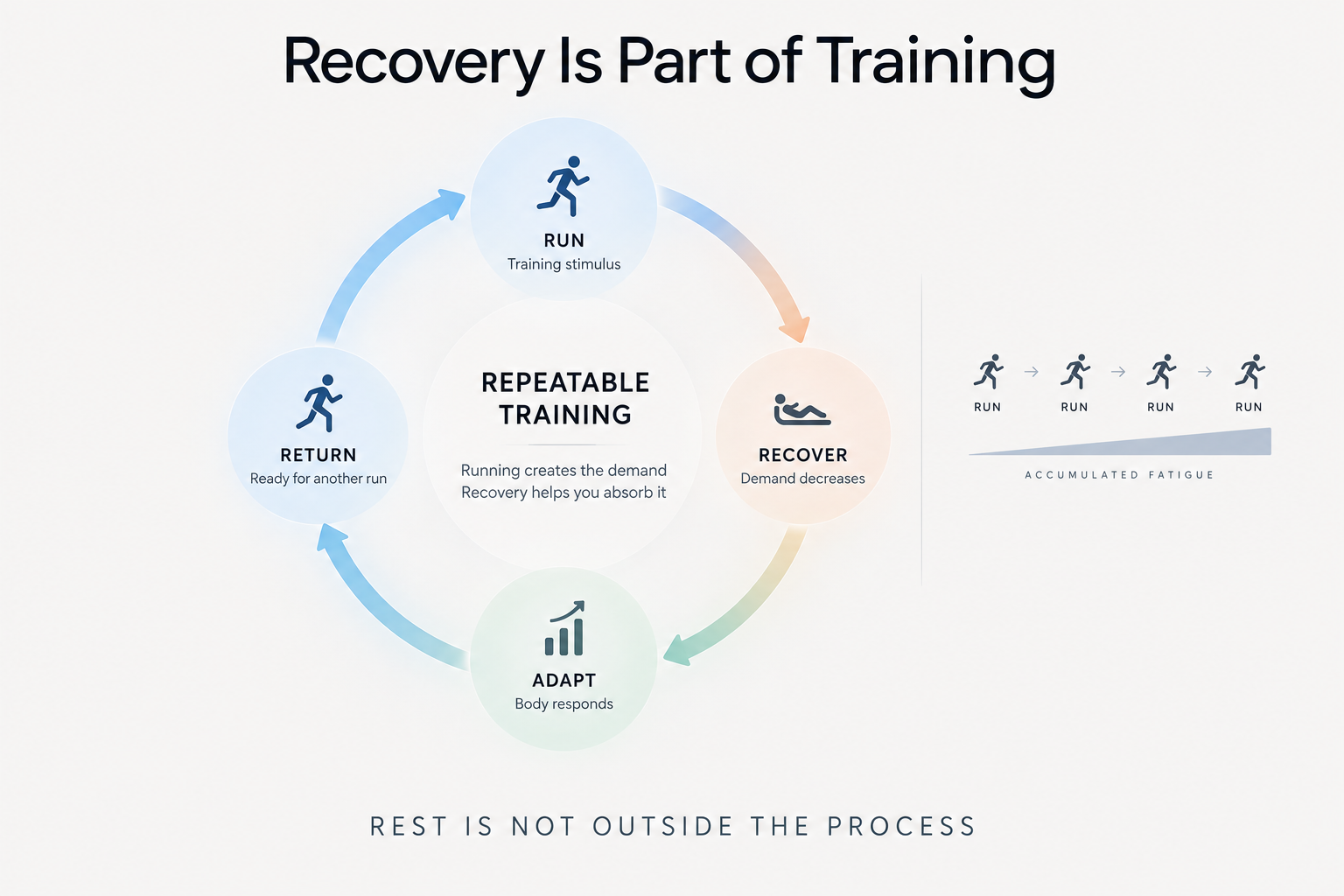
A run provides the stimulus. Recovery gives the body time to respond to it. Then you run again. Seen that way, the rest day is no longer an empty square between two workouts. It belongs to the same process as the workouts themselves.
Feeling Recovered Is Not the Same as Being Fully Adapted
One of the easiest mistakes to make is using soreness as the main measure of recovery. If your legs hurt, you understand why you might need another day. If they feel normal, the argument becomes much less convincing. But soreness is only one signal, and it is a particularly obvious one.
You can wake up feeling perfectly capable of running while some of the adaptation created by the previous run is still taking place. That does not mean your body is damaged or that running again would automatically be a mistake.
It simply means that feeling ready to perform another run and having fully absorbed the previous one are not exactly the same thing.
This becomes easier to notice when you look across several days rather than judging each morning independently.
Monday’s run feels good. Tuesday feels good too, so you run again. Wednesday is still acceptable. By Thursday, the legs are slightly flatter and the same easy pace requires a little more effort.
Nothing dramatic happened on any individual day. The cost accumulated quietly.
The Recovery Check Calculator can be useful here because it shifts the question away from whether you are capable of running today and toward the broader signals that tell you how well recent training is being absorbed.
I think this is also why rest days can feel less important as fitness improves. The fitter you become, the less obvious the immediate cost of an ordinary run may be. You finish with plenty left. A few hours later, running barely feels as though it happened.
That is progress. But it does not automatically turn recovery into wasted time. In fact, the ability to recover well is part of what eventually allows you to train more. You do not earn additional running days by proving that you can tolerate running while slightly tired. You earn them because the running you are already doing has become easy enough to absorb repeatedly.
That difference is subtle. Over weeks and months, it becomes extremely important.
Rest Days Protect the Quality of the Runs Around Them
A rest day is easy to judge in isolation. You did not run, so nothing was added to the training log. But that is probably the least useful way to look at it. The better question is what the day allows you to do afterwards. Imagine two runners completing roughly the same amount of running across a month.
One keeps adding short runs whenever the legs feel reasonably good. Very few individual sessions are difficult, but there is almost always some residual fatigue underneath the next one.
The other leaves deliberate gaps between running days. That runner may appear to be doing less.
But when the next run begins, the legs are fresher. Easy running actually stays easy. Movement feels more natural. And when a harder session eventually becomes appropriate, there is enough capacity available to make that session meaningfully different from an ordinary run.
This is where recovery begins affecting more than fatigue. It affects the quality of the training structure.
If every run begins with a little of the previous run still present, the differences between sessions can gradually disappear. Easy runs become slightly harder than intended. Longer runs become more tiring than they need to be. A session that was supposed to introduce a new stimulus may instead become another exercise in managing accumulated fatigue.
That is why How to Tell If Your Training Load Is Too High (Without Metrics) is useful even before a runner thinks of themselves as doing particularly serious training. Excessive load does not always announce itself with one terrible workout. Sometimes it appears as a gradual change in what ordinary running feels like.
A rest day interrupts that accumulation. Not because every runner needs to be completely fresh before every run. And not because fatigue itself is something to avoid. Training inevitably creates fatigue. The point is to create enough space that fatigue does not quietly become the background condition of all your running.
Seen across a week, the rest day is therefore doing something surprisingly active. It is helping the easy run remain easy. It is helping the harder run eventually become genuinely harder. And it is helping each run do the job you intended it to do, rather than simply adding another layer of tiredness to the one before it.
Rest Days Make Consistency Easier, Not Harder
Consistency is not how rarely you rest. It is how reliably you can return to running.
There is a small psychological trap in running. When motivation is high, consistency can start to look like frequency. If you ran yesterday and you run again today, you are being consistent.
If you take today off, the sequence has been interrupted. That makes sense when you look at individual days. It makes much less sense when you look at months.
Real consistency is not created by avoiding gaps between runs. It is created by being able to return to running again and again without repeatedly needing longer gaps because you asked too much of yourself earlier.
For a beginner, I think this distinction matters enormously. You are not yet trying to see how much running you can fit into seven days. You are trying to establish an amount of running that can survive the next seven days, and the seven after that.
That changes what a rest day means. Tuesday without running is not necessarily a break in consistency if it helps Wednesday’s run remain manageable. Two days without running are not lost training if they allow the following week to begin normally rather than with fatigue carried forward from the previous one.
This is also why the answer to Should Beginners Run Every Day? is more interesting than simply deciding whether daily running is possible. Plenty of people can run on consecutive days. The more useful question is whether doing so improves the pattern of training they are trying to build.
Sometimes it will. As running experience grows, individual easy runs may become inexpensive enough that consecutive running days fit naturally into the week. Rest days may become less frequent without disappearing entirely. But that should usually happen because your capacity has changed. Not because rest itself has become something you are trying to eliminate.
That creates a very different relationship with the days when you do not run. Instead of seeing them as interruptions in the habit, you begin seeing them as part of what makes the habit sustainable.
The run is still the visible part. The ability to keep coming back for it is the part that matters more.
You Do Not Need to Earn a Rest Day
There is another reason runners sometimes resist rest days that has little to do with physiology. Rest can feel as though it needs to be justified. After a long run, perhaps. After a particularly hard workout. When the legs are sore. When you have clearly done enough to deserve a day off.
But after an ordinary easy run, taking the next day completely away from running can feel almost excessive. If yesterday was not particularly difficult, what exactly are you recovering from?
I think this way of thinking quietly turns recovery into a reward for hard training. That is backwards. Rest does not need to be proportional to how heroic the previous run felt. Its role is to help regulate the accumulation of training across time.
For a beginner, this matters because individual runs can look modest while still representing a substantial new load. Thirty minutes of easy running may not feel like a major workout, but if your body is only beginning to become familiar with thousands of repeated running steps, the training demand is not captured by how impressive the session looks.
This is also where adding running becomes deceptive. One extra short run seems almost too small to matter. Then another becomes possible. None of them is difficult enough to create obvious fatigue, yet the week has gradually changed.
The Training Load Check Calculator can help make that accumulated change more visible, particularly when no single run seems responsible for how the week eventually feels.
A planned rest day avoids having to wait for a warning before recovery becomes legitimate. You do not have to wake up tired enough. You do not have to feel soreness. You do not have to prove that yesterday’s run was difficult. Sometimes you rest simply because recovery was already part of the training structure.
That may feel unnecessarily cautious when everything is going well. But there is a useful irony here. The best rest days often happen when you feel as though you do not need them. Because good recovery is not only what you do after training has become too much. It is one of the reasons it never had to become too much in the first place.
Rest Days Do Not Have to Mean Doing Nothing
Once you accept that rest belongs inside training, another question usually appears. What are you actually supposed to do on a rest day? For some runners, the answer is genuinely very little.
For others, a walk feels good. Normal daily movement continues. You might do some gentle mobility, spend time outside, or simply live the rest of your life without turning the day into another training session.
The distinction I find useful is not between movement and complete inactivity. It is between recovery and additional training demand.
A relaxed walk that leaves you feeling better afterwards is very different from replacing the planned run with a hard cycling session because doing nothing felt uncomfortable. An easy bike ride can certainly be useful cross-training, but once it becomes long or demanding enough, it is no longer performing the same role as recovery.
The same applies to strength work. Moving strength training onto every non-running day may create a beautifully full weekly calendar while quietly removing the recovery that those spaces were supposed to provide. How to Combine Strength Training with Running Properly becomes useful here because strength work has to be considered as part of the total training week, not as something that exists outside running load simply because it is not running.
This is why I would not define a successful rest day by what activities are allowed. I would define it by what the day leaves behind. If some light movement helps you feel better, there is little reason to fear it. If the activity creates another meaningful recovery demand, then you have not necessarily done anything wrong.
You have simply changed the purpose of the day. And sometimes the most useful thing about a rest day is precisely that nothing needs to replace the run.
You do not have to maintain fitness every twenty-four hours. You can leave some space in the week. Training will still be there tomorrow.
Conclusion
The longer you run, the easier it becomes to think of training as the part where something is happening.
You ran for forty minutes. You covered a certain distance. You completed the workout. The following day is much harder to see. There may be nothing to record and nothing obvious to improve. You simply do not run.
But your body does not organize training according to what appears in the training log. The run creates a demand. Recovery gives you time to respond to that demand.
Adaptation gradually changes what you are capable of doing the next time. Then you run again. That does not mean more rest is always better. As you become fitter and more accustomed to running, you may recover from ordinary runs quickly enough to run on consecutive days. Your weekly structure can become denser because your capacity to absorb running has changed.
But that is very different from trying to remove rest because you have started seeing it as wasted time. The goal is not to maximize running days. It is to find a rhythm in which running and recovery can keep producing adaptation together.
There is a similar simplicity in the equipment you need for that process. Most runners do not need a shoe rotation built around every possible session, especially early on. A comfortable everyday shoe that works reliably across ordinary training is often enough, which is the thinking behind Best Running Shoes for Daily Training 2026.
Eventually, a rest day may become one of the least remarkable parts of your training week.
You do not need to feel exhausted before taking it. You do not need to earn it. And you do not need to compensate for it.
You run. You recover. Your body adapts. Then you give it another reason to adapt.
Frequently Asked Questions
How many rest days should a beginner runner take?
There is no fixed number that works for everyone, but beginners often benefit from leaving recovery between running days rather than immediately trying to run every day. The useful number depends on how much running you are doing, how familiar your body is with it and how well you are recovering across the week.
Is one rest day a week enough for runners?
It can be for an experienced runner whose body is accustomed to frequent running. A beginner may benefit from more. Instead of treating one rest day as a minimum or maximum, look at whether your current pattern allows ordinary runs to remain manageable and recovery to remain predictable.
Should I take a rest day if I am not sore?
Yes, you can. Soreness is not a requirement for recovery to be useful. A planned rest day can help manage accumulated training even when your legs feel completely normal.
Is walking okay on a rest day?
Usually, yes. Normal daily movement and relaxed walking do not automatically turn a rest day into a training day. What matters is whether the activity adds meaningful fatigue or recovery demand.
Can I cycle on a rest day?
An easy ride may function as light recovery for some runners, but intensity and duration matter. Once the ride becomes a substantial workout, it should be considered part of your total training rather than treated as rest.
Should I rest if my legs feel heavy?
Heavy legs can be a useful reason to reconsider the planned run, particularly if the feeling is unusual or has been accumulating across several sessions. The Today’s Run Decision Calculator can help separate a normal slightly tired day from a broader pattern suggesting that reducing today’s training may be sensible.
Will I lose fitness on a rest day?
No meaningful running fitness is lost because you take a normal rest day. Fitness develops over much longer periods than twenty-four hours, and recovery between training sessions is part of the process that allows consistent training to continue.
Do experienced runners still need rest days?
Many do, although their recovery structure may look different. As running becomes more familiar, easy sessions can become inexpensive enough to place on consecutive days. The important question remains whether the overall training load is being absorbed rather than whether every week contains a predetermined number of complete rest days.