Should Beginners Run Every Day?
Being able to run again tomorrow is not the same as being fully ready to benefit from running again tomorrow.
There is something appealing about doing a new thing every day.
If you have finally decided to start running, a daily routine can feel like the simplest way to make the habit stick. You do not have to decide which days are running days. You wake up, put on your shoes and go.
And after the first few runs, you may discover that you actually can. Your legs are a little tired, perhaps, but nothing hurts. The run is short. Breathing settles quickly afterwards. By the following morning, another easy jog seems perfectly possible.
So why not run every day? The problem is that being capable of completing another run is not quite the same as being ready to absorb another run.
When running is new, the cardiovascular effort is only part of what the body is adapting to. Muscles, tendons, feet and lower legs are also experiencing thousands of repeated running steps that they may have had very little exposure to before.
Some of that adaptation happens quietly. You do not necessarily wake up sore after every run. There may be no obvious signal telling you that the previous session is still being absorbed. Yet repeating the same unfamiliar loading day after day removes the spaces in which you would otherwise get to observe how your body is responding.
This is why the approach in How Often Should Beginners Run? leaves room between sessions. Two or three running days can already provide repeated exposure to running without requiring every day to become another exposure.
That does not make the days between runs empty. You can walk. You can move normally. You can enjoy the fact that yesterday’s run no longer feels quite as significant as the first one did.
More importantly, you get to see whether the body returns to baseline. Do the calves feel normal again? Does stiffness disappear once you have been moving for a while?
When the next running day arrives, do you feel as though you are starting a new run rather than continuing to carry the previous one? Those observations are especially valuable at the beginning because you do not yet know how quickly your body absorbs running.
Running every day removes much of that information. A rest day gives you a chance to see it.
Daily Running Can Hide Accumulating Fatigue
One reason daily running can seem to work at first is that fatigue does not always arrive as a clear warning.
You may finish Monday feeling fine. Tuesday is slightly less comfortable, but still manageable. On Wednesday the legs take a little longer to loosen up. By Thursday, the first ten minutes feel heavier than they did earlier in the week.
None of those runs necessarily feels bad enough to stop. That is what makes accumulating fatigue easy to miss. Instead of one obvious difficult session, you get a series of small changes. The calves remain slightly tighter. The legs feel less responsive. A pace that felt comfortable a few days earlier requires a little more effort.
Because you can still run, it is tempting to interpret all of this as normal training. Sometimes it is. But for a beginner, there is another possibility: you are simply adding the next running stimulus before the previous ones have completely settled.
This is where Recovery Check Calculator can be more useful than asking whether you technically feel capable of running. Recovery is not a binary state where you are either exhausted or perfectly fresh. What matters is whether small signs of fatigue are beginning to accumulate rather than disappear between sessions.
And daily running gives them very little opportunity to disappear. I think this is particularly important because aerobic fitness can create a misleading sense of readiness. Someone who walks a lot, cycles or has a reasonable general fitness level may find that their breathing recovers from beginner runs remarkably quickly.
The legs can still be adapting to running-specific load. You can therefore feel fit enough to run every day before your body has accumulated enough running experience to make every day a sensible choice.
A day without running interrupts that accumulation. Not your progress. The distinction matters.
Rest Days Help Running Become Repeatable
There is another way to look at the days when you do not run. They are practice for the week you are eventually trying to build.
A beginner sometimes thinks consistency means avoiding interruptions. If you run on Monday, Tuesday and Wednesday, you have created a three-day streak. Taking Thursday off can therefore feel as though the streak has been broken. But running consistency is not really measured in uninterrupted days.
It is measured in weeks and months. Three runs this week, followed by three runs next week, is a much more meaningful pattern than running seven days in a row and then needing several days before the legs feel normal again.
That is why I would treat recovery as part of the habit rather than an exception to it. The principles in What Is a Rest Day in Running (And How To Do It Right)? become useful surprisingly early. A rest day does not require complete inactivity, and it does not mean something has gone wrong with the training. It simply removes another running stimulus while the body responds to the ones you have already given it.
For a beginner, that response is the whole point. You run. The body encounters a demand it is not yet completely accustomed to. Then you give it time to deal with that demand before repeating it.
As this cycle happens again and again, running gradually creates less disruption. The legs recover sooner. Minor stiffness becomes less noticeable. The next session starts feeling increasingly independent from the previous one.
That is consistency becoming sustainable. And I think this is where the idea of a running streak can become misleading for someone just starting out. A streak rewards the presence of running.
Your body responds to something slightly different: the balance between running and the ability to recover from it. At the beginning, protecting that balance is far more useful than protecting an unbroken chain of days.
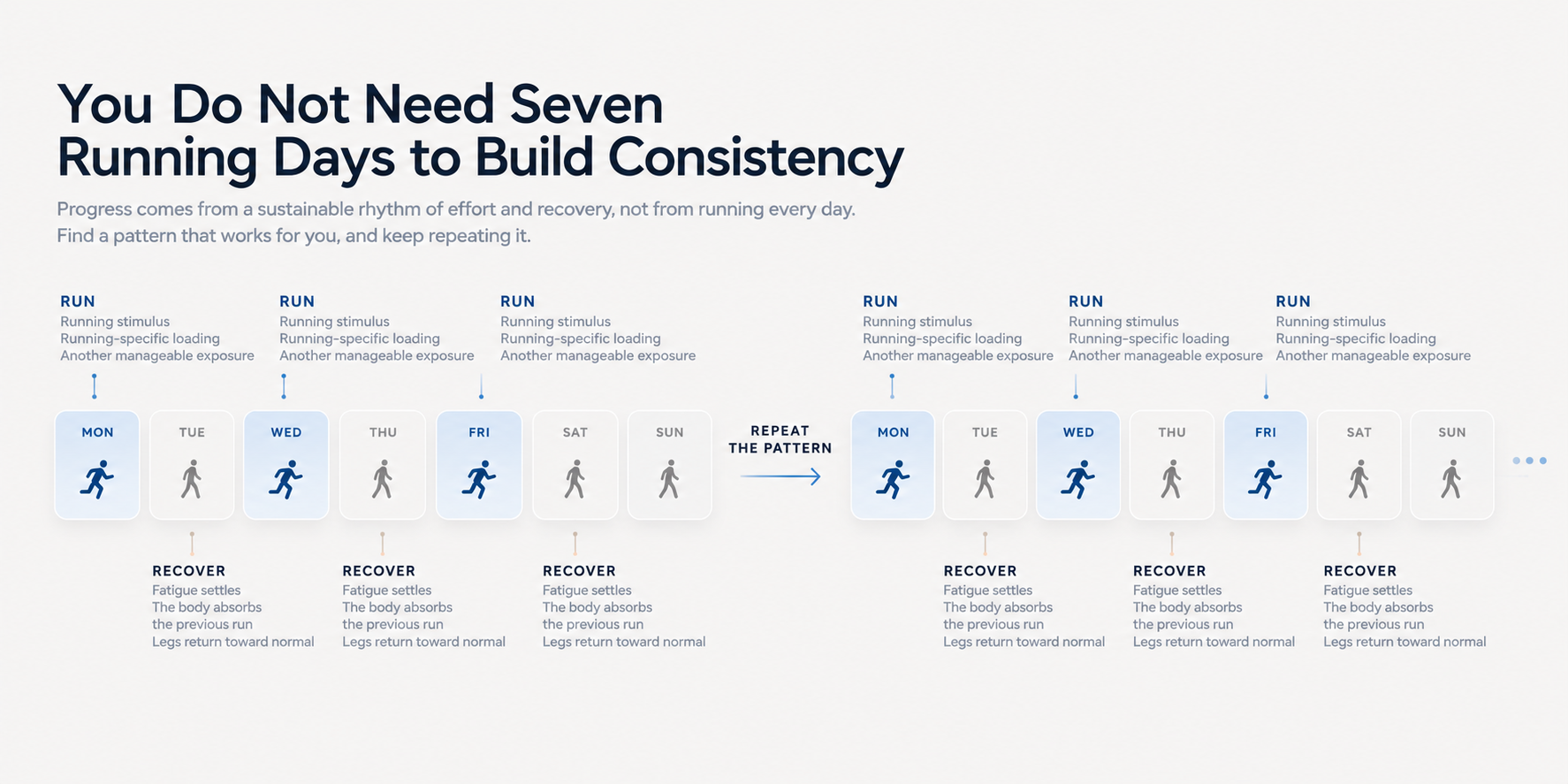
You Do Not Need to Run Every Day to Build the Habit
There is a reasonable argument behind daily running that has nothing to do with fitness. Habits become easier when they are simple.
Running every morning removes negotiation. There is no need to look at the calendar or decide whether today is a running day. The routine itself becomes automatic.
I like that idea.
I just would not make running the part that has to happen every day. You can preserve the routine while changing what happens inside it.
Perhaps you go outside at roughly the same time each morning. On running days, you run. On the days between them, you walk. The shoes still go on, you still leave the house and the same part of the day remains associated with movement.
What disappears is the requirement that every repetition of the habit must also create another running load. This can be particularly useful when enthusiasm is moving faster than adaptation.
The first few weeks often produce a strange combination: running is still physically difficult, but psychologically you may be unusually motivated. You have started something new, progress is noticeable and naturally you want to keep doing the thing that seems to be producing that progress.
That is a good problem to have. It just does not require seven running days. The broader principle from How to Build an Aerobic Base fits well here. Aerobic development comes from repeated sustainable training accumulated over time, not from squeezing the greatest possible number of running sessions into the beginning.
Walking between runs does not cancel that process. Neither does a complete day off. In fact, if those days allow you to arrive at the next run with responsive legs and controlled effort, they may be part of what keeps the process moving.
The habit you are trying to establish is therefore larger than daily running. It is returning to running regularly. Those two things can look almost identical on a calendar for a few days. Over several months, they can lead to very different places.
When Does Running More Often Start to Make Sense?
None of this means running on consecutive days is something a beginner must avoid forever. The interesting part is noticing when the relationship with recovery begins to change.
At first, a run may leave a clear footprint. You notice it later that day, perhaps the following morning, and sometimes when you begin the next session. Even if the fatigue is mild, running still creates enough disruption that a day between sessions feels useful.
Then the footprint becomes smaller. A short easy run no longer changes how the legs feel the following day. Stiffness disappears quickly. Your normal running distance feels familiar rather than demanding, and the next session does not seem to inherit much fatigue from the previous one.
That is a more meaningful reason to consider running more often. Not because you have completed a certain number of weeks. Because your current amount of running has become easier to absorb. Even then, I would not jump from three running days to seven. One additional short, genuinely easy run tells you much more.
The important observation comes afterwards. Did the extra run simply fit into the week, or did it change the runs around it? If easy running suddenly feels less easy, the legs remain persistently heavy or recovery begins stretching from one session into the next, the extra frequency may have arrived before it was useful.
This is where How to Decide Between Easy, Moderate, or Hard on Any Day becomes relevant even before a beginner has a sophisticated training structure. The fact that you have decided to run today does not mean the run has to become substantial. Learning to keep an additional session genuinely easy is part of learning to tolerate greater frequency.
Eventually, some runners reach a point where consecutive running days feel completely ordinary. Some may later enjoy running almost every day. Others can become very capable runners while continuing to prefer four or five running days per week.
There is no particular weekly number that proves you have progressed beyond beginner running. The meaningful change happens earlier. Running stops leaving such a large footprint that you need to organize the entire week around recovering from it.
Running Every Day Should Be an Outcome, Not a Starting Rule
There is a subtle difference between gradually becoming someone who can run every day and deciding at the beginning that you are going to.
The first is adaptation. The second is a schedule.
A schedule can ask for seven runs whether your body is ready for seven runs or not. Adaptation works in the opposite direction. You begin with an amount of running you can absorb, repeat it, and allow greater frequency to become available as the cost of each run becomes smaller.
That distinction becomes especially important when progress starts arriving.
A beginner who has moved from struggling through short run-walk periods to comfortably running for twenty or thirty minutes can feel as though the difficult part is over. Perhaps it is tempting to use that improvement immediately: run farther, run more often, and remove the remaining rest days.
But improvement is not only permission to add training. Sometimes it is evidence that the current amount of training is working.
The Training Load Check Calculator can be useful at exactly this point, because frequency rarely changes in isolation. Adding another running day often increases total weekly running at the same time, even if none of the individual runs becomes longer.
That can turn what looks like a small schedule change into a meaningful increase in total load. There is no prize for reaching seven running days particularly quickly.
If three runs become easy to absorb, four may make sense. If four settle naturally into the week, five may eventually fit as well. At every stage, the useful question remains much the same: does this amount of running leave you ready to keep doing it?
Daily running can eventually be perfectly normal. But for a beginner, it makes much more sense when it appears at the end of adaptation than when it is imposed at the beginning of it.
Conclusion
Beginners do not need to run every day. That answer can sound almost too simple, but the reason behind it matters more than the number of running days.
When running is new, each session is doing two things at once. It is giving you another opportunity to practise running, but it is also creating a load your body is still learning to absorb. More frequent running only becomes useful when the second part stops interfering with the first.
That is why I would not use daily running as an early measure of commitment. A better sign of progress is much quieter.
The run that once left your legs noticeably tired barely affects the following day. Your normal distance no longer requires much recovery. You can add another short run without making the rest of the week feel heavier. Running begins to fit around your life instead of recovery having to fit around your running.
At that point, frequency can grow naturally. Until then, the days between runs are doing useful work. They allow fatigue to settle, make changes easier to notice and give the body time to turn repeated running into something increasingly familiar.
There is also no need to make the equipment side complicated while you are building that consistency. A comfortable, versatile daily shoe is usually enough for most early running, and Best Running Shoes for Daily Training 2026 explains the kind of footwear that makes sense when most of your runs are simply easy, repeatable sessions.
Perhaps the best beginner schedule is not the one that contains the most running. It is the one you can stop thinking about because your body has learned how to live with it.
Frequently Asked Questions
Is it bad for a beginner to run every day?
Not necessarily, but there is usually little reason to begin with daily running. Running places repeated load on muscles, tendons, feet and lower legs that may not yet be accustomed to it. Leaving days between runs makes it easier to recover and to notice how your body is responding before adding more frequency.
How many days a week should a beginner run?
For many beginners, two or three running days can be enough to begin adapting while leaving useful recovery between sessions. There is no need to reach a particular weekly number quickly. The better question is whether you are recovering well enough for your current running to remain repeatable.
Can I run two days in a row as a beginner?
Yes. Consecutive running days are not automatically a problem, particularly when the runs are short and easy. What matters is what happens afterwards. If the second run noticeably increases stiffness, heaviness or fatigue into the following days, your current schedule may work better with more recovery between runs.
Should beginners have complete rest days?
Sometimes, but a day without running does not necessarily have to mean a day without movement. Walking and normal everyday activity can fit comfortably between running sessions. If you are unsure whether another run or a recovery day makes more sense, the Today’s Run Decision Calculator can help you think through how your legs, energy and recent training are lining up.
When can a beginner start running more days per week?
When the existing schedule has become consistently easy to recover from. Instead of adding running days because a certain number of weeks has passed, look for a smaller recovery footprint: normal legs the following day, predictable recovery and no gradual accumulation of fatigue. Add one running day and observe what it does to the rest of the week.
Can I walk every day if I am only running three times a week?
For most beginners, walking can be a useful way to maintain a daily movement routine without turning every day into another running session. It can also preserve the behavioural side of a daily habit while allowing running-specific load to remain appropriately spaced.
Will I improve faster if I run every day?
Not automatically. More running creates more training stimulus, but only when you can recover from it well enough to continue training consistently. For a beginner, increasing frequency too quickly can simply increase fatigue without producing proportionally better adaptation. Progress comes from accumulating manageable running over time, not from collecting the largest possible number of running days.