Why Some Runners Look Effortless
One thing I’ve started noticing is that certain runners seem to glide along the road. Their stride looks smooth. Their shoulders stay relaxed. Their breathing appears calm. Even when they’re running at a respectable pace, they somehow make it look easy.
It’s natural to wonder what they’re doing differently. Do they have perfect running form? Are they naturally gifted? Or have they discovered some technical secret that everyone else has missed?
The answer is usually much less mysterious. Effortless running is rarely the result of consciously trying to look smooth. More often, it’s the visible outcome of years of consistent training.
As fitness improves, coordination becomes more automatic, unnecessary tension disappears, and efficient movement begins to emerge almost without thinking about it. I honestly believe that’s encouraging. It means looking effortless isn’t a talent reserved for a lucky few. It’s something that often develops gradually as your body becomes more experienced and comfortable with running.
If you’re wondering how running form evolves over time, Can You Improve Running Form Naturally? explains why better movement usually develops through consistent training rather than constant correction.
Relaxed Doesn’t Mean The Run Feels Easy
I’ve started noticing that one of the biggest misconceptions about experienced runners is that they must be finding the run easy. After all, they look comfortable. Their stride is smooth. Their breathing appears controlled.
There’s very little unnecessary movement. From the outside, it almost seems effortless. But appearances can be deceptive.
That relaxed runner may be working extremely hard.
The difference isn’t that they’re using less determination. The difference is that they’re wasting less energy.
Years of consistent training allow the body to coordinate movement more efficiently, even when the effort itself is high. I honestly believe this is an important distinction. Effortless running doesn’t mean the work disappears.
It means the work is directed towards moving forward instead of fighting unnecessary tension.
If you’re interested in why efficient movement develops gradually, Can Running Drills Improve Running Economy? explores how small improvements accumulate over thousands of strides.
Fitness Changes The Way Running Looks
Another thing I’ve started noticing is that as runners become fitter, they often begin to move differently without ever trying to change their running form. Their posture becomes more stable. Their arm swing relaxes. Their rhythm becomes easier to maintain.
Most importantly, they stop spending energy on movements that don’t help them run. That’s why experienced runners often appear smoother than beginners.
Not because they have memorized perfect technique, but because their body has learned to solve the movement more efficiently.
Running becomes familiar. The stride requires less conscious attention. Confidence replaces hesitation. To me, this is one of the most fascinating parts of endurance running.
The body quietly teaches itself. Each run provides another opportunity to refine coordination, timing, and rhythm. Eventually, those small adaptations become visible to everyone watching.
Not because the runner is trying to look effortless. But because efficient movement has become their normal way of running.
Confidence Makes Movement Look Easier
I’ve started noticing that confident runners often appear more relaxed long before they become significantly faster. They’ve run enough miles to trust their body. They don’t worry about every step. They aren’t constantly checking whether their arms are swinging correctly or if their cadence is exactly where it should be.
Instead, they simply run. That confidence changes movement in subtle ways. The shoulders relax. The hands stop clenching. Breathing settles into a comfortable rhythm. The entire stride begins to look calmer, even though the effort may be exactly the same.
That’s one reason experienced runners often seem so composed. They’re no longer fighting the movement. They’re working with it. I think confidence is an underrated part of good running form.
It allows the body to do what it has already learned instead of interrupting that process with constant self-correction.
If you’d like to understand how running form develops over time, Can You Improve Running Form Naturally? explains why consistent training often changes movement more effectively than consciously controlling every stride.
Stop Trying To Look Effortless
I see that the harder runners try to look smooth, the less natural their movement often becomes. They stand a little too tall. They exaggerate their arm swing. They overthink where each foot should land.
Instead of running freely, they’re performing a version of what they believe good running should look like. Ironically, that’s usually the opposite of effortless movement.
The runners who look most comfortable aren’t acting relaxed. They genuinely are relaxed. Their movement reflects years of repetition, growing fitness, and confidence rather than constant conscious control.
To me, that’s the real lesson. Don’t chase the appearance of effortless running.
Build the habits that create it. Run consistently. Become stronger. Stay patient. Allow your body to learn.
Eventually, the smooth stride you’re looking for often appears as a natural consequence rather than a deliberate goal.
Conclusion
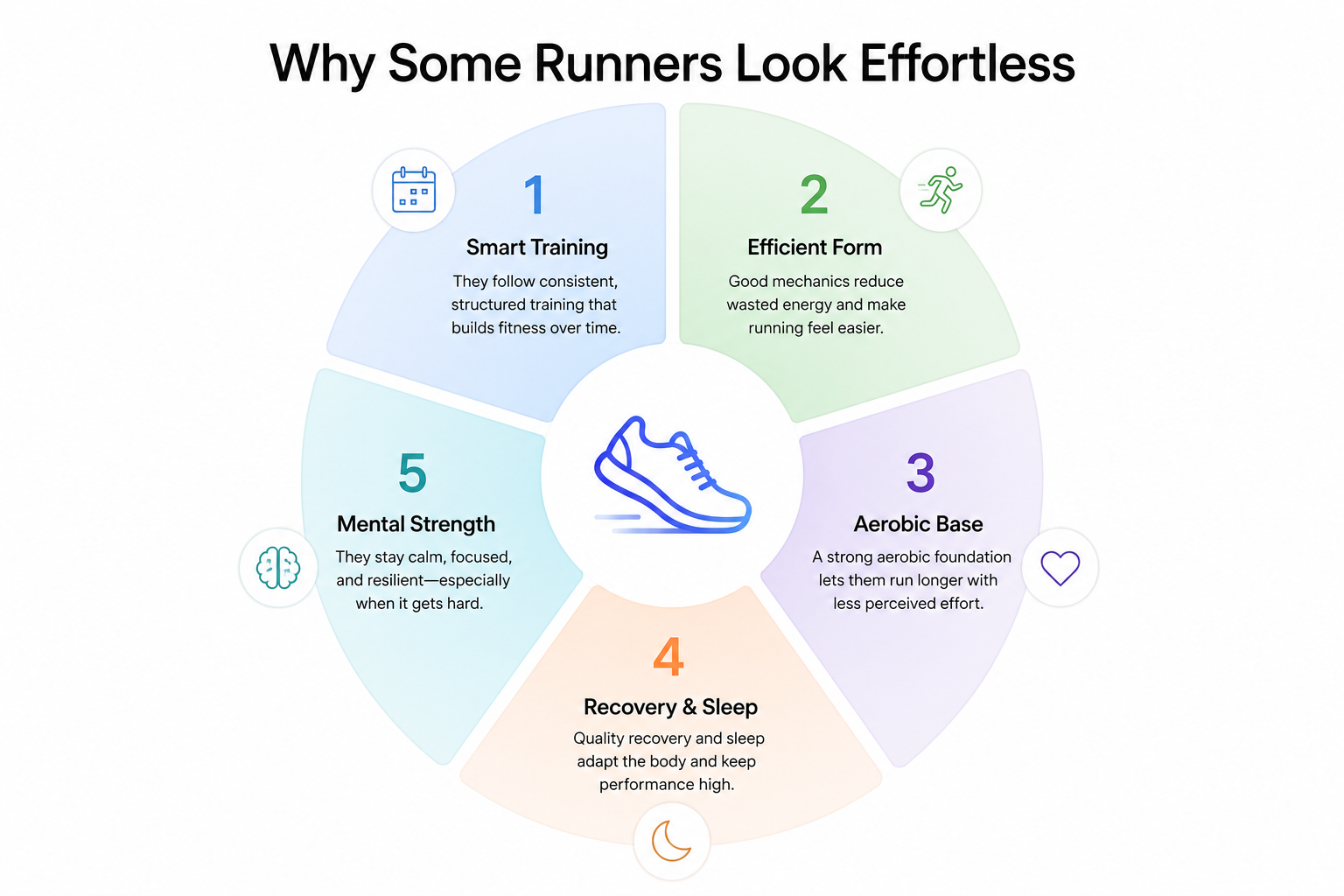
Some runners look effortless not because running is easy for them, but because years of consistent training have made efficient movement feel natural.
Their relaxed stride is usually the result of improved fitness, better coordination, growing confidence, and countless repetitions rather than perfect technique.
I believe that’s encouraging for every recreational runner. You don’t need to imitate someone else’s running style to move more smoothly. Focus on building your fitness, staying consistent, and allowing your body to adapt over time.
The goal isn’t to look effortless.
The goal is to become so comfortable with running that effortless movement gradually becomes the natural outcome.
If you’re interested in understanding how that process begins, Does Running Form Actually Matter? explores why there is no single perfect running technique, while our guide to the Best Running Shoes for Daily Training compares versatile shoes designed to support comfortable, natural movement on every run.
Frequently Asked Questions
Why do some runners look effortless?
Most effortless-looking runners have developed efficient movement through years of consistent training, improved fitness, and experience rather than consciously trying to look smooth.
Does effortless running mean the runner isn’t working hard?
No. Many experienced runners are working at a high intensity, but they waste less energy through unnecessary movement, making their running appear more relaxed.
Can recreational runners learn to run more effortlessly?
Yes. Consistent training, improved fitness, strength, and confidence often lead to smoother, more economical movement over time.
Is effortless running the same as perfect running form?
No. There is no single perfect running form. Effortless movement is usually the result of natural adaptation rather than copying a specific technique.
Should I try to copy runners who look effortless?
Not exactly. It’s more effective to build your own fitness and running experience than to imitate someone else’s stride. Efficient movement usually develops naturally as you become a stronger and more experienced runner.