
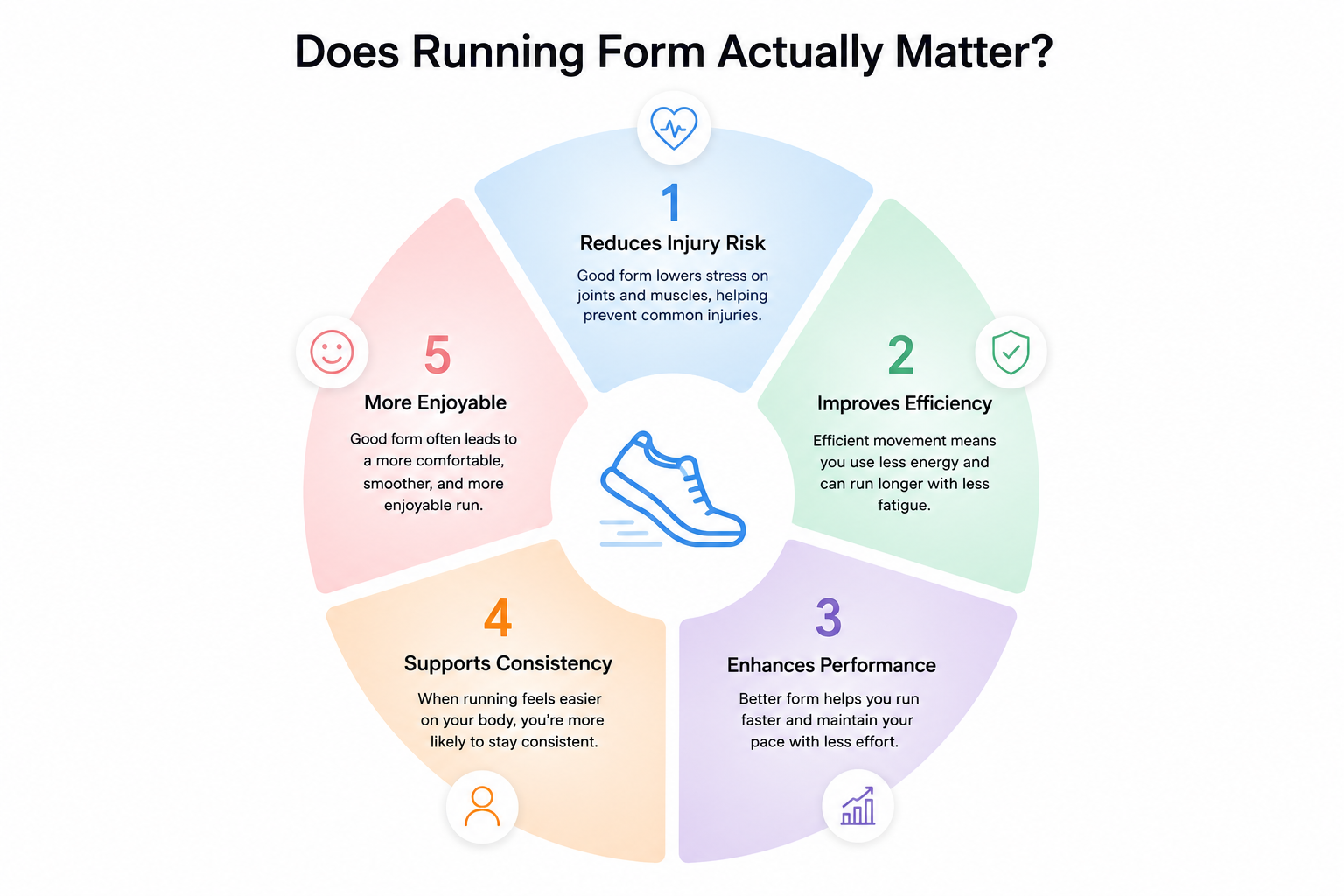
Does Running Form Actually Matter?
Almost every runner has wondered whether their running form is holding them back.
Perhaps you’ve watched a race on television and noticed how smooth elite runners look. Or maybe you’ve seen a video online promising that changing the position of your arms, feet, or posture will instantly make you faster. It’s an appealing idea.
If better technique leads to better performance, surely copying the “perfect” running form should help everyone. The reality is more complicated. Running form certainly matters. But probably not in the way many runners imagine.
There isn’t one ideal running style that every runner should try to imitate. Instead, the body gradually develops its own movement pattern based on strength, mobility, fitness, experience, and thousands of kilometres of practice.
I believe that’s reassuring. It means your goal isn’t to run exactly like someone else. Your goal is to become the most efficient version of your own running style.
If you’re unsure whether today’s run should focus on easy mileage or more structured training, the Today’s Run Decision Calculator can help you choose the session that best supports long-term progress.
There Is No Single Perfect Running Form
I’ve started noticing that runners often speak about running form as though there’s one correct way to move. Stand taller. Land here. Swing your arms like this. Keep your cadence exactly there.
It’s easy to come away believing that every runner should look almost identical. But if you watch a major marathon closely, something interesting happens.
Elite runners all move efficiently, yet they don’t move exactly the same. Some have a slightly longer stride. Others carry their arms differently. Some appear to bounce a little more than others. Despite those differences, they’re all running exceptionally well.
That’s because efficient running isn’t about copying one specific style. It’s about finding a movement pattern that works naturally for your own body. I honestly believe that’s one of the most reassuring things recreational runners can learn. You don’t need to become someone else’s version of an efficient runner.
You need to become a better version of yourself.
If you’re curious about how efficient movement develops over time, Can Running Drills Improve Running Economy? explains why consistency usually matters far more than chasing perfect technique.
Good Running Form Is Usually A Result, Not A Starting Point
Another thing I’m noticing is that many runners try to improve their running form by thinking about every movement while they’re running.
Should my elbows be lower? Am I landing too far forward? Is my posture upright enough?
The intention is understandable. The problem is that running isn’t a movement you consciously control one instruction at a time.
It’s a skill that becomes more automatic through repetition. That’s one reason experienced runners often appear relaxed. They aren’t constantly correcting every stride.
Their movement reflects years of consistent training, stronger muscles, better coordination, and thousands of kilometres of practice. In other words, good running form is often the result of becoming a better runner rather than the thing that makes you one.
That doesn’t mean technique is unimportant. It simply means the biggest improvements usually come from building fitness, strength, and experience while allowing your movement to adapt naturally.
Actually, that’s a much healthier perspective than chasing an imaginary “perfect stride.”
If you’d like to understand how simple coordination exercises fit into that process, Why Running Drills Matter explores why drills help reinforce movement rather than completely changing it.
Small Adjustments Can Be Helpful
It looks like conversations about running form often swing between two extremes. One side says you should never think about your technique. The other encourages you to change everything at once. Neither approach is particularly helpful.
There are times when small adjustments make sense. For example, if a runner consistently overstrides, runs with excessive upper-body tension, or develops discomfort linked to a specific movement pattern, a gradual change may improve comfort or efficiency.
The important word is gradual. The body has spent months—or often years—learning its current running pattern.
Expecting it to adopt a completely different one overnight is unrealistic. That’s why the best technique changes are usually simple enough that they can become natural through repetition rather than constant concentration. I honestly believe the goal isn’t to think about your running form forever. The goal is to stop thinking about it because the movement has become comfortable and automatic.
If you’re beginning to pay more attention to your mechanics, What Are Running Drills? explains how simple drills can reinforce movement patterns without turning every run into a technique session.
Relaxed Runners Often Move Better
Runners with the smoothest form rarely look as though they’re trying very hard. Their shoulders stay relaxed. Their arm swing feels natural. Their stride follows an easy rhythm instead of appearing forced.
At first glance, it might seem as though they’re consciously controlling every detail. In reality, the opposite is often true.
Efficient running usually becomes easier as fitness, strength, and confidence improve. The body naturally finds a rhythm that allows it to waste less energy without needing constant mental corrections. That’s one reason experienced runners often look so effortless.
Their movement has been refined through thousands of kilometres, not through memorising a checklist of technique cues. To me, that’s one of the most encouraging things about running form.
You’re not trying to perform a perfect movement.
You’re allowing better movement to emerge from consistent training.
Conclusion
Running form matters, but not because there’s one perfect technique that every runner should copy.
The most effective running form is usually the one that allows your body to move efficiently, comfortably, and consistently over time.
While small adjustments can sometimes improve comfort or address specific movement patterns, the biggest improvements often come from becoming a stronger, more experienced runner.
I honestly believe that’s a healthier way to think about technique. Instead of chasing perfect form, focus on building consistent training habits, improving your fitness, and staying relaxed as you run.
Good running form is rarely something you force. More often, it’s something you gradually develop.
If you’re interested in building better movement habits, Common Running Drill Mistakes highlights simple ways to avoid the errors that reduce the effectiveness of your warm-up, while our guide to the Best Running Shoes for Daily Training compares reliable shoes that support comfortable, natural running across a wide range of workouts.
Frequently Asked Questions
Does running form actually matter?
Yes. Running form affects comfort, efficiency, and movement quality. However, there isn’t one perfect technique that every runner should try to copy.
Can I improve my running form?
Yes, but improvements usually happen gradually through consistent running, strength development, coordination, and experience rather than consciously changing every aspect of your stride.
Should I think about my running form while running?
Occasionally focusing on one simple cue can be helpful, but constantly analysing every movement often makes running feel less natural. Most technique improvements become automatic over time.
Do running drills improve running form?
Running drills can reinforce coordination and efficient movement patterns, especially before faster workouts. They support better running form rather than completely changing it.
Do elite runners all have the same running form?
No. Elite runners share many efficient movement characteristics, but their stride length, arm swing, cadence, and overall running style still vary from person to person.