
Cadence in running refers to the number of steps you take per minute.
It’s one of the most important — and often misunderstood — running metrics.
Many runners focus only on pace.
But cadence tells you how you’re moving, not just how fast.
Two runners can run at the same pace — but with completely different cadence and efficiency.
Modern running watches allow you to track pace, distance, heart rate, cadence and much more during workouts.
If you’re choosing one for training, see our guide to the Best Running Watches for Running (2026).
Cadence Explained (Simple Definition)
Cadence is usually measured in steps per minute (SPM) — the number of steps you take in one minute while running.
For example:
- 160 SPM = 160 steps per minute
- 170 SPM = quicker turnover
- 180 SPM = often associated with efficient running
But here’s the key:
There is no single “perfect” cadence that works for everyone.
Cadence isn’t about hitting a specific number — it’s about improving efficiency and reducing unnecessary stress on your body.
Why Cadence Matters in Running
Cadence plays a key role in how efficiently you run and how your body handles impact.
A slightly higher cadence often leads to:
smoother running form
shorter steps
less overstriding
This usually means less braking force with each step — and more forward momentum.
Over time, this can help reduce stress on your joints and improve overall running economy.
What Is a Good Running Cadence?
For most runners, cadence typically falls within this range:
- 150–165 SPM → common for beginners
- 165–175 SPM → more efficient range
- 175–185 SPM → often seen in experienced runners
But just like pace, cadence isn’t one-size-fits-all.
Your ideal cadence depends on:
- your height
- your running speed
- your experience level
For example, taller runners often have a slightly lower cadence, while shorter runners naturally take quicker steps.
Cadence vs Pace: What’s the Difference?
Pace tells you how fast you’re running.
Cadence tells you how you’re running.
You can run at the same pace with:
- long, heavy strides
- or shorter, quicker steps
Only one of those is usually more efficient.
This is why cadence matters — it gives context to your pace.
How to Improve Your Cadence
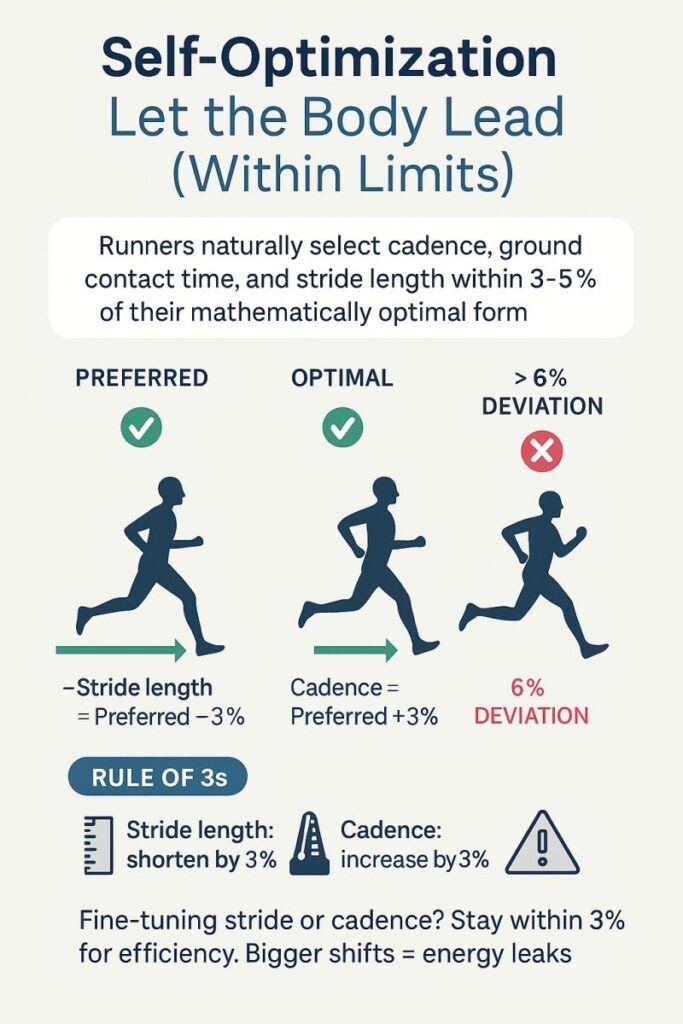
If your cadence is on the lower side, you don’t need to force big changes.
Instead, focus on small, gradual improvements:
◦ Keep your movement relaxed and natural
◦ Increase cadence by 2–5% at a time
◦ Take shorter, lighter steps
◦ Avoid overstriding
Even a small increase in cadence can make your running feel smoother and more efficient.
Do You Need a Watch to Track Cadence?
You don’t need advanced tools to improve your cadence — you can develop a better running rhythm just by focusing on how your steps feel.
But tracking cadence can make things easier.
This helps you become more aware of your movement and make small adjustments over time.
Common Cadence Mistakes
When improving cadence, many runners make the mistake of changing too much, too quickly.
Here are some of the most common mistakes:
◦ Trying to force 180 SPM immediately
◦ Increasing cadence too aggressively
◦ Overthinking every step
◦ Ignoring overall running form
Cadence should develop naturally — not be forced into a specific number.
Conclusion: Cadence Is About Efficiency
Cadence isn’t about copying elite runners or chasing a specific number.
It’s about finding a rhythm that helps you run more efficiently and comfortably.
Over time, small improvements in cadence can lead to smoother running, better performance, and less stress on your body.