
What is a good running pace?
It’s one of the most common questions runners ask — especially when starting out.
You’ll often see answers like “6:00 min/km is good” or “5:00 min/km is average.”
But the truth is: those numbers don’t tell the full story.
Because a “good pace” isn’t just about how fast you run — it’s about how hard your body is working.
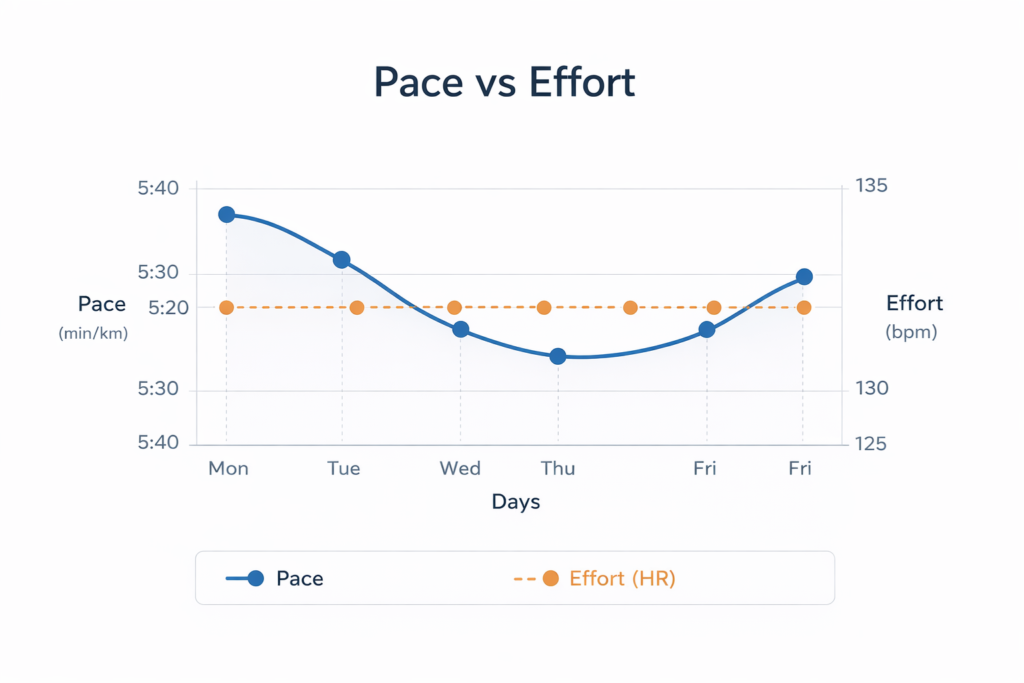
On some days, your easy run might be 6:00 min/km.
On others, it might be 5:30 — at the exact same effort.
So instead of chasing a fixed number, the real goal is to understand what “good pace” actually means for your training.
In this guide, we’ll break it down in a simple way — so you know exactly how fast you should be running, and why.
A good running pace isn’t a fixed number — it’s the right effort level for your goal, whether that’s an easy run, a long run, or a faster workout.
Modern running watches allow you to track pace, distance, heart rate and much more during workouts.
If you’re choosing one for training, see our guide to the Best Running Watches for Running (2026).
Average Running Pace: What Do the Numbers Say?
If you search for a “good running pace,” you’ll usually find numbers like these:
- Beginners: 6:30–8:00 min/km
- Recreational runners: 5:00–6:00 min/km
- Advanced runners: 3:30–4:30 min/km
At first glance, this seems helpful.
It gives you a rough idea of where you stand.
But here’s the problem:
These numbers don’t tell you how hard the effort actually is.
Two runners could both run at 5:30 min/km — but for one, it might feel easy,
while for the other, it could be close to maximum effort.
Even for the same runner, pace can vary from day to day:
- weather conditions
- fatigue
- terrain
- sleep and recovery
So while average pace ranges can give you context, they don’t define what a good pace is for you.
This is why many runners rely on effort or heart rate instead of pace alone.
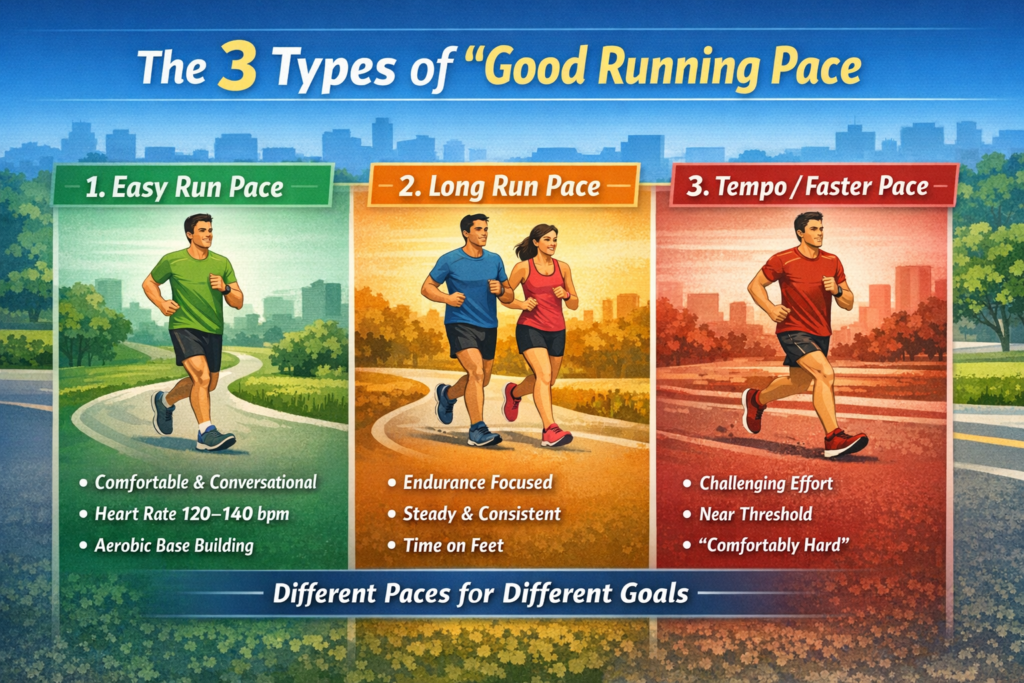
The 3 Types of “Good Running Pace”
Instead of thinking about one “good pace,” it’s much more useful to think in terms of different types of running.
Because the right pace depends entirely on what you’re trying to achieve.
In simple terms, there are three main types of “good pace”:
1. Easy Run Pace
This is the pace where running feels comfortable and sustainable.
- You can hold a conversation
- Your breathing is controlled
- Your heart rate typically stays in a lower zone (often around 120–140 bpm), depending on your heart rate zones
For most runners, this is where the majority of training should happen.
This is your aerobic base pace — and it’s the foundation of long-term progress.
2. Long Run Pace
Long runs are similar to easy runs, but with a slightly different purpose.
- The effort stays controlled
- The focus is on endurance and time on feet
- Pace is often similar to — or slightly faster than — easy pace
What matters most is consistency, not speed.
A good long run pace is one you can maintain for the full duration without breaking down.
3. Tempo (or Faster) Pace
This is where the effort becomes more challenging, but still controlled.
- Breathing is deeper and more rhythmic
- Talking becomes difficult
- You’re working close to your threshold
This type of pace helps improve speed, efficiency, and performance.
It’s not all-out — it’s “comfortably hard.”
Why Your “Good Pace” Changes (Even When You’re Improving)
One of the most confusing things for runners is this:
Your pace doesn’t always improve — even when your fitness does.
You might expect that as you get fitter, your pace should constantly get faster.
But in reality, that’s not how it works.
Your “good pace” can change from day to day — even if your effort stays the same.
Here’s why:
Weather Conditions
Heat, wind, and humidity all affect how your body performs.
On a hot day, your heart rate rises faster —
which means your pace will naturally slow down, even at the same effort.
Fatigue and Recovery
If you’re tired, your body needs to work harder to produce the same pace.
That means:
- higher heart rate
- slower pace
- same effort
This is completely normal — and expected.
If your heart rate feels unusually high even at an easy pace, it might be worth understanding what’s causing it and how to fix it.
Terrain
Running uphill, on trails, or uneven surfaces changes everything.
Trying to “hold pace” in these conditions often leads to overtraining.
Effort stays consistent — pace adapts.
Fitness Level (Long-Term Progress)
Over time, as your fitness improves:
you’ll be able to run faster at the same effort — especially if you train consistently within the right zones.
This is where real progress happens —
not by forcing a faster pace, but by improving the engine behind it.
How to Find Your Own Good Running Pace
So if a “good pace” isn’t a fixed number — how do you actually find yours?
The answer is simple: focus on effort, not speed.
Here are three practical ways to do it:
Use the Talk Test (Simplest Method)
This is the easiest way to check if your pace is right.
- If you can hold a conversation → you’re in an easy pace
- If speaking becomes difficult → you’re moving into harder effort
No watch required — just awareness.
Use Heart Rate as a Guide
If you track heart rate, you can define your pace more precisely.
- Easy runs: typically in a lower heart rate zone
- Harder efforts: higher zones
This helps you stay consistent, even when your pace changes from day to day.
If you’re considering using a chest strap or watch to monitor effort, see our guide to the Best Heart Rate Monitors for Running.
Not every number on your watch tells the full story — understanding what to trust is key.
Use Race Results (Optional)
If you’ve raced before, your results can give useful benchmarks.
- 5K pace → high intensity
- Half marathon pace → moderate-high
- Marathon pace → steady effort
But remember:
These are reference points — not rules you should force in training.
Common Mistakes When Trying to Find a “Good Pace”
Even when you understand the idea of effort-based running, it’s easy to fall into common traps.
Here are the mistakes most runners make:
Running Too Fast on Easy Days
This is by far the most common mistake.
Many runners turn their easy runs into moderate efforts —
which feels productive, but actually slows down progress.
Easy runs should feel easy. That’s the point.
Chasing Someone Else’s Pace
Comparing your pace to others is tempting — especially with apps and shared data.
But pace without context is meaningless.
What’s easy for someone else might be hard for you — and vice versa.
Ignoring Heart Rate or Effort Signals
If your breathing is heavy and your heart rate is high,
but you keep pushing just to hold a certain pace… you’re training the wrong system.
Listening to your body is more important than hitting a number.
Expecting Constant Progress
Not every run will be faster than the last.
Some days will feel slower — and that’s completely normal.
Progress happens over weeks and months, not day to day.
Conclusion: A Good Pace Is the Right Effort
So, what is a good running pace?
It’s not a fixed number like 5:30 or 6:00 min/km.
It’s the pace that matches your goal and your current fitness —
whether that’s an easy run, a long run, or a harder effort.
Some days, that pace will be faster.
Other days, it will be slower.
And that’s exactly how it should be.
Because real progress doesn’t come from forcing a specific pace —
it comes from training at the right effort, consistently over time.