
Most runners start by tracking their pace. Minutes per kilometer or mile feel like the most natural way to measure running performance.
But pace does not always reflect the true effort your body is making.
On some days, a pace that normally feels easy suddenly pushes your heart rate much higher than expected. On other days, you may be able to run faster while keeping your heart rate surprisingly low.
This is often a reflection of your running economy — how efficiently your body uses energy at a given pace.
This raises an important question for many runners:
Should you train by pace or by heart rate?
The answer is not as simple as choosing one over the other. Both metrics provide valuable information, but they measure different aspects of training.
To actually compare pace and heart rate in a meaningful way, you need a device that can track both consistently during your runs.
To understand how heart rate works during training, it helps to first understand how running heart rate zones are structured.
Pace tells you how fast you are moving, but heart rate reveals how hard your body is working.
For most runners, heart rate is the more reliable guide for controlling effort — especially on easy runs.
Modern running watches allow you to track both pace and heart rate during workouts.
If you’re choosing one for training, see our guide to the best running watches for running.
Why Pace Became the Default Metric
For most runners, pace is the first metric they learn to follow. Minutes per kilometer or mile provide a simple and intuitive way to measure how fast you are moving.
Long before GPS watches became common, runners already used pace on the track or during races to estimate their effort and performance. Pace felt objective, easy to understand, and easy to compare.
If you’re not currently using a device, you might be wondering whether it’s actually necessary — here’s a simple breakdown of whether you need a running watch.
Modern GPS watches made pace even more accessible. With a quick glance at your watch, you can instantly see whether you are running at 5:00/km or 4:30/km, which makes it tempting to use pace as the main training guide.
Pace is also attractive because it feels directly connected to race results. After all, finishing a race faster usually means maintaining a faster pace.
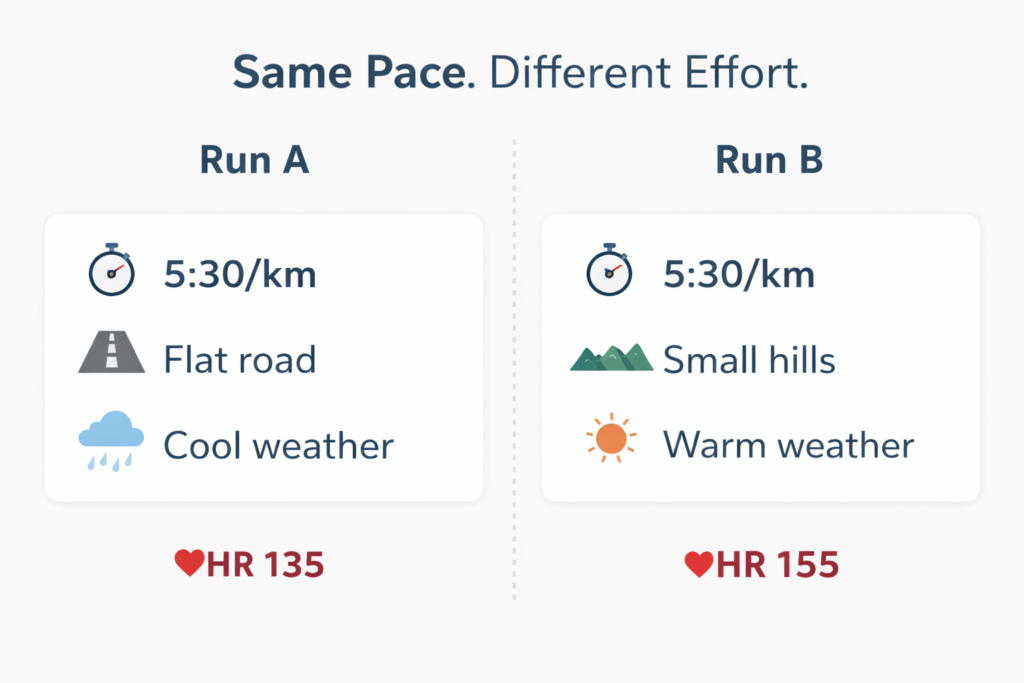
The problem is that pace measures speed, not physiological effort. Two runs with the exact same pace can require very different levels of effort depending on terrain, weather, fatigue, or recovery.
What Heart Rate Actually Measures
While pace tells you how fast you are moving, heart rate tells you how hard your body is working.
Your heart rate responds directly to the physiological stress of running. When effort increases, your muscles require more oxygen, and your heart must pump faster to deliver it.
This makes heart rate one of the most useful indicators of true training intensity.
Unlike pace, heart rate automatically adjusts to the conditions of the day. If the weather is warmer, if you are tired, or if the terrain becomes more demanding, your heart rate reflects that change immediately.
This is why many endurance athletes prefer to use heart rate to guide their easy runs and aerobic training and heart rate zones become useful for structuring training.
If you’re trying to understand what your heart rate should look like during different runs, read What Is a Good Heart Rate for Running — it puts the numbers into context.
However not all heart rate data is equally reliable — here’s what actually matters in Are Optical Heart Rate Monitors Accurate?
The Main Problem With Pace-Based Training
The biggest limitation of pace-based training is that pace does not account for changing conditions.
Two runs at the exact same pace can require very different levels of effort depending on what is happening around you — and inside your body.
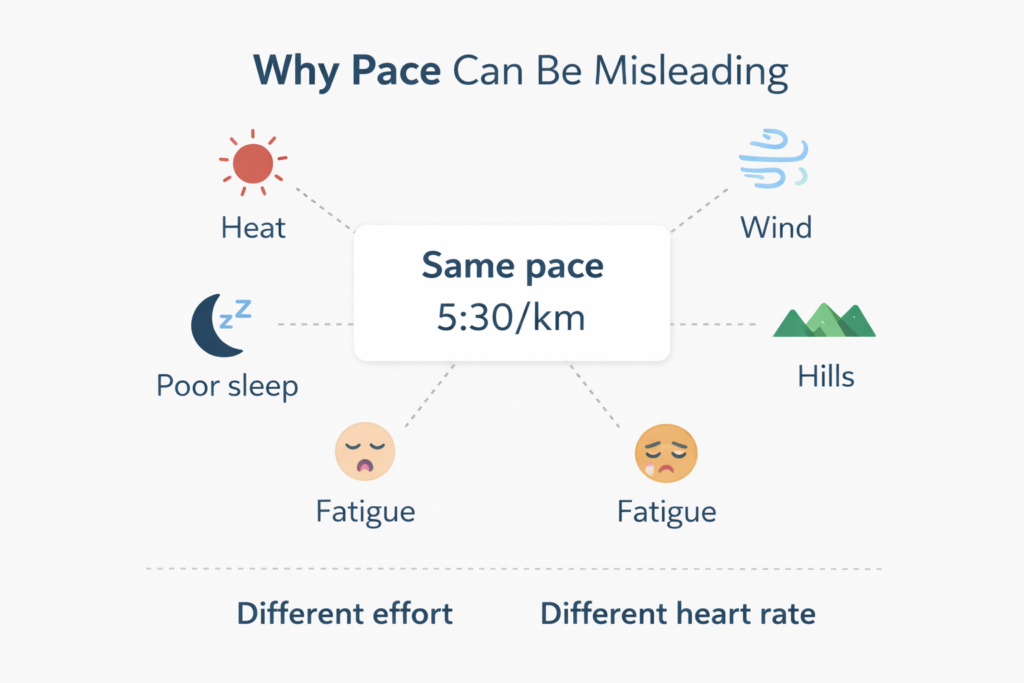
Small hills, wind, temperature, fatigue, or poor sleep can all increase the physiological stress of a run. Yet your watch will still show the same pace.
This often leads runners to push harder than intended during easy runs. Instead of staying in a comfortable aerobic zone, they unknowingly drift into higher intensity simply to maintain a target pace.
Over time, this can turn many easy runs into moderate-effort runs, which reduces recovery and slows long-term progress.
Heart rate helps reveal this hidden effort by showing how your body is actually responding to the run.
When Pace Is Still Useful
Despite its limitations, pace is still an important metric for runners. In certain situations, it provides valuable feedback that heart rate alone cannot replace.
During races, for example, pace becomes a direct indicator of performance. If your goal is to finish a 10K or marathon within a specific time, maintaining an appropriate pace is essential.
Pace is also helpful during structured workouts such as intervals or tempo runs. These sessions often aim to develop specific performance abilities, and pace targets can provide a clear reference point.
Another advantage of pace is its immediate responsiveness. Heart rate usually reacts with a short delay when effort changes, while pace reflects speed instantly.
For this reason, many experienced runners combine both metrics rather than choosing only one.
The best runners do not choose between pace and heart rate.
They use pace to guide performance and heart rate to control effort.
Together, they create a much clearer picture of training intensity.
Heart Rate vs Pace: Which Should You Follow?
In practice, most runners benefit from using both heart rate and pace, but for different purposes.
Heart rate is particularly useful for controlling easy runs and aerobic training. It helps ensure that the effort stays within the intended intensity, even when conditions change.
Pace, on the other hand, is often more helpful during structured workouts and races, where performance targets matter.
This is why many experienced runners treat heart rate as a guide for effort, while pace becomes a reference for speed combining both metrics within their weekly training structure.
When both metrics are used together, they provide a more complete picture of training. Heart rate reveals how hard the body is working, while pace shows how fast that effort is translating into movement.
A simple rule many runners follow:
Races → pace becomes the main guide
Easy runs → follow heart rate
Workouts → use pace targets
A Simple Strategy That Works For Most Runners
For most recreational runners, the simplest approach is to use heart rate and pace together, each for the situations where they work best.
Heart rate works particularly well for controlling easy and aerobic runs. By keeping your heart rate within the intended zone, you avoid running too hard on days that should support recovery and endurance development.
Pace becomes more useful during structured workouts such as intervals or tempo sessions, where the goal is to develop speed or race-specific performance.
In practice, many runners follow a simple guideline when deciding which metric to prioritize.
A practical rule of thumb:
Races → pace becomes the main guide
Easy runs → follow heart rate
Long runs → prioritize heart rate
Workouts → use pace targets
This approach keeps easy runs truly easy while still allowing pace to guide performance when it matters most.
For higher accuracy, especially during intervals, some runners also use chest strap monitors.
If you’re choosing one for training, see our guide to the Best Heart Rate Monitors for Running
Frequently Asked Questions
Should beginners train by heart rate or pace?
Beginners often benefit from using heart rate as the primary guide for easy runs. Heart rate reflects how hard the body is working and helps prevent running too fast on days meant for aerobic development.
Pace can still be useful during structured workouts or races, but for most everyday training runs, heart rate helps maintain the correct intensity.
Why is my pace slower when I follow heart rate?
This is very common when runners first start using heart rate training.
Many runners unknowingly run their easy sessions too fast. When they begin to stay within the correct heart rate zone, the pace often becomes slower at first. Over time, as aerobic fitness improves, pace typically increases again while the heart rate stays the same.
Can heart rate replace pace completely?
Not entirely. Heart rate and pace measure different things.
Heart rate reflects effort, while pace reflects speed. Most runners benefit from using both metrics together rather than choosing only one.
Is heart rate training more accurate than pace?
Heart rate is often more reliable for controlling training intensity, especially on easy runs or long aerobic sessions.
However, pace remains important for performance-focused sessions such as intervals, tempo workouts, and races.
To better understand how heart rate zones work in practice, see our guide on Heart Rate Zones Explained for Runners.