
The Best Running Drills for Beginners
One thing I’ve started noticing is that beginners often assume running drills have to look complicated.
Videos online can make it seem as though every runner should be skipping, bounding, hopping, and performing perfectly coordinated movements before every workout. That can be intimidating. Fortunately, it isn’t necessary. Most recreational runners don’t need a long list of advanced drills.
In fact, I honestly believe the opposite is true. A handful of simple exercises performed consistently will usually provide far more benefit than constantly learning new ones. Running drills aren’t about showing athletic ability.
They’re about teaching your body to move a little more efficiently before faster running begins. For beginners, that means choosing drills that are easy to understand, easy to repeat, and directly connected to better running mechanics.
The goal isn’t to master every drill. The goal is to build confidence and coordination one movement at a time.
Start With Drills That Feel Natural
I’ve started noticing that beginners sometimes judge a drill by how impressive it looks.
In reality, the best drill is usually the one you can perform with good control. If you’re constantly losing balance or struggling to remember the movement, you’re probably learning the drill instead of improving your running.
That’s perfectly normal in the beginning, but it also means there’s no reason to rush into more advanced exercises. I honestly believe most runners can build an excellent foundation with just three or four simple drills.
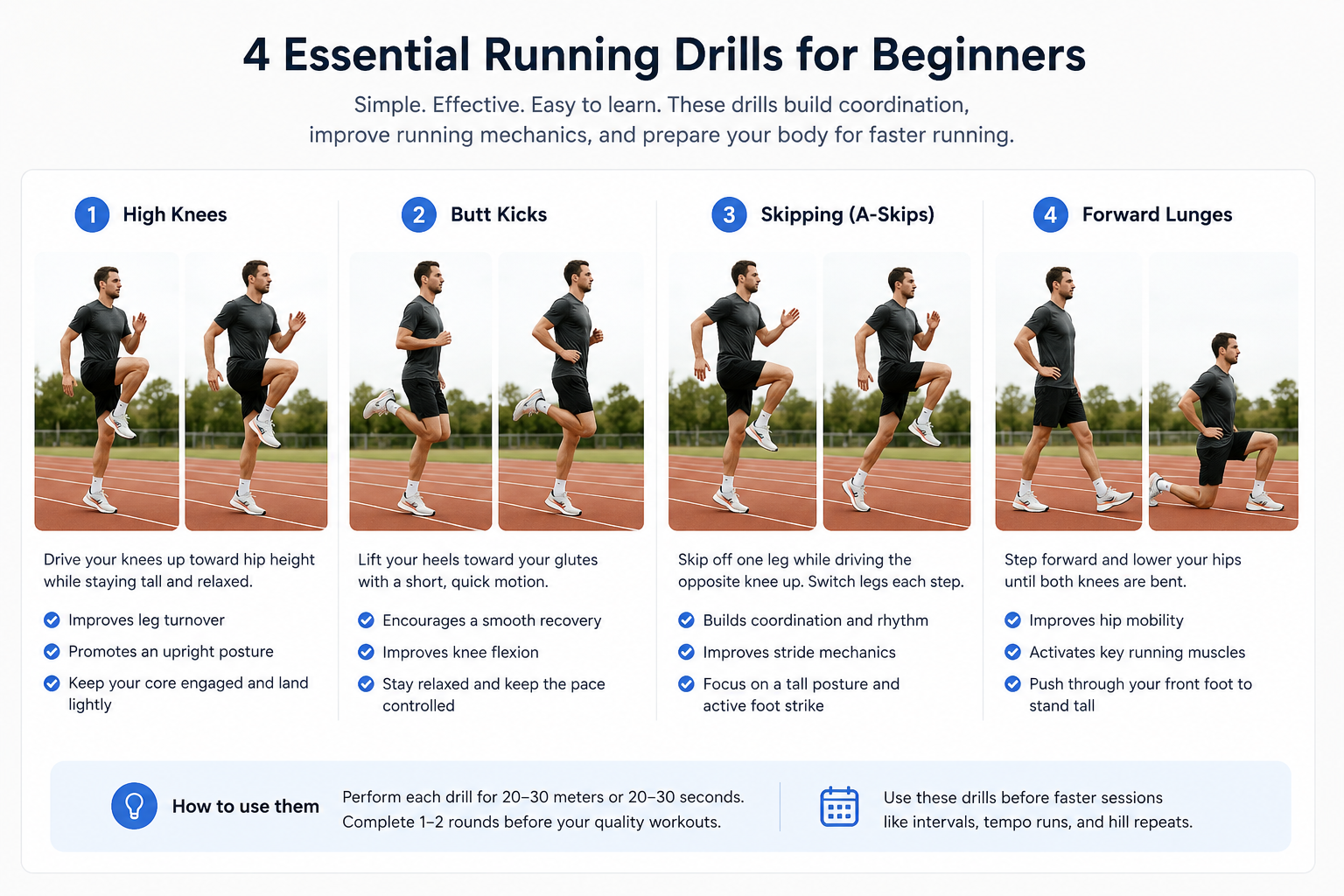
High knees encourage an upright posture and quick, controlled leg turnover.
Butt kicks help develop a relaxed recovery phase while reminding you to keep your stride smooth.
Skipping drills improve rhythm and coordination, teaching your body to move in a light, controlled way.
These movements aren’t complicated. That’s exactly why they work so well.
Instead of overwhelming yourself with variety, repeat the same small group of drills until they begin to feel natural. Your coordination improves not because you’ve learned dozens of exercises, but because you’ve practised the important ones consistently.
If you’re wondering why these simple movements make a difference, Why Running Drills Matter explains how better coordination can improve the quality of every faster workout.
Focus On Quality, Not Speed
One of the biggest misconceptions about running drills is that they should be performed as quickly as possible.
That’s rarely the goal. Running drills aren’t miniature sprint workouts.
They’re movement practice. Slow, controlled drills almost always teach better mechanics than rushing through them.
Take high knees as an example.
Lifting your knees a little lower with good posture and relaxed shoulders is far more valuable than moving as fast as possible while bouncing out of control.
The same idea applies to every beginner drill. The movement should feel smooth.
Balanced. Comfortable.
I’ve started noticing that runners who stay patient during drills often look more relaxed once the workout begins. That isn’t a coincidence. They’re rehearsing efficient movement before they ask their body to run at a faster pace.
Think of drills as practice rather than performance. Nobody is timing them. Nobody is scoring them. Their only job is to help you move a little better than you did yesterday.
If you’re unsure whether today’s run actually calls for drills, our Today’s Run Decision Calculator can help you decide whether you’re heading into an easy run, a quality session, or a workout where a few minutes of preparation are likely to make the biggest difference.
Consistency Is More Important Than Variety
I think one of the biggest surprises for new runners is how little variety they actually need. It’s easy to believe that improving requires constantly adding new drills.
One week it’s A-skips. The next it’s B-skips. Then bounding. Then another drill you’ve seen on social media.
Before long, the warm-up becomes more complicated than the workout itself.
I’ve started noticing that the runners who benefit most from drills usually do the opposite. They keep the routine remarkably simple.
The same familiar movements appear before quality sessions week after week. Because the drills become familiar, less attention is spent remembering what to do and more attention is spent doing each movement well.
That’s where the real progress happens. Coordination improves through repetition, not constant novelty.
I honestly believe that’s reassuring for beginners. You don’t need ten different drills. You only need a few that you perform with good technique and regular consistency.
If you’re wondering how often those drills should appear in your training week, How Often Should Runners Do Drills? explains why matching drills to your quality workouts is usually the most effective approach.
Confidence Comes Before Complexity
One thing I’ve started noticing is that the best drill routine is often the one you actually look forward to doing.
If every warm-up feels confusing or frustrating, there’s a good chance you’ll stop doing drills altogether. That’s why confidence matters.
When the movements feel familiar, you begin every quality session with a small success instead of a small challenge. You already know what comes next. Your body settles into a rhythm.
The transition from warming up to running becomes smoother and more natural. Only then does it make sense to explore additional drills if you want more variety. Not because the original exercises have stopped working, but because you’re ready to build on a solid foundation.
To me, that’s exactly how beginners should approach running drills. Start small. Repeat often. Improve gradually.
The goal isn’t to perform the most advanced warm-up on the track. It’s to arrive at the first fast repetition feeling prepared, coordinated, and confident.
Conclusion
The best running drills for beginners aren’t the most advanced ones. They’re the ones you can perform with good control and repeat consistently before your quality workouts.
A small collection of simple drills—performed with patience and good technique—will usually provide more long-term benefit than constantly chasing new exercises.
I honestly believe that’s the biggest lesson for beginners. Keep your routine simple. Focus on smooth, controlled movement.
Allow confidence and coordination to grow together over time.
As those habits become automatic, every workout begins with better preparation and a little more efficiency than the one before.
If you’re just starting out, What Are Running Drills? introduces the purpose behind these exercises, while Best Running Shoes for Daily Training compares comfortable, stable shoes that work well for drills, warm-ups, and everyday running.
Frequently Asked Questions
What are the best running drills for beginners?
Simple drills such as high knees, butt kicks, and skipping drills are excellent starting points because they’re easy to learn and reinforce good running coordination.
How many running drills should beginners do?
Most beginners only need three or four familiar drills. A short, consistent routine is usually more effective than trying to learn many different exercises.
Should beginners perform running drills before every run?
Not necessarily. Drills are most beneficial before quality workouts like intervals or tempo runs. Before easy runs, a simple warm-up is often enough.
How long should a beginner drill routine last?
Around five to ten minutes is sufficient for most runners. The purpose is to prepare your body for efficient movement, not create another workout.
Are advanced running drills necessary?
No. Most recreational runners can improve coordination and movement quality for a long time using only a small number of basic drills performed consistently.