
You head out for an easy run.
Your breathing feels controlled. You can speak in full sentences. It doesn’t feel hard. Then you glance at your watch.
Zone 4
Now you’re confused.
Is your fitness worse than you thought?
Are you training incorrectly?
Shouldn’t an easy run stay in Zone 2?
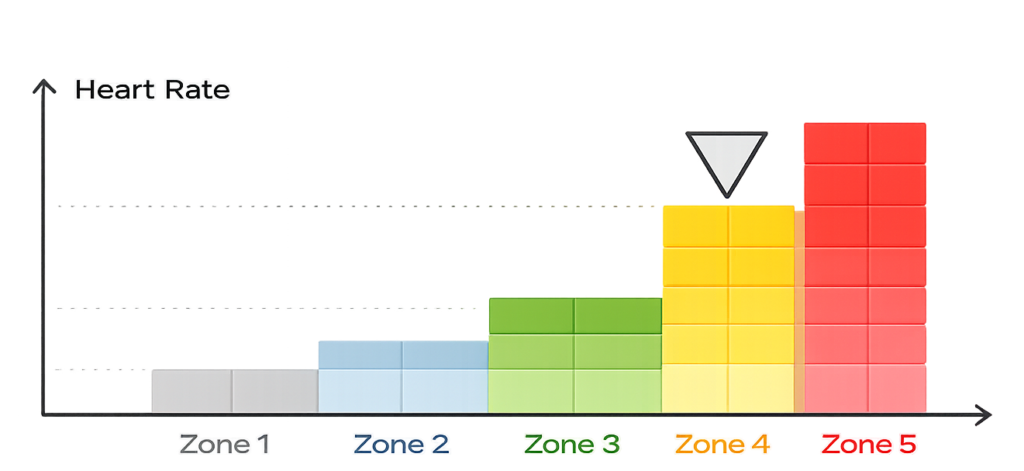
If you’re unsure whether your heart rate is actually “too high”, read What Is a Good Heart Rate for Running — it explains what’s normal and what isn’t.
If your heart rate is too high on easy runs, you’re not alone. This is one of the most common questions everyday runners ask once they start tracking heart rate.
The good news?
In most cases, nothing is wrong. But something might need adjusting.
Let’s break it down.
Many runners believe their heart rate is “too high” during easy runs, but this is often a normal part of aerobic development.
Your heart rate reflects the effort your body is producing, not just your pace.
Why Your Heart Rate Is Too High on Easy Runs
There are four main reasons this happens:
- Your heart rate zones are inaccurate
- Your wrist sensor is misleading you
- Cardiac drift is occurring
- Your aerobic base is still developing
Understanding which one applies to you makes all the difference.
1. Your Heart Rate Zones Might Be Wrong
Most watches calculate zones using a simple formula:
220 – your age = estimated max heart rate
The problem? That formula can be off by 10–20 beats per minute. Sometimes more. If your real maximum heart rate is higher than the formula predicts, your zones will be set too low. That means moderate effort may show up as Zone 3 or 4 — even when it feels easy. So the issue might not be your fitness. It might be your settings.
2. Wrist Heart Rate Sensors Aren’t Perfect
Wrist-based heart rate monitors are convenient, but they aren’t flawless.
They can struggle with:
- Sudden pace changes
- Cold weather
- Tight sleeves
- Arm swing variation
- Dry skin
If you notice sudden unexplained spikes — 10–20 bpm jumps without effort change — it may be sensor noise. For runners who want more accurate data, a chest strap monitor is significantly more reliable, especially during intervals or long runs.
Accuracy helps. But interpretation matters even more.
Wrist-based sensors can sometimes struggle with rapid pace changes or interval sessions.
If you want more reliable data, see our guide to the best heart rate monitors for running.
3. Cardiac Drift Is Real (And Normal)
Even if your zones are correct and your device is accurate, heart rate can gradually rise during longer runs.
This is called cardiac drift.
As you run:
- Body temperature increases
- You lose fluids
- Fatigue accumulates
To maintain the same pace, your cardiovascular system works harder. Your heart rate rises — even though your pace stays the same.
This doesn’t mean you’re suddenly running too hard. It means your body is adapting to stress. As your aerobic base improves, cardiac drift becomes smaller.
4. Your Aerobic Base Might Still Be Developing
If your heart rate climbs quickly even at slower paces, your aerobic system may still be building capacity. That’s not failure. That’s training reality. When runners begin structured easy running, they often discover their truly easy pace is slower than expected.
Sometimes much slower.
Building an aerobic base takes consistency and patience. But it leads to:
- Lower heart rate at the same pace
- Better endurance
- Improved recovery
- Stronger race performance
How to Set Your Heart Rate Zones Yourself (Simple Methods)
For the most accurate training zones, many runners rely on a chest strap — see our comparison of the best heart rate monitors for running.
You don’t need a lab test to improve your zone accuracy.
Here are two practical field methods.
Option 1:
Estimate Your True Max Heart Rate
Only do this if you’re healthy and accustomed to hard efforts.
Step-by-step:
- Warm up for 15–20 minutes.
- Run 3–4 short uphill efforts (20–30 seconds each), gradually increasing intensity.
- Recover fully between efforts.
- On the final uphill, run hard for 60–90 seconds.
- The highest heart rate near the end is close to your true max HR.
Why uphill?
- Lower injury risk
- Controlled intensity
- Strong muscle engagement
Many runners discover their real max HR is higher than predicted by age formulas.
Option 2:
Find Your Lactate Threshold Heart Rate (LTHR)
For everyday runners, this method is often more practical.
LTHR represents the highest effort you can sustain for about an hour.
Simple field test:
- Warm up 15–20 minutes.
- Run 30 minutes at the hardest pace you can sustain evenly.
- Press lap at 10 minutes.
- Take the average heart rate of the final 20 minutes.
That number is a strong estimate of your LTHR.
You can then set zones based on percentages of that value.
Example: Why Correct Max HR Matters
Let’s take a practical example.
Assume a 40-year-old runner.
The watch estimates max HR using the age formula:
220 – 40 = 180 bpm
Zones Based on Estimated Max HR (180 bpm)
| Zone | % Max HR | Heart Rate | Meaning |
|---|---|---|---|
| Z1 | 50–60% | 90–108 | Very easy |
| Z2 | 60–70% | 108–126 | Easy run |
| Z3 | 70–80% | 126–144 | Moderate |
| Z4 | 80–90% | 144–162 | Hard |
| Z5 | 90–100% | 162–180 | Very hard |
Now imagine this runner sees 148 bpm during an easy run.
The watch says: Zone 4.
They panic.
But after testing, they discover their true max HR is actually 195 bpm.
Zones Based on Real Max HR (195 bpm)
| Zone | % Max HR | Heart Rate | Meaning |
|---|---|---|---|
| Z1 | 50–60% | 97–117 | Very easy |
| Z2 | 60–70% | 117–136 | Easy run |
| Z3 | 70–80% | 136–156 | Moderate |
| Z4 | 80–90% | 156–176 | Hard |
| Z5 | 90–100% | 176–195 | Very hard |
Now that same 148 bpm sits comfortably in Zone 3.
Nothing changed in the body.
Only the reference number changed.
Max HR vs LTHR: Which Is Better?
Let’s compare both approaches using real numbers.
Assume:
- Max HR = 195 bpm
- LTHR = 162 bpm
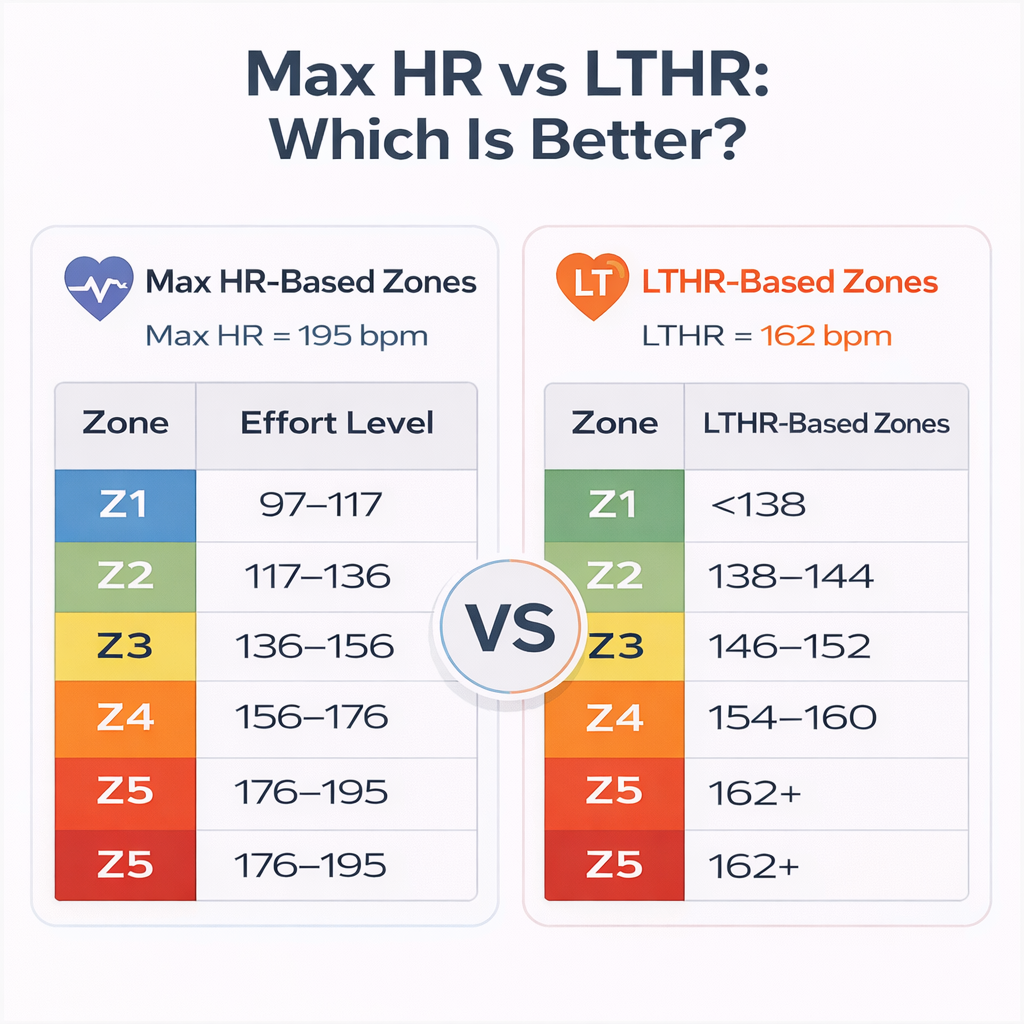
A higher heart rate during easy runs does not mean your training is failing.
It often means your aerobic system is still adapting — and consistent easy running will gradually lower it over time.
Simple Explanation
Max HR tells you: How high your heart rate can go.
LTHR tells you: How hard you can sustainably work.
Most structured training happens around threshold. For everyday runners, LTHR-based zones often provide more practical guidance than max HR alone.
If You’re a Beginner, Start Here
If you’ve been running less than a year, don’t overcomplicate it.
You don’t need perfect data. You need a reliable baseline. Here’s a simple starting plan:
- Skip max HR testing for now.
- Use the 20–30 minute threshold test.
- Combine heart rate with perceived effort.
If you can speak in full sentences, you’re likely running easy enough.
Data refines training. It does not replace how your body feels.
What To Do If Your Heart Rate Seems “Too High”
Use this framework:
- Recheck your zone settings.
- Don’t blindly trust age-based formulas.
- Consider a chest strap if accuracy matters.
- Start slower than your ego prefers.
- Stay hydrated.
- Give your aerobic base time to adapt.
Easy runs are not about pace.
They are about managing stress.
When You Should Actually Worry
High heart rate during easy runs is usually harmless.
However, consult a medical professional if you experience:
- Chest pain
- Dizziness
- Unusual shortness of breath
- Irregular heart rhythm
Training confusion is common. Medical symptoms are not.
Final Thoughts: Clarity Over Intensity
If your watch says Zone 4 but your breathing says “easy,” don’t panic. Heart rate data is a tool — not a judgment. For everyday runners, improvement doesn’t come from pushing harder. It comes from understanding what the data actually means.
At PaceFoundry, we believe smarter progress starts with clarity — not intensity.
Build your pace.
One informed decision at a time.