
Why Some Runs Feel Easy and Others Feel Hard
You head out for a run expecting it to feel normal.
Same route. Same pace. Same plan. But something feels off.
Your breathing is heavier. Your legs feel slower. The effort is higher than it should be. And then a few days later, everything feels easy again.
That contrast can be confusing.
Why does the same run feel completely different?
The truth is simple: your body is not the same every day. And running reflects that more than most people expect.
Modern running watches allow you to track pace, distance, heart rate, cadence, VO2 max and much more during workouts.
If you’re choosing one for training, see our guide to the Best Running Watches for Running (2026).
Not all runs feel the same — and that’s normal
One of the biggest misunderstandings in running is expecting consistency in how it feels. You expect your runs to feel predictable. Controlled. Repeatable.
But running doesn’t work that way.
Some days feel light. Others feel heavy. Even when nothing obvious has changed.
That’s not a problem. It’s part of the process.
If you’ve ever had a run that suddenly felt much harder than expected, Running Feels Hard? Here’s Why breaks down the most common reasons behind that experience.
What matters is not how one run feels, but how your training looks over time.
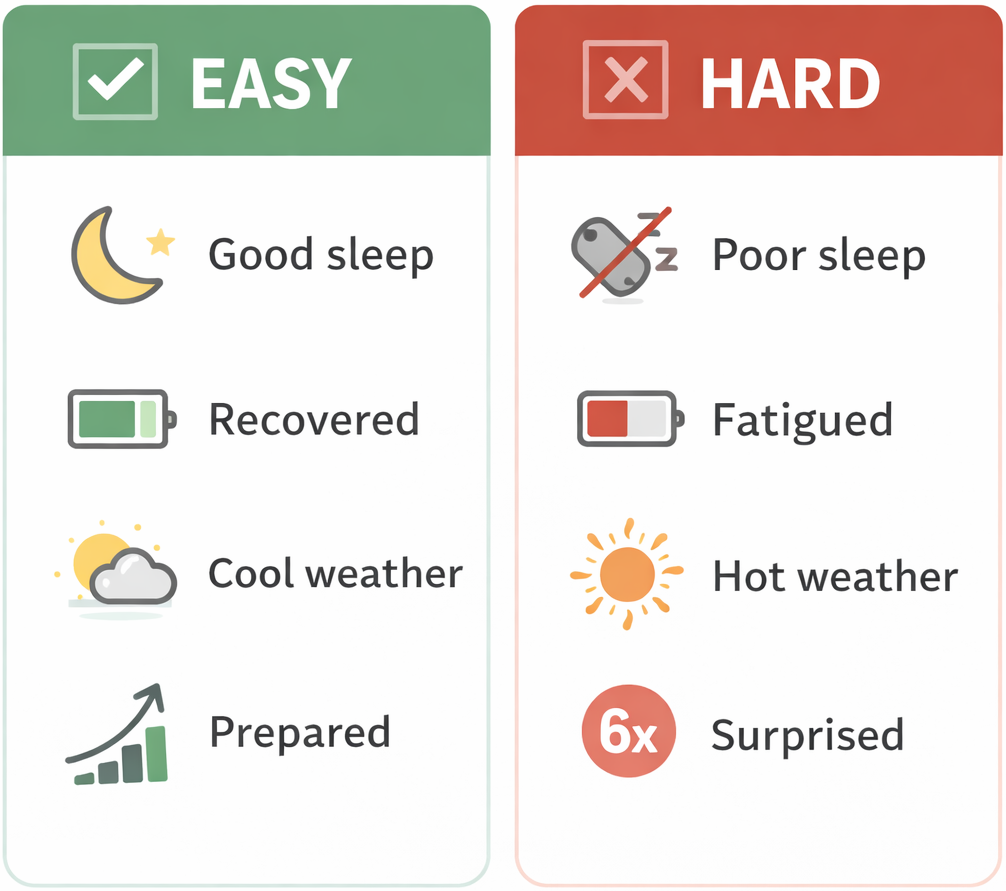
Your body is not the same every day
Your performance is influenced by more than just your training.
Sleep, stress, nutrition, hydration, and even your mental state all affect how a run feels.
On a well-rested day, everything works together. Your breathing is smooth. Your stride feels natural. On a more fatigued day, the same pace can feel significantly harder.
Nothing is broken. Your body is simply responding to its current state.
This is why chasing consistency in feeling is the wrong goal.
Effort changes even if pace stays the same
One of the most important things to understand is this: the same pace does not mean the same effort.
You can run at 5:30/km and feel relaxed one day, and struggle at the exact same pace another day.
That’s because effort is internal, not external.
If you’re unsure how to interpret this, What Does Easy Pace Actually Mean explains why pace alone is not a reliable measure of effort.
The better signal is always how the run feels.
Fatigue accumulates
One run rarely tells the whole story.
What you feel today is often the result of what you did before.
Fatigue builds gradually. Not always in a way that is obvious, but enough to change how a run feels.
A harder session earlier in the week. A slightly too fast easy run. A long run that took more out of you than expected.
Individually, these don’t seem like much. Together, they add up.
That’s when a normal run suddenly feels harder.
This is also why progress can feel inconsistent. Even when you’re improving overall, accumulated fatigue can temporarily mask it.
External conditions matter more than you think
Not all runs happen in the same conditions.
Temperature, wind, terrain, and even humidity can change how a run feels.
A slightly warmer day increases effort. A headwind makes your pace harder to maintain. Softer terrain demands more from your muscles.
These are small changes, but they have a real effect. And because they’re not always obvious, it’s easy to misinterpret them as a drop in fitness.
In reality, your body is just working against different conditions.
Your expectations influence how it feels
How you expect a run to feel often shapes how you experience it.
If you expect an easy run, even small discomfort can feel frustrating.
If you expect a hard session, you’re more prepared for effort.
This mental side is easy to overlook, but it matters. Running is not just physical. It’s also perception.
When expectations and reality don’t match,
the run feels harder than it actually is.
What consistent running actually feels like
Consistency in running does not mean every run feels the same.
It means your training continues, regardless of how individual runs feel.
Some days are smooth. Some days are heavy. Some days feel better than expected. That variation is normal.
In fact, it’s a sign that your training is working.
Because adaptation happens over time, not in a single session.
What to focus on instead
Instead of trying to control how every run feels, focus on what stays stable.
Your effort. Your consistency. Your ability to keep showing up.
Ask yourself:
✔︎ Is my effort controlled?
✔︎ Am I recovering between runs?
✔︎ Am I training regularly?
If the answer is yes, you’re on the right track.
Not every run needs to feel good to be a good run.
Frequently Asked Questions
Why do some runs feel harder than others?
Because your body and conditions change daily. Fatigue, recovery, and external factors all influence how a run feels.
Is it normal for the same pace to feel different?
Yes. Pace is external, effort is internal. The same pace can require different effort depending on your state.
Does a hard-feeling run mean I’m not improving?
No. It often reflects temporary fatigue or conditions, not a loss of fitness.
Should I adjust my pace when a run feels hard?
Yes. Adjusting effort is more important than sticking to a fixed pace.
If you want your running to feel more consistent and comfortable, the gear you use can make a difference.
The right shoes help reduce unnecessary strain and support smoother movement.
If you’re unsure what to choose, take a look at our guide to the Best Running Shoes for Daily Training (2026).
Key takeaway
Not all runs feel the same.
And they’re not supposed to.
Some days feel easy. Others feel harder.
What matters is not the feeling of a single run, but the direction of your training over time.