
Learn how to recognize Zone 2 effort by feel, breathing, and rhythm — without constantly checking your pace or heart rate.
If you’re not sure what heart rate you should actually aim for, read What Is a Good Heart Rate for Running — it helps you understand what “good” really means in practice.
Many runners try to stay in Zone 2 by constantly checking their watch. Pace, heart rate, and alerts can make every run feel like a technical exercise rather than a natural rhythm.
But Zone 2 running is not only about numbers on a screen. Over time, experienced runners learn to recognize the effort by feel — through breathing, rhythm, and how relaxed their body feels while running.
The good news is that you can learn this skill too. With a few simple cues, it becomes surprisingly easy to recognize Zone 2 effort without constantly looking at your watch.
Zone 2 running should feel controlled, relaxed, and sustainable.
If your breathing is steady, your muscles feel loose, and you could hold a conversation, you are very likely running at the right intensity.
Even though this guide focuses on running by feel, many runners still use a watch to confirm their effort level.
See our guide to the Best Running Watches for Running (2026).
What Zone 2 Actually Feels Like
Zone 2 running is often described as “easy,” but that word can be misleading. The effort is controlled and comfortable, yet still purposeful. You are running, not jogging slowly, but you never feel like you are pushing.
Your breathing stays steady and rhythmic. You should be able to speak in short sentences without gasping for air, and your shoulders and arms remain relaxed rather than tense.
Most importantly, Zone 2 feels sustainable. The pace may vary depending on terrain, weather, or fatigue, but the effort remains smooth and manageable.
If you want a deeper explanation of how heart rate zones work, see our guide to heart rate training zones.
Why Runners Become Too Dependent on Their Watch
Modern running watches are incredibly powerful tools. They track pace, heart rate, cadence, training load, recovery, and dozens of other metrics. Used well, they can make training more structured and more effective.
But many runners fall into the habit of checking their watch every few seconds. Instead of feeling the rhythm of the run, they react to every small change in pace or heart rate.
The result is that the run becomes a constant stream of corrections rather than a natural flow. The watch starts to control the run instead of simply supporting it.
Ironically, learning to run in Zone 2 often becomes easier when you stop staring at the numbers and start paying attention to how your body actually feels.
Sometimes the best way to solve a problem or think something through is simply to run about it.
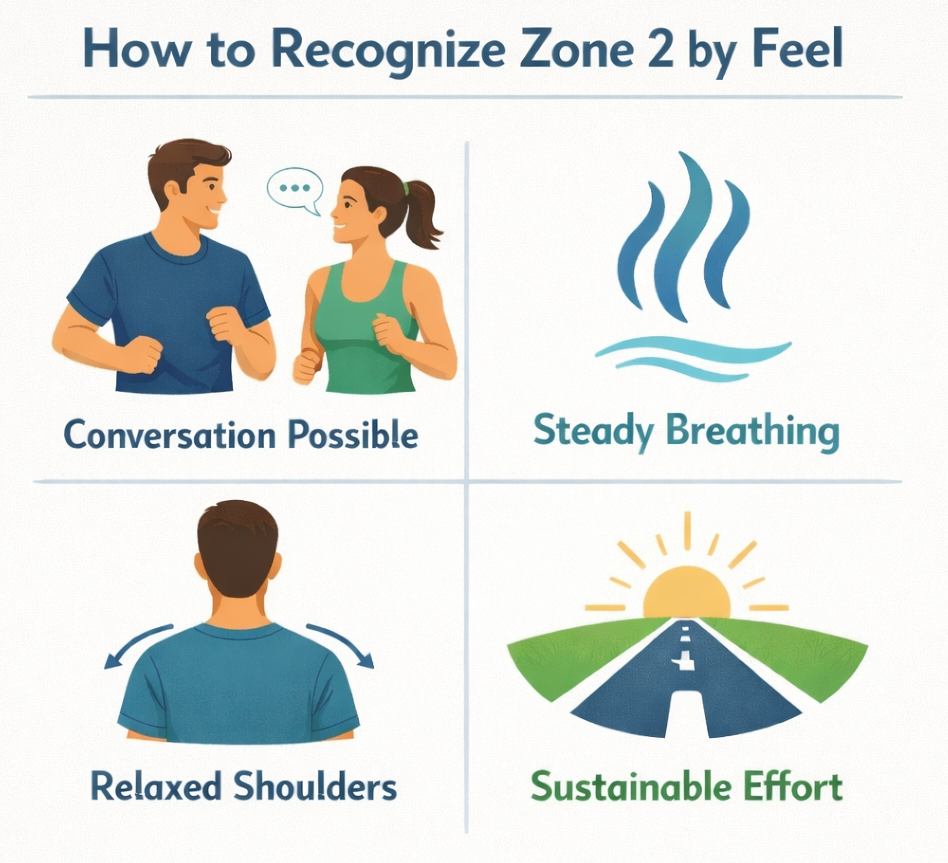
4 Ways to Recognize Zone 2 Without Looking at Your Watch
Many runners assume that staying in Zone 2 requires constant monitoring of heart rate or pace. In reality, your body gives you several clear signals about effort level. Learning to recognize these signals makes it much easier to run by feel.
1. Use the Talk Test
One of the simplest ways to recognize Zone 2 effort is the talk test. At the right intensity, you should be able to speak in short sentences without struggling for breath.
If talking becomes difficult or you can only say a few words at a time, the effort is probably already above Zone 2.
2. Notice Your Breathing Rhythm
Your breathing pattern is another reliable indicator. In Zone 2, breathing remains steady and controlled rather than forced.
You should feel a consistent rhythm rather than a sense that your breathing is trying to “catch up” with the pace.
3. Pay Attention to Muscle Tension
Zone 2 running usually feels relaxed in the body. Your shoulders stay loose, your stride feels smooth, and your arms swing naturally without tension.
If you start noticing tight shoulders, clenched hands, or heavy legs, the effort may be drifting higher.
4. Focus on Effort, Not Pace
The biggest mistake runners make is trying to force a specific pace during easy runs. But pace naturally changes with terrain, weather, fatigue, and even sleep.
Instead of chasing a number on your watch, focus on maintaining a controlled and sustainable effort.
Why Pace Can Mislead You in Zone 2 Training
Many runners try to define Zone 2 using pace. But pace is one of the least reliable ways to judge effort, because it constantly changes with terrain, temperature, wind, and fatigue.
A pace that feels easy on a cool morning might feel much harder on a warm afternoon. The same pace can also change depending on hills, surface, or how well you recovered from your previous training session.
This is why experienced runners focus more on effort than on a specific pace number. Heart rate, breathing, and perceived effort usually give a much clearer picture of training intensity.
This is also why many runners find it helpful to understand the difference between pace and heart rate in training.
How to Use Your Watch Less — But Still Use It Smartly
Running watches are extremely useful tools, especially for understanding long-term training patterns. Heart rate trends, pace data, and recovery metrics can all help runners train more consistently.
But during easy runs, the watch works best as a confirmation tool rather than a constant guide. Instead of checking it every few seconds, use it occasionally to confirm that your perceived effort matches your heart rate.
Over time, this approach helps you develop a much better internal sense of effort. Eventually, you will notice that you can stay close to Zone 2 even without looking at your watch.
Your watch should support your running, not control it.
The more you learn to recognize effort through breathing, rhythm, and body awareness, the easier it becomes to run in the right zone naturally.
Conclusion
Learning to recognize Zone 2 effort without constantly checking your watch is a skill that improves with practice. The more you run by feel, the easier it becomes to stay relaxed, controlled, and consistent during easy runs.
If you want to go deeper into heart rate training, you may also find our guide on how to lower heart rate while running helpful.
Frequently Asked Questions
Can you run in Zone 2 without a heart rate monitor?
Yes. While a heart rate monitor helps you learn the correct effort level, it is possible to recognize Zone 2 by feel. Steady breathing, relaxed muscles, and the ability to hold a conversation are usually good indicators of the right intensity.
How do I know if I leave Zone 2 while running?
The easiest signs are changes in breathing and tension. If your breathing becomes noticeably harder, you can no longer speak comfortably, or your shoulders and arms begin to tense up, the effort has likely moved above Zone 2.
Why does my Zone 2 pace change from day to day?
Zone 2 pace naturally varies depending on many factors such as temperature, terrain, fatigue, and recovery. This is why focusing on effort and breathing is often more reliable than trying to hold a fixed pace.
Is the talk test accurate for Zone 2 running?
The talk test is one of the simplest and surprisingly reliable ways to estimate aerobic effort. If you can speak in short sentences without gasping for air, you are usually very close to Zone 2 intensity.