
Many runners assume that long runs should be one of the hardest workouts of the week. After all, they are the longest session in the training plan and often the most mentally demanding.
But experienced runners and coaches usually follow a very different approach. In most training plans, long runs are not supposed to feel hard. In fact, they are often run slower than many runners expect.
Understanding the right long run pace is important because running them too fast is one of the most common mistakes in endurance training.
Long runs are not meant to be fast.
Their purpose is to build endurance, not to test your limits every week.
Modern running watches allow you to track pace, distance and heart rate during workouts.
If you’re choosing one for training, see our guide to the Best Running Watches for Running (2026).
Why Long Runs Are Not Supposed to Be Fast
The main purpose of long runs is to develop aerobic endurance. This means improving your body’s ability to use oxygen efficiently and sustain effort over a long period of time.
When long runs are performed at a moderate and controlled intensity, they stimulate important adaptations such as improved fat utilization, stronger muscles, and better resistance to fatigue.
Running them too fast often turns the workout into something completely different — a stressful effort that requires longer recovery and increases the risk of injury.
This is one of the reasons why many endurance runners spend a large part of their training in lower intensity zones.
What Pace Should Long Runs Actually Be?
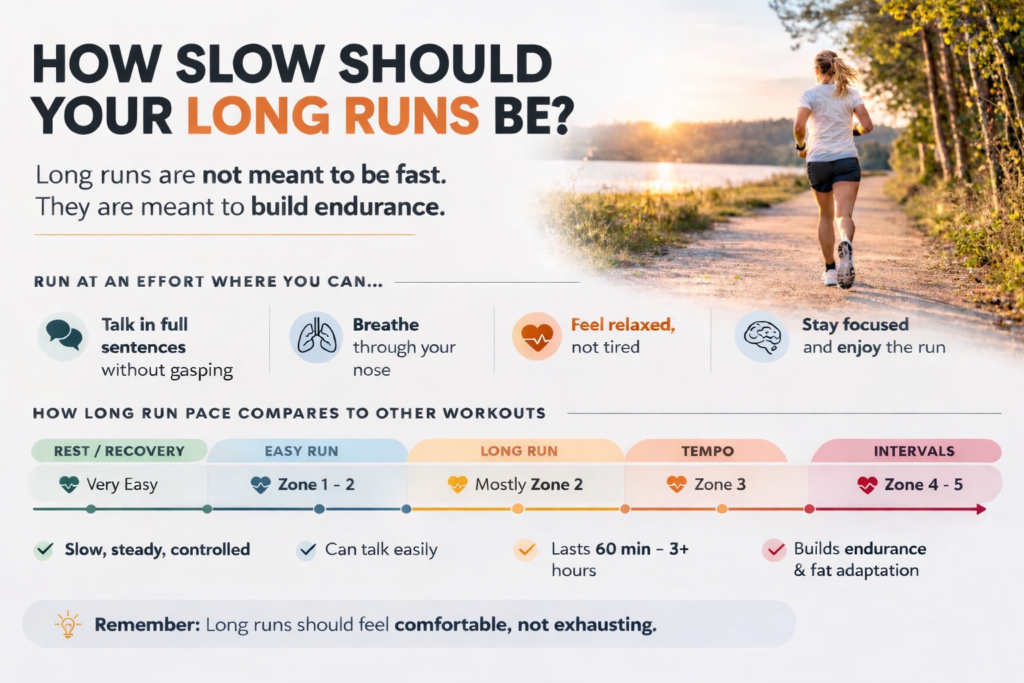
Long runs should feel controlled, relaxed, and sustainable. They are designed to build aerobic endurance, not speed.
How to Know If Your Long Run Pace Is Correct
Your long run pace is likely correct if:
- You could continue running another 10–15 minutes if needed
- You can speak in full sentences while running
- Your breathing stays relaxed and controlled
- Your heart rate stays mostly in Zone 2
- You finish the run feeling tired but not exhausted
Common Mistakes Runners Make With Long Run Pace
- Running long runs too fast
- Turning long runs into tempo workouts
- Ignoring heart rate and effort
- Trying to “prove fitness” every weekend
Sometimes the best way to solve a problem or think about something is simply to run about it.
The Real Purpose of Long Runs
Long runs are one of the most important workouts in endurance training. Their main purpose is not speed, but building aerobic endurance and preparing your body for longer efforts.
By running at a controlled and sustainable pace, your body adapts to using energy more efficiently and staying comfortable for extended periods of time.
Typical long run pace example
If your marathon pace is 5:00/km, your long run pace will often fall somewhere around 5:30–6:00/km.
This slower pace allows you to build endurance without turning the long run into a hard workout.
Running slower than race pace allows your body to build endurance without turning the workout into a hard effort.
Long runs work best when they feel controlled and sustainable — not fast.
Running slower allows your body to build endurance while staying consistent week after week.
The Goal Is Endurance, Not Speed
Long runs are not meant to prove your fitness every weekend.
Their goal is to gradually extend your endurance and make longer distances feel manageable.
To see how long runs fit into a structured training plan, read Build a Weekly Running Structure.
Frequently Asked Questions
What heart rate zone should long runs be in?
For most runners, long runs are performed mostly in Zone 2, occasionally drifting toward the upper aerobic range on hills or later in the run.
How much slower should a long run be than marathon pace?
A typical long run pace is 30–60 seconds per kilometer slower than marathon pace, depending on your fitness and training phase.
Should long runs include faster segments?
Sometimes. More advanced runners may include progressive finishes or marathon-pace segments, but the majority of the run should remain comfortable.