What a heart rate strap actually does
A heart rate strap measures your heart rate using electrical signals.
Similar to how an ECG works.
Instead of estimating blood flow like optical sensors, it detects the actual signal your heart produces.
This makes it:
→ very precise
→ very stable
→ and extremely fast to respond
In comparison, optical sensors (whether on your wrist or arm) use light to track changes in blood flow.
And while modern sensors are very good,
they are still one step removed from the source
Are Optical Heart Rate Monitors Accurate for Running? (Wrist vs Arm vs Chest)If you want a deeper breakdown of how these measurement methods differ in real-world use, read Are Optical Heart Rate Monitors Accurate? — it explains why the difference is often about response speed, not just accuracy.
A chest strap measures directly.
Optical sensors estimate.
Even though chest straps are more precise,
that doesn’t automatically make them necessary.
For most runners, the difference shows up mainly in:
→ how stable the signal is during movement
→ how quickly heart rate reacts to changes
not in whether the data is usable
And this is where context matters.
Because if your training doesn’t require second-by-second precision,
that extra accuracy often doesn’t change your decisions.
Better measurement doesn’t always mean better training.
The real difference: speed, not accuracy
Most runners think the difference between sensors is accuracy.
→ but in real training, the bigger difference is response speed
When your effort changes — for example during an interval —
your heart rate doesn’t jump instantly.
It rises gradually.
A chest strap captures that change almost immediately.
Optical sensors, on the other hand, take a bit more time to catch up.
→ this delay is small
→ but it exists
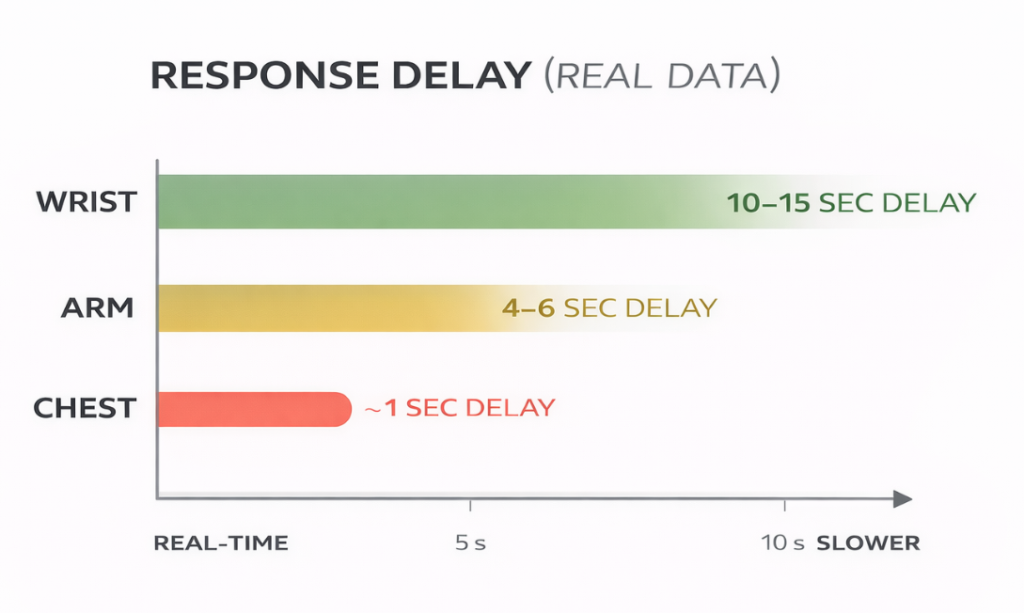
What this means in practice:
- chest strap → reacts almost instantly
- arm-based optical → slight delay
- wrist-based → more noticeable delay
→ but here’s the key point:
The difference isn’t about whether the data is right.
It’s about how fast it reflects change.
And for most runs, that delay doesn’t actually change anything.
If you’re running steady, or even moderately hard efforts, your training decisions stay exactly the same
If you want a deeper explanation of how different sensors behave in real training, read Are Optical Heart Rate Monitors Accurate? — it breaks down the real-world differences between wrist, arm, and chest sensors.
Chest straps are faster.
Optical sensors are slightly delayed.
Both can still guide your training effectively.
When you actually need a chest strap
A chest strap is not essential for most runners.
But there are situations where it does make a real difference.
Short intervals
During short, high-intensity intervals (like 200–400m),
your effort changes quickly.
→ this is where response speed matters most
A chest strap captures those changes almost instantly,
while optical sensors can lag slightly behind.
→ if your training depends on precise timing,
this difference becomes noticeable
Structured heart rate training
If you train strictly by heart rate zones,
accuracy and consistency become more important.
→ especially when you’re trying to stay within tight ranges
In this case, a chest strap gives you:
- cleaner data
- faster feedback
- more confidence in your numbers
If you’re following a structured approach, you’ll get more value from understanding how to train with heart rate first — start with How to Train with Heart Rate before deciding whether you need more precise data.
Data-focused runners
Some runners simply prefer more precise data.
→ not because they need it
→ but because they value it
If you enjoy analyzing your runs,
a chest strap gives you a more detailed picture.
You don’t need a chest strap.
But in specific situations, it can be useful.
When you definitely don’t need one
For most runners, a chest strap is not necessary.
In fact, in many situations, it doesn’t change your training at all.
Easy runs
Easy runs are based on effort, not precision.
→ you’re not chasing exact numbers
→ you’re staying controlled and relaxed
A small delay in heart rate data doesn’t affect your pacing or decisions.
If you’re unsure how easy runs should actually feel, read Easy Runs Explained — it helps you focus on effort instead of numbers.
Long runs
Long runs are about consistency.
→ steady effort
→ controlled pace
→ time on your feet
You don’t need second-by-second accuracy to execute them well.
If you want to better understand how to structure these efforts, How Slow Should Long Runs Be explains the right intensity.
General training
Most runners fall into this category.
They want to:
- stay healthy
- improve fitness
- train consistently
→ not optimize every data point
In these cases, an arm-based optical sensor gives you everything you need:
- stable data
- enough accuracy
- far more comfort
And that comfort matters more than most runners think.
→ no strap around your chest
→ nothing shifting during your run
→ nothing you need to adjust mid-workout
If your training doesn’t require precision,
you don’t need a precision tool.
What most runners should do instead
Most runners don’t need more accurate data.
→ they need more consistent training
And that changes how you should think about your setup.
Instead of asking:
“What’s the most accurate option?”
Ask:
“What will I actually use every run?”
Because the best sensor is not the most precise one.
→ it’s the one you use consistently
The practical recommendation
For most runners, the best setup is:
an arm-based optical sensor
It gives you:
- stable data
- enough accuracy
- excellent comfort
And that comfort is not a small detail.
→ no strap around your chest
→ nothing sliding down during the run
→ nothing you need to adjust mid-session
That means:
→ fewer distractions
→ more consistent use
→ better long-term training
Why this matters more than accuracy
Training improvements don’t come from perfect data.
They come from:
- consistent effort
- repeatable sessions
- gradual progression
If your data is consistent,
it becomes useful over time.
This is the same principle behind running efficiency — learn how small improvements compound over time in What Is Running Economy.
Consistency beats precision — every time.
A simple decision rule
If you’re still unsure which one to choose,
use this:
Choose a chest strap if:
✓ you do structured interval training regularly
✓ you analyze heart rate data in detail
✓ you care about second-by-second accuracy
This is about precision.
Choose an optical sensor if:
✓ you want comfort and simplicity
✓ you train mostly by effort
✓ you want reliable, low-friction data
This is about consistency.
The shortcut most runners need
If you’re not sure which category you fall into:
✓ you’re in the second one
And that’s completely fine.
You don’t need the best data —
you need data you’ll actually use.
Frequently Asked Questions
Is a chest strap more accurate than optical sensors?
Yes.
Chest straps measure electrical signals from your heart (ECG),
which makes them the most precise option.
However, modern arm-based optical sensors are already
accurate enough for most runners — even during harder efforts.
Is wrist-based heart rate reliable?
Not really — especially during running.
Wrist-based sensors can struggle with:
- movement
- vibration
- changing intensity
They may work for general tracking,
but they’re not ideal for training.
Do I need a chest strap to improve as a runner?
No.
You can build strong fitness and improve performance
without using a chest strap.
What matters more is:
- consistent training
- appropriate intensity
- good recovery
If you want to understand how to structure your training properly, How to Build a Weekly Running Structure gives you a clear framework.
Is an arm-based optical sensor a good compromise?
Yes — and for most runners, it’s the best option.
It combines:
- solid accuracy
- high comfort
- ease of use
Which makes it far more likely
that you’ll actually use it consistently.
If you want to choose the right device
If you’re thinking about upgrading your setup, the biggest difference doesn’t come from strap vs optical — it comes from the device you actually use every day.
→ battery life
→ data clarity
→ ease of use during training
These factors matter more than most runners expect.
If you want a clear breakdown of the best options available right now,
read Best Running Watches for Running (2026) — it compares the top devices in a simple, practical way.
Key takeaway
You don’t become a better runner by measuring more precisely.
You become a better runner by training consistently and recovering properly.